
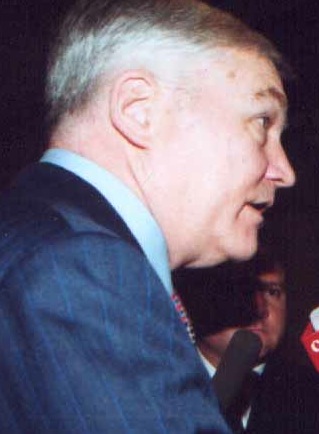
Yesterday, three judges of the Seventh Circuit Court in Chicago upheld two criminal charges against Baron Black of Crossharbour.
In other words, Conrad Moffat Black, late of the federal Correctional Complex in Coleman, Fla., where he resided for a spell at the courtesy of the U.S. taxpayer, remains a convicted felon.
According to Article 3 of the Policy and Procedure for Termination of Appointment to the Order Of Canada, revocation of the Order may be considered when the holder has been convicted of a criminal offence.
Surely it is time at long last for the Governor General of Canada to revoke Black’s membership in the Order. Indeed, it is a disgrace and a blot upon the nation’s highest civilian honour that this person remains an Officer of the Order of Canada.
Clearly, there is a strong argument to be made that such a measure is long overdue. Notwithstanding that, the still-well-connected Black remains on the list of members of the Order of Canada, windily honoured on the Governor General’s Website as “a distinguished Toronto entrepreneur and publisher … a man of diverse achievements within the realms of Canadian commerce, education, literature and the arts.”
The previous Governor General, Michaëlle Jean, may have hesitated to strip Black of this great Canadian honour because he still had appeals outstanding against his multiple convictions for fraud, racketeering and conspiracy in the United States.
Reading between the lines, she suggested as much in a Jan. 23 news release announcing that Stephen Fonyo had been given the bum’s rush from the ranks of the order “related to his multiple criminal convictions, for which there are no outstanding appeals.” (Emphasis added.)

The hapless Fonyo, of course, hardly has the means enjoyed by Black to pursue appeals against his convictions.
As has been argued in this space before, the treatment of the troubled Fonyo and that of Black makes for an ironic contrast.
Fonyo, who when he was 12 lost a leg to cancer and who was made an Officer of the Order in 1985, has since had a history of criminal behaviour including assault, aggravated assault, theft, fraud, drunk driving and driving without a license.
However, he also ran across Canada in 1984 on one good leg and one artificial one — following and completing the route of the saintly, cranky and doomed Terry Fox — and in the process raised $13 million for cancer research. This was no small feat for an ordinary man with a serious disability and it is said here that Fonyo — bad judgment, substance abuse and all — deserved his Order of Canada.
This is somewhat different from the record of Black, about whom it would be a fair comment to say that both his past remarks about Canada, which he once termed “an oppressive little world,” and his manner of conducting his business affairs both deviated “from generally recognized standards of public behaviour,” which may also be considered grounds for revocation of the Order. Black, of course, renounced his Canadian citizenship in 2001 to become a member of the British House of Lords.
Yet Black, by contrast to Fonyo, remains to this day a member of the Order despite having been properly convicted of serious criminal offenses by an impartial court in a neighbouring democracy.
Black has had some success overturning some of those charges, but as of yesterday the unanimous decision of the U.S. appeal court upheld two charges and indicated the judges believe Black, who at the moment is free on bail, should still face a stiff sentence for his crimes.
Black was sentenced to six and a half years in jail in 2007 and had served about two years when he was released on bail. He will now be re-sentenced by Judge Amy St. Eve of the District Court of Northern Illinois, who was the judge in his original trial. If she chooses, she may impose the same sentence as before or let him serve his time in the community on probation.
But Judge St. Eve’s eventual decision regarding how Black spends his time is really irrelevant to the matter of his Order of Canada. His conviction stands. Surely it is now time for David Johnston, the Governor General who replaced Jean, to say “enough” and end this blemish on the Order of Canada by dismissing Black from its ranks.
This post also appears on David Climenhaga’s blog, Alberta Diary.
Support rabble today!
We’re so glad you stopped by! Thanks for consuming rabble content this year.
rabble.ca is 100% reader and donor funded, so as an avid reader of our content, we hope you will consider gifting rabble with a donation during our summer fundraiser today.
Whether it be a one-time donation or a small monthly contribution, your support is critical to keep rabble writers producing the work you’ve come to rely on as a part of a healthy media diet.
Whether it be a one-time donation or a small monthly contribution, your support is critical to keep rabble writers producing the work you’ve come to rely on as a part of a healthy media diet.
Become a rabble rouser — donate to rabble.ca today.
Nick Seebruch, editor