
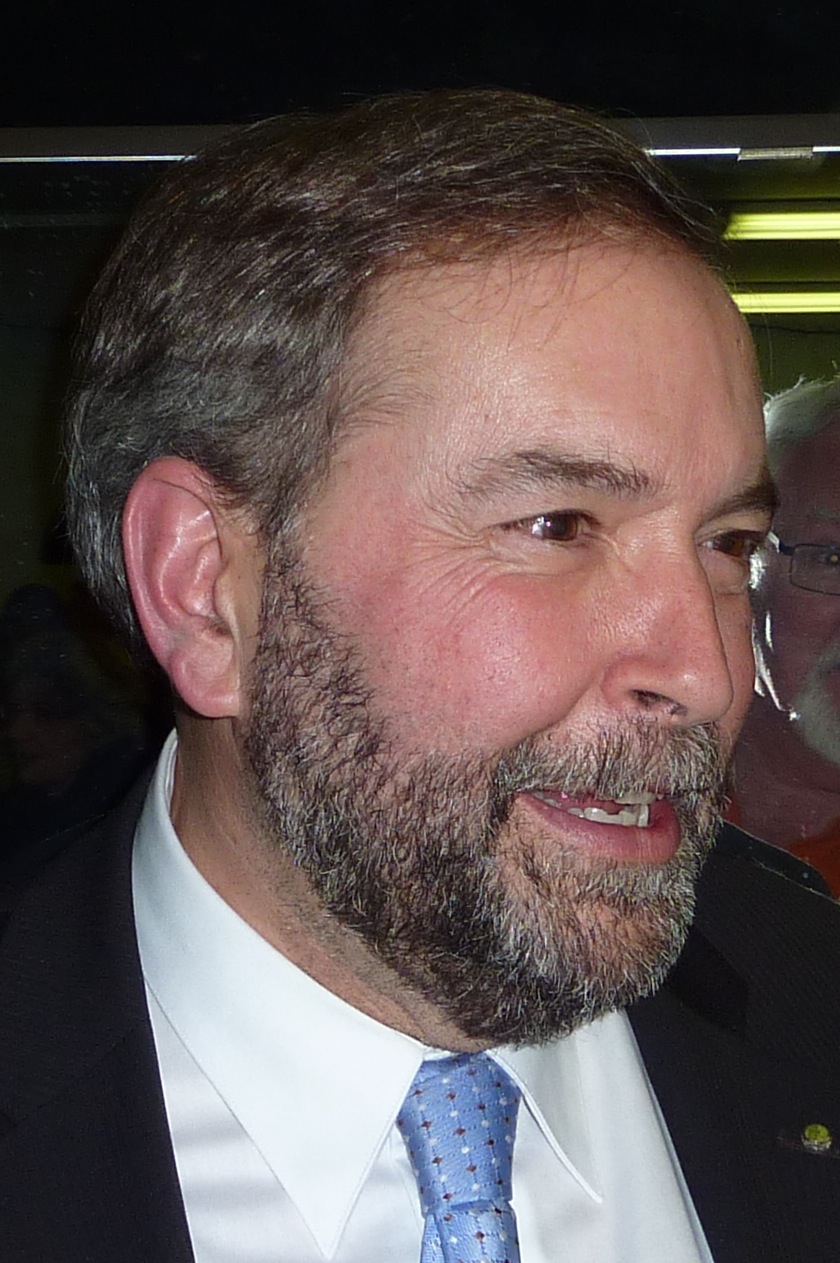
Thomas Mulcair turned in a virtually faultless performance in Edmonton last night, proving once again that the federal Opposition New Democratic Party is attracting top-quality candidates as it completes its sad duty to replace Jack Layton.
Leastways, as far as this blogger could see, the 57-year-old Member of Parliament for Outremont, Que., never made a false step, except for a stumble that didn’t much matter when he left the stage.
This wasn’t because he was asked no tough questions. He faced a few of those, and a couple that bordered on truculent, from NDP traditionalists unhappy at the thought their church may be on the cusp of becoming a political party that really could form the next national government.
But the choice between doing what traditionalists are comfortable with and continuing the work Layton started is really pretty stark, Mulcair told the biggest and most energetic crowd seen to date at the Edmonton “kitchen-table talks” for party’s leadership candidates.
“Do we really want to form a government or not?” In other words, if the NDP is going to live up to the promise Layton made possible, it’s going to have to aspire to be something more than the national finger-wagger. “We’re not going to win with slogans. … One of the knocks I hear is, ‘All you want to do is win.’ Well, I thought that was the idea!”
So, last night, Mulcair was by turns funny, charismatic, insightful, passionate and feisty. He even looked like he’s probably pretty telegenic — but who can be sure, since, as usual, Edmonton’s pathetic media didn’t bother to turn up to cover his standing-room-only conversation at the Strathcona Community League hall?
His comedic timing was great. On the need to re-engage young people, Mulcair cracked up the mostly graying crowd: “Maybe we’re not connecting with young people as well as we can. (Beat. Beat.) What we did in Quebec was we got them elected.”

As Layton’s Quebec deputy and one of the principal architects of the party’s astonishing victory there last year, he was blunt about the need to help those new Quebec MPs put down roots. Naturally, he argued he’s the best candidate to do it.
He also offered lessons for Albertan New Democrats in how the Quebec NDP worked to make that victory possible, arguing there’s a striking similarity in the role played up to the May 2011 federal election by the Bloc Quebecois in Quebec’s psyche and that played now by the Conservatives in Alberta.
Describing the Prairies as a “target rich area” for New Democrats, he argued that Alberta Conservatives need to be defined in the same way as party that’s not serving the interests of Albertans who, like Quebeckers with the Bloc, habitually vote for them anyway.
That would require different arguments but the same basic strategy as the party used in Quebec, where the Bloc for years flashed left while turning right: “We took the BQ apart by attacking them from the left and they never saw it coming.”
Mulcair even kindly started the work of dismantling the Harper Tories here in Alberta — or at least defining them as they ought to be defined. “They love snapping their suspenders and saying what good managers they are … and they have absolutely nothing to show for it!” Well, nothing except blueprints for billion-dollar prisons and plans to buy fighter jets that won’t work in Canadian conditions. “These are good administrators?”
Mulcair also dealt effectively with the slam he was a provincial Liberal in Quebec — since, after all, there is no other provincial party for Canadian federalists there. And he was blunt in dealing with the few questioners who wanted to return to state ownership of Petro-Canada or Air Canada. The decisions to privatize them might have been mistakes, he said, “but you have to deal with the situation that’s in front of you. … So the answer is no.”
His skill at stick-handling tough questions makes this crowd sound less friendly than it actually was. There’s a lot of interest in Mulcair because he’s perceived as a candidate who can preserve the gains made in 2011 in Quebec. So Alberta New Democrats are serious about seeing if he can do the job in English Canada as well.
From this observer’s perspective, there’s not much doubt that Prime Minister Stephen Harper and his Conservatives should worry that Mulcair might win.
Bilingual almost from birth, he even passed a French-language test, Alberta style — answering the single question of the evening in the other official language, apparently quite thoroughly, but ending it after only one minute and 15 seconds, well before members of the mostly unilingual crowd started to shuffle their feet and squirm. Then he provided a nice summation in English.
Mulcair did one other persuasive thing that we haven’t seen from any of the other candidates up to now. He carried himself like he was already the winner. It was a pretty persuasive performance.
Actually, he did two things that were unique. He told us he was tireless, and then proved it by reconvening the meeting in a pizza parlour and pub, where he was still schmoozing when your faithful correspondent toddled off home.
We’ve now heard from Brian Topp, Peggy Nash and Mr. Mulcair — who by my reckoning are the Big Three in this race. Judging by their performances in Edmonton, I’d give it to Mulcair by a nose.
The federal NDP leadership vote is on March 24. Then, as one member of the audience was overheard saying, “if we want to have a real chance in four years, this is the guy.”
This post also appears on David Climenhaga’s blog, Alberta Diary.
Support rabble today!
We’re so glad you stopped by! Thanks for consuming rabble content this year.
rabble.ca is 100% reader and donor funded, so as an avid reader of our content, we hope you will consider gifting rabble with a donation during our summer fundraiser today.
Whether it be a one-time donation or a small monthly contribution, your support is critical to keep rabble writers producing the work you’ve come to rely on as a part of a healthy media diet.
Whether it be a one-time donation or a small monthly contribution, your support is critical to keep rabble writers producing the work you’ve come to rely on as a part of a healthy media diet.
Become a rabble rouser — donate to rabble.ca today.
Nick Seebruch, editor