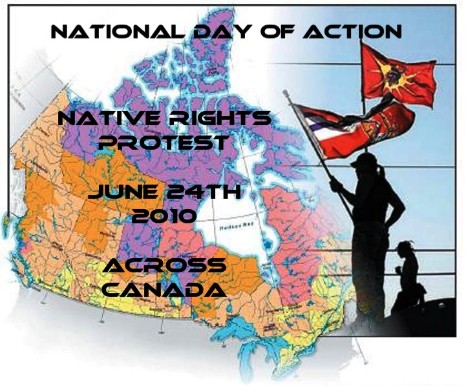
Canada likes to play coy on the world stage and present itself as a world example but our “glowing hearts” cannot shine bright and true until we have the integrity to face our own shadows here.
Native rights are human rights, you can’t take them away.
JUNE 24 DAY OF ACTION FOR INDIGENOUS RIGHTS @ 11:00 AM
Queen’s Park; South lawn.
CANADA CAN’T HIDE GENODICE
Note: Please do not wear bandanas, keep them in your pocket if you do.
*
INDIGENOUS ASSEMBLY @ 4:00 pm – 8:00 pm
Council Fire (439 Dundas Street East)
**
With all the government's attempts to make Canada look perfect in the world's eyes this weekend, and with activists pointing fingers at global governments and economies, we must be truthful regarding our own record of human rights.
This kind of accountability must be important to any activist who wants to be the change they want to see.
How we treat ourselves and each other as brothers and sisters on the land we are blessed to be able to share is what will give our hearts courage.
Because it takes courage to confront the truth: Canada likes to play coy on the world stage and present itself as a world example but our "glowing hearts" cannot shine bright and true until we have the integrity to face our own shadows here on Mother Earth on the land we call Canada; and Canada's dirty big secret is our treatement of First Nations communities.
When the G8/G20 comes to Canada in June let's tell the world the real story about Canada's record on Indigenous rights:
--Canada is continuing its policy of assimilation and extinguishment of Aboriginal rights, title, and Treaty rights. Canada's collusion with Ontario to bring in a new 'Harmonized Sales Tax' is only the latest unilateral extinguishment of Aboriginal and treaty rights
--Canada is the only country still opposing the UN Declaration on the Rights of Indigenous Peoples; the other three countries opposed to it have changed their vote or are reconsidering. We recognize the importance of the UN Declaration in protecting the rights of Indigenous peoples in Canada as well as the rest of the world"
--Canada continues to criminalize Indigenous activists who stand up for Aboriginal and treaty rights - even though these rights have been affirmed by the Canadian constitution and the United Nations Declaration on the Rights of Indigenous Peoples
--Canada's policies of dispossession and control continue to create extreme poverty and social distress for Indigenous Nations across Canada.
--Canada's resource economy is based on the exploitation of Indigenous lands. Industrial gigaprojects like the tar sands threaten the health of communities, culture and the land.
"Canadians who respect human rights and want to protect our environment need to realize that Aboriginal and Treaty Rights are the only legitimate means of challenging big government's and big business' unconditional monopoly on decision-making. The G8/G20 framework is the mechanism through which globally structured companies will consolidate money and power at the expense of domestic and Indigenous economies. The G8/G20 is a top down approach to decision making.
When the G8/G20 comes to Canada in June let's tell the world the real story about Canada's record on Indigenous rights: a continued policy that aims to terminate Indian Peoples by removing our land and resource base and denying us the right to self-determination, under the power of the Indian Act and the Department of Indian Affairs."
**
OUR RIGHTS AS NATIVE PEOPLE AND HUMAN BEINGS by Red Power United from its June 24 call out:
1. Native peoples have the right as a collective or as
individuals, of all human rights and fundamental freedoms as
recognized in the Canadian Charter of Rights and Freedoms,
Canadian Human Rights Acts, Charter of the United Nations,
the Universal Declaration of Human Rights and international
human rights law.
2. Native peoples have the right to the recognition,
observance and enforcement of treaties, agreements and
other constructive arrangements concluded with Government
or their successors and to have the Government honour and
respect such treaties, agreements and other constructive
arrangements.
3. Native peoples have the right to self-determination. By
virtue of that right they freely determine their political status
and freely pursue their economic, social and cultural development.
4. Native individuals have the rights to life, physical and
mental integrity, liberty and security of person.
5. Native peoples; particularly Native women and children
shall have the Right to full protection and guarantees against
all forms of violence and discrimination.
6. Native peoples have the collective right to live in freedom,
peace and security as distinct peoples and shall not be
subjected to any act of genocide or any other act of violence,
including forcibly removing their children.
7. Native peoples and individuals have the right not to be
subjected to forced assimilation or destruction of their
culture.
8. Native peoples shall not be forcibly removed from their
lands or territories. No relocation
shall take place without the free, prior and informed consent
of the Native peoples concerned and after agreement on just
and fair compensation and, where possible, with the option
of return.
9. Native peoples have the right to their educational systems
and institutions providing education in a manner appropriate
to their cultural methods of teaching and learning.
10. Native peoples have the right to participate in decision-
making in matters which would affect their rights, through
representatives chosen by themselves in accordance with
their own procedures, as well as to maintain and develop
their own decision-making institutions.
a) In Canada, First nations, Métis and Inuit people represent
three percent of the population, yet they constitute
approximately 60 percent of the inmates in prisons and jails.
When brought before the courts Native people cannot hope to
get a fair hearing from non Native judges, jurors and court
officials.
Therefore, we want Native people to be tried in *The Gladue
people who understand how colonization and oppression
contributes to these disproportionate numbers.
11. Native peoples have the right to maintain and develop
their political, economic and social systems or institutions, to
be secure in the enjoyment of their own means ofsubsistence
and development, and to engage freely in all their traditional
and other economic activities.
12. Native peoples have the right, without discrimination, to
the improvement of their economic and social conditions,
including, the areas of education, employment, vocational
training and retraining, housing, sanitation, health and social
security.
13. Native peoples have the right to the lands, territories and
resources which they have traditionally owned, occupied or
otherwise used or acquired.
14. Native peoples have the right to own, use, develop and
control the lands, territories and resources that they possess
by reason of traditional ownership or other traditional
occupation or use, as well as those which they have
otherwise acquired.
15. Native People have a legal right to recognition and
protection to these lands, territories and resources. Such
recognition should be conducted with due respect to the
customs, traditions and land ownership, systems of the
Native peoples concerned.
16. Native peoples have the right to redress, by means that
can include restitution or, when this is not possible, just, fair
and equitable compensation, for the lands, territories and
resources which they have traditionally owned or otherwise
occupied or used, and which have been confiscated, taken,
occupied, used or damaged without their free, prior and
informed consent.
a) Unless otherwise freely agreed upon by the peoples
concerned, compensation shall take the form of lands,
territories and resources equal in quality, size and legal
status or of monetary compensation or other appropriate
redress.
17. Native peoples have the right to the conservation and
protection of the environment and the productive capacity of
their lands or territories and resources. Government should
establish and implement assistance programmes for Native
peoples for such conservation and protection, without
discrimination.
18. Native people have the right to effective measures be
taken by government to ensure that no storage or disposal of
hazardous materials shall take place in the lands or territories
of indigenous peoples without their free, prior and
informed consent.
a) Government shall also take effective measures to ensure,
as needed, that programmes for monitoring, maintaining and
restoring the health of Native peoples, as developed and
implemented by the peoples affected by such materials.
19. Native peoples have the right to determine development
or use of their lands or territories and other resources.
20. All the rights and freedoms recognized herein are equally
guaranteed to male and female Native individuals.
* Under the Indian Act; in respect to taxation: GST, HST, PST taxes.
Tax exemption is not a tax loophole but a constitutional right of
Aboriginal people, reflected in Section 87 of the Indian Act.
#30#
Support rabble today!
We’re so glad you stopped by! Thanks for consuming rabble content this year.
rabble.ca is 100% reader and donor funded, so as an avid reader of our content, we hope you will consider gifting rabble with a donation during our summer fundraiser today.
Whether it be a one-time donation or a small monthly contribution, your support is critical to keep rabble writers producing the work you’ve come to rely on as a part of a healthy media diet.
Nick Seebruch, editor
Whether it be a one-time donation or a small monthly contribution, your support is critical to keep rabble writers producing the work you’ve come to rely on as a part of a healthy media diet.
krystalline kraus is an intrepid explorer and reporter from Toronto, Canada. A veteran activist and journalist for rabble.ca, she needs no aviator goggles, gas mask or red cape but proceeds fearlessly...
More by Krystalline Kraus