

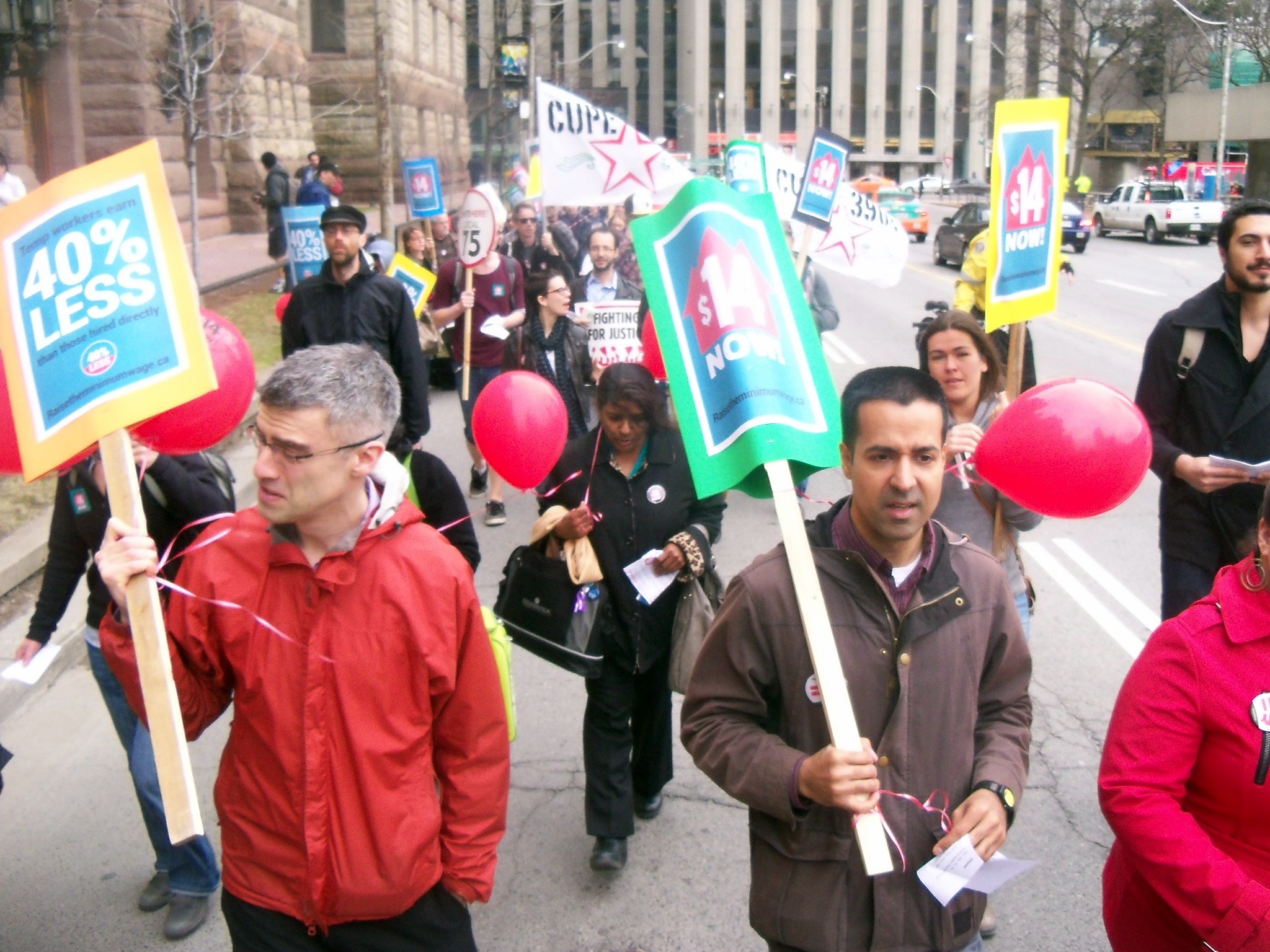
This past April 14 Ontario’s Campaign to Raise the Minimum Wage held rallies across Ontario including one that I attended in Toronto. For a blustery April Monday the rally had a solid turnout and was very enthusiastic.
Speaker after speaker confronted the reality of what the poverty wages that are the minimum wage in Ontario (and elsewhere) mean in the day-to-day lives of those being forced to subsist on them. One woman talked about what it was like to be a temp worker and her actual experience of the economic insecurity and injustice that this represented.
With the best of all possible intentions, I am sure, several speakers said that the campaign would punish the Liberals in the election if they did not implement a $14 an hour minimum wage right away.
But how will we punish them exactly?
Given that the ONDP also favours poverty minimum-wage legislation, and that the Hudak Tories, needless to say, favour an austerity apocalypse, it is a totally empty threat unless one is willing to back it up in some way in the electoral arena. Why bother being militant for a change that you cannot even force the “left” to advocate for in parliament?
Welcome to the new era of the “progressive.” Where expectations are so low that those that seek to inspire with soaring (and facile) Obamaesque rhetoric need not worry about disappointing; they have done so in advance.
In Ontario, a hardly unique example, the ONDP has gone even further than simply, and these days predictably, throwing sisters and brothers living on poverty wages or on extreme poverty social “assistance” rates under the bus, and has even sought to repudiate what little remains of its “left” narrative in its craven desire to win office. It has begun to send explicitly clear signals to the business community that it has capitulated even before taking “power.”

Thus we find that:
Andrea Horwath is on a quiet charm offensive with big business, holding closed-door sessions with top players on Bay Street and other corporate leaders in the run-up to a possible spring election.
The Ontario New Democratic Leader has made some unexpected promises at these meetings in a bid to assuage executives’ fears about her left-wing party, The Globe and Mail has learned. She has pledged not to hike corporate taxes back to 14 per cent if elected premier, and has signalled she is willing to do whatever it takes to bring the province’s books back to balance in four years — including cutting government spending and playing tough with public-sector unions.
“Playing tough with public-sector unions.” Like every other neo-liberal game in town.
Somewhat humorously, the article goes on to note:
A top financial-sector executive who met with Ms. Horwath at his request said that, while some people on Bay Street still hold knee-jerk anti-NDP views, others have no problem with a social-democratic agenda at Queen’s Park, provided there is no dramatic hike to corporate taxes.
Of course they have no problem with a “social-democratic” agenda with no tax hikes. A social democratic agenda is not possible without tax hikes!
And the NDP is not at all offering a social democratic agenda anyway.
The irony is, due to their unwillingness to threaten NDP (or Liberal) seats in an electoral sense, the public (or private) sector unions really have no way to meaningfully respond to this. Compromising as much as we have for as long as we have has meant there is nowhere to turn. Literally.
Leftism in Ontario and Canada has given way to the ephemeral emptiness of being “progressive,” a feel-good state of doing nothing of any significance in conditions of extreme inequality and environmental crisis while spouting a lot of meaningless rhetoric about it. Echoing off of distant memories of once radical initiatives, the new progressives are sad shadows of their forebears, be they Liberal or NDP.
There is very little difference between the “progressive” parties in the provinces outside of Quebec.
There is also precious little that separates them from the “progressives” in the United States anymore.
We are told, regularly, that one has to compromise to get elected. But these compromises always seem to be on “our” part and not the right’s. The right is not compromising at all when it comes to economic principles.
But, more significantly, these compromises are always at the expense of those living in poverty, those on social assistance, unions and public sector workers. Always. In other words, these “progressive” political compromises are a basic part of the attack on unions, public sector workers, those living in poverty and those on social assistance as they directly facilitate them.
They are the “progressive” flank that legitimizes the reactionary agenda.
The progressive agenda in North America has become so insignificant in its aims that if it got any less so it would simply cease to be. There is nowhere for it to go that is anymore insignificant than it already is.
Are minimum-wage workers and those on social assistance going to be once more sacrificed on the alter of political expediency? Is their extreme need of solidarity to be forsaken yet again?
The answer is yes. They will be and have been.
In the emptiness of the new “progressive” construct there is no room for solidarity with those who most need it. They are the collateral damage of abandoning the important policies we used to fight for.
photo by Michael Laxer
Support rabble today!
We’re so glad you stopped by! Thanks for consuming rabble content this year.
rabble.ca is 100% reader and donor funded, so as an avid reader of our content, we hope you will consider gifting rabble with a donation during our summer fundraiser today.
Whether it be a one-time donation or a small monthly contribution, your support is critical to keep rabble writers producing the work you’ve come to rely on as a part of a healthy media diet.
Whether it be a one-time donation or a small monthly contribution, your support is critical to keep rabble writers producing the work you’ve come to rely on as a part of a healthy media diet.
Become a rabble rouser — donate to rabble.ca today.
Nick Seebruch, editor

