

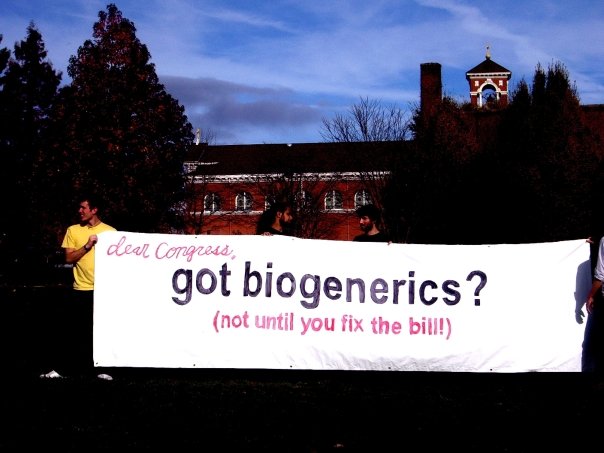
Armed with the willingness to make change and the support of their university student bodies, over 120 students from around the world traveled to Yale University in New Haven, Connecticut this November to attend the 3rd annual conference of the student advocacy group Universities Allied for Essential Medicines (UAEM).
UAEM was formed at Yale in 2001 to encourage universities to support funding and implementation of neglected disease research that focuses on illnesses primarily affecting developing countries, such as HIV/AIDS, tuberculosis, and Chagas. UAEM also works with universities’ research and medicine patent and licensing offices to ensure that both are made globally available and are financially affordable.
In its early days, UAEM-in collaboration with Doctors Without Borders-advocated on behalf of the millions of people who could not access a life-saving antiretroviral medication, essential for people living with HIV, because of its insurmountable cost and the lack of an available generic alternative. With international pressure mounting, Bristol-Myers Squibb released the patent of Zerit at no cost, and the price of the drug plummeted worldwide. For example, in South Africa, where 11% of the total population lives with the virus, prices fell from $1600 to $55 per patient per year. Since this first highly successful campaign, chapters of the group have sprouted up worldwide. UAEM is now represented at more than 40 universities.
Invigorated the group’s increasing prominence and hard work, representatives from Tanzania, Norway, Germany, Brazil, the UK, Canada, and the U.S. spent their mid-November weekend discussing each chapter’s progress, the current stance of UAEM on numerous international issues, and plans for future advocacy.
Canadian chapters of UAEM were well represented at the conference, with members from the University of British Columbia, McGill University, Simon Fraser University, and University of Toronto attending.
UAEM Canada’s main focus currently lies on the revision of the Canadian Access to Medicines Regime (CAMR), enacted in 2005 and originally called the Jean Chrétien Pledge to Africa Act. By allowing generic versions of patented drugs to be produced in Canada and sent to less developed countries facing chronic medicines shortages, the law was the Canadian government’s response to an urgent global need for essential medicines, and it’s lofty goals were applauded by the global public health community. Rwanda was the first nation to benefit from the generic production and export of antiretroviral therapy in September 2008 by Apotex Inc., Canada’s largest generic medicine manufacturer. While this first mission sparked great hope for the Regime, due to the complexities of CAMR Apotex has stated that it will never again utilize the legislation unless some reform is seen: the company argues that the high costs associated with deploying CAMR led to no return in profit. Apotex has promised to produce a child formulated antiretroviral therapy for export if the legislation is reformed, a promise which could potentially save millions of lives worldwide. UAEM Canada and its global partners, including the Canadian HIV/AIDS Legal Network and UNICEF Canada, have therefore pushed for the immediate and substantial cutting of the law’s red tape. The second reading of the proposed reformed CAMR is taking place on November 27th, followed by a vote on December 2nd.
A week after the conference, students are invigorated with the possibility of increased access to essential medicines in developing countries through the power of advocacy and research taking place at universities across Canada and the world. We believe that the reform of CAMR could result in a similarly positive outcome as occurred with Yale’s Zerit campaign. If a strongly reformed CAMR is passed, Canadians can be proud that they helped to save millions of lives by ensuring their access to essential medicines.
For more information on Universities Allied for Essential Medicines, please visit our website.
Andreas Pilarinos is a second year undergraduate students at Simon Fraser University working towards his B.Sc. in Infectious Diseases. He has been involved with UAEM for over a year, and as of September became a member of UAEM’s coordinating committee.
Support rabble today!
We’re so glad you stopped by! Thanks for consuming rabble content this year.
rabble.ca is 100% reader and donor funded, so as an avid reader of our content, we hope you will consider gifting rabble with a donation during our summer fundraiser today.
Whether it be a one-time donation or a small monthly contribution, your support is critical to keep rabble writers producing the work you’ve come to rely on as a part of a healthy media diet.
Become a rabble rouser — donate to rabble.ca today.
Nick Seebruch, editor
