
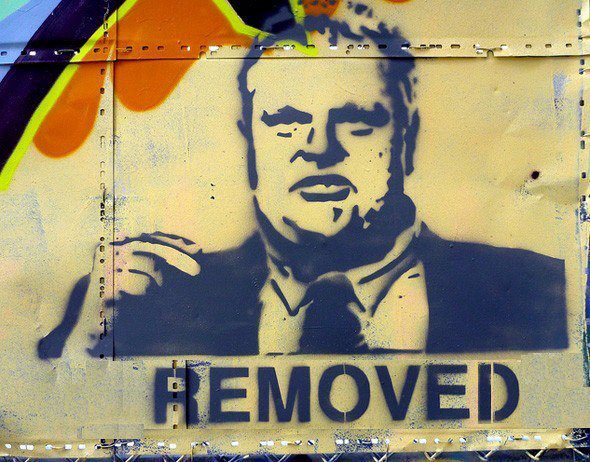
Today Torontonians celebrate Rob Ford’s imminent removal from office, after he was found guilty of conflict of interest. This is the result of pressure from below and splits from above, and should give confidence to the fight against austerity.
The technical reason Ford has been removed from office (if his appeal fails) is conflict of interest, and there’s a detailed http://www.thestar.com/news/gta/article/1293190--mayor-rob-ford-guilty-k...)">timeline of the legal proceedings. But like the removal of Richard Nixon in the context of the anti-war movement, what’s more important about the removal of Ford is the anti-austerity movement.
Ford was elected just two years ago in a landslide victory that caught many off guard. Toronto had organized two massive anti-austerity movements—the 2009 city workers strike and the 2010 G20 protests—and yet Ford came to office attacking these movements, leading many to assume that Toronto had shifted to the right or that people were simply stupid.
Austerity and right-wing populism
But Ford’s victory was not a rebuke to those movements, but a result of them having no electoral expression. When the economic crisis began, “left-wing” mayor David Miller’s attack blamed city workers and provoked a strike in the summer of 2009, which opened the gate to Rob Ford’s backlash—just like Obama’s participation in the austerity agenda opened the terrain for the tea party movement. Ironically city workers received less support from council than they did in their strike against Mayor Mel Lastman, allowing Ford to lead an unopposed charge against workers.
While other candidates spoke about continuing the same policies, Ford was the only one who spoke to people’s anger at the crisis—though channeled in the wrong direction. Ford filled the electoral void with a right-wing populist campaign that abstractly spoke to people’s anxieties about the economic crisis (“respect” and “ending the gravy”), and promised not to cut any public services.
Ford was massively popular when he was first elected, for contradictory reasons, and would never have been removed from office without grassroots activism that exposed his agenda, mobilized support against it, and provoked splits on council.
Timeline of resistance
As I wrote in April, 2011:
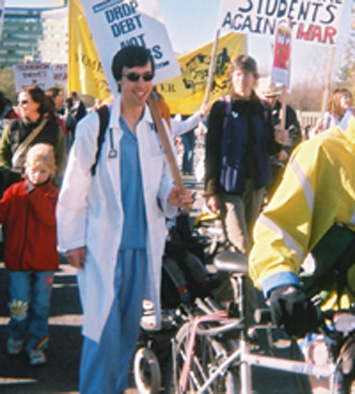
“On his inauguration on a cold December day, 150 people protested. On his first council meeting, a temper tantrum about ‘left-wing pinkos by his invited guest Don Cherry sparked protest by councillors, while thousands of people across the city got ‘left-wing pinko’ buttons that they continue to wear with pride. In March organizers of International Women's Day confronted Rob Ford about his cuts to public services, and that weekend thousands marched for public services and jobs…On April 9 unions joined with student and community groups to bring 10,000 people into the streets of Toronto, transforming Ford's motto ‘respect for taxpayers’ into ‘respect for communities, public services and good jobs.’”
This mass demonstration so soon into Ford’s term exposed Ford’s hallow rhetoric and showed the desire to protect jobs and services—which continued through the summer. As I wrote in September of 2011:
“Instead of dividing the city, Ford's boycott of Pride in June backfired and isolated him. In July a petition by Toronto Public Library Workers Union became a lightning rod when Margaret Atwood called on her supporters to sign. On July 28, the first marathon deputations spoke overwhelmingly against cuts revealing that the so-called ‘Ford Nation’ of citizens demanding austerity was non-existent. Instead August revealed a "Jack Nation" as thousands of Torontonians covered City Hall in a rainbow of progressive messages to honour the life of Jack Layton and pledge to continue the fight for a better world. In September, hundreds gathered at local organizing meetings—the Stop the Cuts meeting in the west, and a town hall meeting in the east—to discuss the cuts and organize against them. Left councillors have reflected the growing anti-austerity sentiment—like Adam Vaughn’s critique of KPMG—while Ford's inner circle has started to crack, from Karen Stintz opposing library cuts to Jay Robinson opposing arts cuts.”
Ford’s falling popularity, as a result of grassroots organizing, also had provincial repercussions—derailing Ontario Conservative leader Tim Hudak’s election campaign. Ford scrambled to reassert his agenda but the resistance continued. As I wrote in January of this year,
“In September a poll found a majority of Torontonians in all wards were against the cuts and that Ford's popularity was plummeting. Ford announced a delay of some cuts, hoping the opposition would dissipate, but on September 26 a second labour/community rally organized by Respect Toronto brought thousands more to protest outside City Hall. In October and November, Occupy Toronto organized a series of marches to City Hall—hearing from library workers, social housing advocates and others against the Ford agenda—and on December 3 hundreds of labour and community activists held a mass meeting in Scarborough to protect jobs and services. This year of organizing by labour and community groups won a majority on council to revoke millions of cuts, as a third mass protest occurred outside City Hall.”
All this grassroots, rank-and-file organizing pushed council to pass an amended budget—a slap in the face to Ford—followed by further rebukes on everything from transit, to public housing, to plastic bags. Many of these came from people on the centre or right of council, showing increasing splits and power struggles that isolated Ford and facilitated legal proceedings against him.
Ford tried to revive his agenda by going after city workers. Despite the bitter experience of the 2009 strike, city workers from CUPE 416 and 79 gave a strong strike mandate, but received no lead from the leadership. Library workers, on the other hand, had built a strong campaign connecting the fight for jobs with the fight for services—and when they went on strike they received widespread support and pushed back against the cuts—showing how rank-and-file organizing, connecting jobs with services, is key to fighting austerity.
The struggle continues
Ford has vowed to appeal, and to run the next election if necessary. But if he is removed there’s no way the right-wing will back him next election. The arrogance that led to his conflict of interest speaks to the general overconfidence with which he has been ruling, one that misread his initial victory and triggered such broad opposition. The right-wing will try to reorganize around someone who can do a smoother jobs of promoting attacks on jobs and services.
Ford’s inner circle and right-wing allies are deserting him, but not his agenda. Karen Stintz, TTC chair, was a firm supporter of revoking transit workers’ right to strike; Doug Holyday, who will take over Ford’s position, has already been speaking on behalf of the increasinly-muzzled mayor and will try to revive his agenda.
The splits at the top that isolated Ford to the point of being vulnerable to a legal challenge have not ended the austerity drive against jobs and services that the rest of the right-wing on council shares. But Ford’s imminent departure from office does show that the austerity agenda is vulnerable to pressure from below, and should give confidence to rank-and-file movements to keep organizing and fighting back.


@'talkback':
"Porkbarrel infrastructure projects, and not merely public sector wages, are why municipal taxes keep going up, in every Canadian city."
Then why are public sector workers asked to pay for pork barrel projects by cutbacks in their wages and benefits? Like the banker bailout, capitalists get the gravy and workers have to pay for it.
"most citizens are annoyed by this"
Exactly right but corporate mainstream media and lackey politicians, including Miller, channel citizen annoyance toward workers. So-called populists like Ford channel it toward trivial but safe targets - saving on office expenses and fixing potholes whilst ignoring the millions spent on pet projects like junkets to Chicago and removing bicycle lanes. Let's not forget his millionaire 1% status.
Faux liberals like Miller support elite interests over workers and use them as scapegoats. Populists like Ford and his bro support personal, which is to say, elite interests whilst effecting support for the 'common man', carefully choosing pet projects safe from jeopardizing their interests - whorehouses on Centre Island, streets clear of public transportation, etc.
Faux liberals cause citizen anger, populists capitalize on it but don't address its root causes which is why they are invariably ephemeral. Ford was more short-lived than most due to his undisciplined, self-destructive nature.
"most taxpayers are NOT public sector union workers."
And most taxpayers are not lion tamers. So? Union workers fight hard for their gains against powerful bosses. Ideally workers would stand together but lackey corporate media highlight higher worker wages whilst ducking the stratospheric salaries executives are paid, encouraging the un-unionized to see union workers, not the bosses as 'over-paid'.
A recent CCPA report noted that the growth of the middle class in Canada during the golden period - after the war, up to the mid 70's - "reflects the success of one of the largest social movements in Canadian history: the labour movement." When the deunionization effort began taking root, resulting from neo-liberalism, in the late-1980s, "the majority of workers have experienced a shrinking share of income gains while the richest 1% enjoyed a higher share of income gains reminiscent of the 1920s. Deunionization has effectively led to a redistribution of income, concentrating it back into the hands of an elite few."
It pays to look in more detail at what's in the report - " A Shrinking Universe, How concentrated corporate power is shaping income inequality in Canada" - http://www.policyalternatives.ca/sites/default/files/uploads/publications/National%20Office/2012/11/Shrinking_Universe.pdf Relevant to this discussion, it contains:
"Political debate in Canada is pulling in multiple directions, but two threads stand out. The first thread is premised on the belief that the most pressing problems facing Canadians are the result of over-indebted governments, a bloated public sector, extravagant entitlement programs and unions. To avert fiscal and demographic disaster we need to reform these institutions, and ultimately, rein them in. Austerity is the order of the day.
The second, less prominent, thread is premised on the belief that the social experiment we have been running for the past generation, neoliberal globalization, has failed to deliver on core promises. One manifestation of this failure is a sharp divergence in incomes, with a growing gap between the richest Canadians and the rest."
"Do you overpay your plumber, because he wants more money?"
How about overpaying your real estate developer or your Horton's executives or your Macdonalds executives or your Walmart executives? A plumber performs an essential service. And the others? I would rather overpay plumbers but somehow we are not concerned about overpaid executives. Why?
"many citizens/taxpayers would like to be rid of some 'services' entirely, like Toronto's costly and invasive pet licensing bureaucracy."
My pet is licensed and the service is quite valuable. I'm a cat-owner. She goes outside and stays close to home but I'm always concerned that someone might mistake her for a stray and pick her up. She is micro-chipped and registered with the service.
If you don’t have a pet, you won’t see a need for the service. If you never go to a park, you will see no need for the Parks service. If you never go to a library you won’t see a need for a library.
"Austerity candidates have done well in North American elections"
With catch-phrases like 'end the gravy train', they will, until folks learn what the meaningless nature of them. Torontonians learned in less than two years on this one.
"polls have indicated support for contracting out"
Polls are one thing, practice is another. Let's wait to see what happens with the garbage workers. Let's wait and see if people start to use those privatized highways or privatized public transportation systems. Received wisdom is that services used by everyone are not suitable for privatization. Toronto is just a bit late in the game to imbibe the knowledge. We don’t have to learn the hard way, like others have, but humans have a history of not learning from history and the experience of others.
"Public support for unions evaporates during strikes on essential services."
And for mayors who are responsible for them as well, it seems.
"people would be happy to dispense with bureaucracies" (followed by a list of perceived public sector shortcomings).
Bureaucracies reflect the society they operate in. You can try to operate without them in a city environment but Toronto would come to resemble something out of a Mad Max movie. The options are to either move out to the bush and live a 'Walden Pond' existence or learn how to work effectively with your fellow citizens like many of us have.
"A good system would be a two-stage runoff"
At last, something we can agree on.
"And the biggest reform would be a Federal-style ban on business, union, and organization (e.g. Chamber of Commerce, developers' associations) donations, with a very modest individual donation cap."
And another point of agreement. More's needed, however, including proportional representation. I've lived in countries that have it and it works. It's not perfect, but no system is unless people make it work. Citizens, as far as I know, have never voted to remove proportional representation once it's in. New Zealand's right-wing government is trying at the moment but my kiwi friends tell me it doesn’t stand a chance.
"SOMEBODY voted for Ford" and "People voted for Ford because he promised cuts to spending and a harder line with city unions.
We've chewed on this bone before. You agree we should have runoffs. Since we didn't, we both agree Ford was not the majority choice. I think we can also agree that Ford would not have won in a runoff. Therefore, you cannot claim he won for reasons that you would have liked him to win for.
"Ford actually looks squeaky-clean" (in comparison to far worse cases)
Unfortunately, too often we have come to this - voting for the least awful candidate. "Holding your nose and voting" became a catchphrase in the mayoral election. Changing the electoral system - having runoff elections - at least will ensure Torontonians agree on who the least odious is. Allowing and counting 'none of the above' votes will register our dissatisfaction with the choices on offer, encouraging better candidacies.
"The "overspending" mantra came from above..."
Maybe--if they are not infrastructure contractors. Porkbarrel infrastructure projects, and not merely public sector wages, are why municipal taxes keep going up, in every Canadian city. But most citizens are annoyed by this, and not the one-percenters who pay comparatively less in property taxes than middle and low-income citizens (even renters pay property taxes, passed on by landlords/REITs, on their rent).
"Public sector union workers and city contractors ARE taxpayers..."
Yes, but most taxpayers are NOT public sector union workers. And the end-user does want good services at the lowest cost possible. Do you overpay your plumber, because he wants more money? And many citizens/taxpayers would like to be rid of some 'services' entirely, like Toronto's costly and invasive pet licensing bureaucracy.
"The public is never given a chance to indicate what they practically will support..."
Actually, they do, in elections. Austerity candidates have done well in North American elections, from Wisconsin to Alberta. People do not like paying more for services, and dislike strikes. As for things like garbage collection, polls have indicated support for contracting out, rather than paying city workers more money to avoid strikes. Public support for unions evaporates during strikes on essential services.
"If the " layoffs and other cuts" meant curtailed services, it's doubtful."
Again, people would be happy to dispense with bureaucracies like much of the pet licensing department, or social programs like the one that hired a convicted criminal on house arrest for sexual assault (Christopher Husbands), public housing for Hummer-driving, gun-toting gangsters who throw parties with $200/bottle cognac on tap, etc. After the most recent spell of shootings, there was a public outcry over the fact that convicted criminals could not be removed from social housing. There are many 'services' that are glorified make-work projects, with little public functionality, not to mention costly infrastructure projects that are porkbarrels for well-connected firms. The latter actually hurts the corporate donors to candidates, since public works projects are their bread an butter.
"That's why electoral reform is imperative, to avoid this happening."
I agree. A good system would be a two-stage runoff, as is used in France's Presidential elections, with the two leading candidates for Mayor and Councillors running against each other in a second round. But not the opaque Condorcet-type (preferencial) systems, which often deliver strange outcomes, and are susceptable to fraud. And the biggest reform would be a Federal-style ban on business, union, and organization (e.g. Chamber of Commerce, developers' associations) donations, with a very modest individual donation cap. At the municipal level, a hundred bucks per donor would be more than enough.
"No, the main factor that made him mayor was the split vote."
Again, SOMEBODY voted for Ford--i.e., more than for any other candidate. And the rolly-polly, and often obtuse and buffoonish Councillor didn't win the Mayoral seat on his looks, or charm and wit. People voted for Ford because he promised cuts to spending, and a harder line with city unions (as with that garbage strike you mentioned, which infuriated Torontonians).
"The voters are seeing a great deal in this affair."
Again, Fordists are already putting their spin on it, which goes something like this: "caring and popularly-elected politician booted from office by an unelected judge, at the request of powerful unions (like the kind who left garbage rotting on city streets), for helping out disadvantaged youth." And, not to make excuses for flouting the law, but Ford's screw up is not the PR disaster on the scale of what just came out of the Alison Redford government, the staggering criminality in Quebec municipal politics, or the shennanigans in the Ontario Liberal Government--multimillion-dollar nepotism and illegal donations, Sopranos-style mafia politics, or things like the e-health and gas plant scandals. Ford actually looks squeaky-clean and decent, next to these very high-profile cases. And Ford's replacement will likely be another, slicker right-wing candidate, promising more spending cuts.
And the plot thickens:
http://www.cbc.ca/news/canada/toronto/story/2012/11/27/toronto-ford-conf...
@talkback:
Re: "legitimate concerns about overspending and taxes among citizens, most of whom are not 'one percenters.'"
The "overspending" mantra came from above - corporate businesses and governments - starting in the mid 70's, not from ordinary citizens. It was sold as a need to "balance budgets" and flew in the face of Keynesian economics. Instead of the goal of full employment, the Canadian state became committed "to fighting inflation." It was an excuse to 'liberalize' trade and investment, deregulation of labour markets and de-unionization, retrenchment of the welfare state and tax cuts, especially for business and the wealthy.
The consequences, almost 40 years later, are obvious to Canadians - the golden age of controlled capitalism, starting after WWII, ended in the mid 70's when the neoliberal globalization policies brought on a “new gilded age”, reflecting a significant shift in income inequality.
Re: "As a Marxist would put it, public sector unions and city contractors do not have the same 'class interest' as taxpayers and end-users of municipal services, who want good services at low cost."
This is a gibberish sentence. Public sector union workers and city contractors ARE taxpayers and end-users of municipal services as everyone else. Marx differentiated between workers and capitalists. "Good services at low cost" at the expense of workers makes no sense whatsoever. Read about the recent fire in the Walmart factory in Bangladesh for what happens when it is.
Re: "There is very little public support for public sector workers' demands for wage increases, nor increases in taxes to pay for them."
The public is never given a chance to indicate what they practically will support. If a referendum was offered Torontonians asking whether they would agree that the garbage workers should retain the sick leave perks they negotiated for over the years in lieu of salary increases - the main bargaining sticking point - or alternatively, suffer a summer of uncollected garbage, we can assume they would vote for the former.
Re: "The majority of citizens/taxpayers would also be okay with layoffs and other cuts, if this meant no tax increases."
If the " layoffs and other cuts" meant curtailed services, it's doubtful. Your supposition is based on the remaining work force being able to do what those laid off did. "Just make them work harder" - the common cry of bosses and slave-owners everywhere.
Re: "Rob Ford pandered to this 'right wing populist' base, which is the bulk of voters" and "he advocated policies that resonated with the plurality of voters."
The "bulk of voters" cast their votes for someone else. A "plurality" is not a majority, only enough to win in a three or more way race. That is why the "bulk of voters" are not happy, nor should they be, dominated by a minority right-wing populist base.
Re: Ford's "replacement likely will be another 'right wing populist.'"
That's why electoral reform is imperative, to avoid this happening.
Re: "The fact remains that more people voted for Mr Ford than any other candidate".
And the fact also remains that more people voted for a candidate other than Ford. In a democracy, the majority rules. In a broken electoral system, the manipulators of the system come out ahead.
Re: "And the main factor in the last election was that Mr Ford advocated spending cuts."
No, the main factor that made him mayor was the split vote. In a runoff election, he would not likely have been the winner.
Re: the "bad political optics" of removing Ford from office.
We shall see. But if I was a betting man, I wouldn’t put my money on it. The voters are seeing a great deal in this affair. I would be surprised if many voters find him a very appealing figure in how he is acting. But we shall see.
Again, comments about 'right wing populism' dismisses legitimate concerns about overspending and taxes among citizens, most of whom are not 'one percenters.' As a Marxist would put it, public sector unions and city contractors do not have the same 'class interest' as taxpayers and end-users of municipal services, who want good services at low cost. There is very little public support for public sector workers' demands for wage increases, nor increases in taxes to pay for them. The majority of citizens/taxpayers would also be okay with layoffs and other cuts, if this meant no tax increases. Rob Ford pandered to this 'right wing populist' base, which is the bulk of voters.
Ford may be a buffoon and a dim bulb, but he advocated policies that resonated with the plurality of voters, who are frustrated with taxes, spending, and what they (rightly, or wrongly) view as feather-bedding city labour practices. And, even if Ford loses his appeal, or a by-election, his replacement likely will be another 'right wing populist.' ALL votes are 'split votes,' but the winner always receives the pluraity of votes. The fact remains that more people voted for Mr Ford than any other candidate, just as they did for former Mayor David Miller. And the main factor in the last election was that Mr Ford advocated spending cuts. Most citizens are not fond of public sector unions, either.
Whatever legally valid justifications you make for the removal of Ford from office, do not underestimate the bad political optics of this: a popularly-elected official was removed by an unelected judge, after legal action from the elected official's political enemies (public sector unions, etc.), over fund-raising for disadvantaged children. The right could not have asked for a better narrative. Even with people who have grown tired of Mr Ford, this will not sit well. Ford and his supporters will leverage this to their political advantage, and the payback will be severe. Progressives are not heeding what happened in Wisconsin.
@vajrasattva1 Seriously? The judge did not mention unions or taxes or any of the other reasons you gave for why Ford was removed from office. Ford broke the law, pure and simple. The judge did what elected lawmakers intended a judge to do when they passed the conflict of interest legislation in the first place.
@talkbalk Your concern that "the judge 'corrected' the 'mistake' that voters made" is erroneous. It's not the voters' mistake that is being corrected. It is Mr Ford's. He broke the law - after he was elected. The judge ruled on that, not on any opinion he has about the results of the election. Are you suggesting that the citizens of Toronto should have no recourse until the next election if their municipal officials choose to flout the law? There has to be a set of checks and balances to keep the system from becoming (more) corrupt.
Thanks to Jesse for pointing out the underlying causes of Ford nation and tea party populism. Miller let us all down over the garbage strike and then fled the city for US employment afterwards despite being re-electable according to polls. Chris Hedges quite well defines what Miller and the tea party movement represents in 'Death of the Liberal Class'.
But Jesse was massively wrong, writing, "Ford was elected just two years ago in a landslide victory". Ford was elected on a split vote. Most people voted for someone else and there was a record low turnout, indicating many others chose 'none of the above'. If you add these two together, Ford would have had a landslide defeat.
Commenter 'talkback' chooses his words carefully to support his ideology, writing, "Ford was still elected by a plurality of voters in Toronto". A plurality is not a majority. Pluralities provide a resolution for elections, majorities provide what most people vote for.
Above all, the lesson of Ford's election graphically illustrates a critical need for electoral reform. At the least we need to have what is the norm in Europe and throughout North America - runoff votes when a clear majority is not achieved. We also need a way to register 'none of the above' to stop media from spinning low turnouts as 'apathy'.
But what we really need, if we want to have democratic government, is proportional representation at all government levels. It's possible, even in a political party-less system like Toronto's. Auckland NZ has it. We can too.
There are several groups working for electoral reform and a working alliance - Canadian Electoral Alliance - http://www.electoralalliance.ca/ The next meeting is Monday December 17, 2012 at Democracy Salon, The 519 Community Centre, 519 Church St., Toronto, 6-7:30pm. Bring a snack to share.
Please, let's work to stop having another Ford as mayor - or heaven forbid, Ford redux!
@vajrasattva1,
The facts remain that A. this Superior Court judge was still a (patronage) appointee, and B. Rob Ford was still elected by a plurality of voters in Toronto. Like the Scott Walker case in Wisconsin, there will be negative popular consequences of this action. But, unlike Wisconsin--which held a democratic recall vote on the issue (which Walker won, by an even greater margin)--the removal of Rob Ford was done by an unelected judge. Regardless of how this is justified, hundreds of thousands of people are not going to like having their votes effectively cancelled by decree. And, regardless of the legality of Ford's behaviour, or the results of his pending appeal, there will be an explosive backlash against the public sector unions and their political supporters, by Toronto voters.
Again, while it may come as a great shock to people in progressive circles, most citizens are not particularly fond of public sector unions and employees. And most urban taxpayers, in any city, don't like tax increases. There are a lot of reasons to dislike Mr Ford, but few people oppose cuts to public sector wages, and fewer still support their increase, or tax increases to pay for them, and even Ford's replacement would not mean an end to cuts. This is what happened in Wisconsin, where most voters supported severe reductions in collective bargaining rights, as well as labour cost cuts. Use of the loaded term 'right wing populism' dismisses voters' valid concerns about taxes, spending, and services, and actually speaks to contempt for citizens and taxpayers themselves.
Let's be honest, here, and admit that this is what the conflict of interest charges were really about. And, no, public sector unions--which represent a fraction of the electorate, and have large resources for lobbying--are not 'grass roots' by any means. Polling stations, and not judges' chambers, are where elected officials should be removed from office. If you don't like Rob Ford and his cuts, fine--wait a couple of years, and work actively to convince Toronto's voters why they should not support him, or another candidate espousing a similar platform. But don't go running to the courts because voters didn't vote the way you wanted them to. This smacks of elitism and anti-populism, and this is something voters will get back at you for.
@talkback
Parroting right-wing talking points. This particular "unelected official" is a Superior Court judge charged with the task of interpreting a provincial law. He did not bring the suit himself. It was assigned to him. And it didn't require much interpretation, since on the face of it, Ford was clearly in breach of the law. The judge made a legal decision, which he was able to do precisely because he is unelected. As for worrying about right-wing attacks on progressives, I prefer to think of this as a warning to all politicians to keep their noses clean, which should be good for citizens regardless of their political proclivities.
@caters,
Mark my words, there will be similar attacks on other elected officials. The Conservatives have already grumbled about the relationship between the NDP and unions, and you can bet that grounds could be found to remove elected NDP MPs from office, based on interpretation of campaign finance laws.
The way to remove elected officials is at the ballot box, and not the courthouse. Remember that judges in Canada are not elected--they are patronage appointments, with their own partisan leanings. They are hardly a 'check' on the democratic process, which involves actual democratic votes, as opposed to patronage appointments. Canada's unelected judiciary is anything but 'democratic.' And, because of their own ideological biases, many progressives don't realize the deep antipathy many people have towards public servants, as well as resentment over taxation. And tossing the results of a democratic election through an unelected judiciary smacks of anti-populist elitism.
If you progressives think a victory has been won here because the majority of Toronto voters didn't vote the way they'd hoped, and the judge 'corrected' the 'mistake' that voters made, then you are gravely mistaken. Remember that Ford was elected by a plurality of voters, in a clean and fair election. Ford's promised austerity measures actually resonated with voters. Already, people (not merely the right wing press) are grumbling that this is a partisan case of sour grapes, and whining to the courts because the election didn't go the public sector unions' way. If Ford wins on appeal (likely), the public blowback against his opponents will be severe. This is what happened in the ill-considered recall vote against Scott Walker--his supporters were galvanized, and the unions and their supporters suffered greatly.
To talkbalk, "voiding the results of democratic elections through an unelected judiciary is a dangerous precident"
Your position that an unelected judiciary should not have the power to remove a elected official from his/her job would actually be the dangerous precedent to set here. Having a strong and empowered judiciary is an essential component of fair and honest government. Conflict of interest legislation in every province requires the justice system to interpret conflict of interest charges and rule whether or not a municipal leader has broken the rules.
And bear in mind that Mr. Ford broke the rules not once, but twice. Once when he solicited funds for his charity using office staff to send out the requests. And the second time he was in a conflict of interest was when he did not excuse himself from the debate about these actions. He had the chance to right the wrong, but he elected to flout the law (ignorance is no excuse). Apparently, Mr Ford feels that he is either above the law or that he can interpret it better than a judge with years of legal training and experience.
Do NOT cheer this! Whatever one thinks of Rob Ford, the ballot box--and not an unelected judge--is how candidates are elected, or turned from office. Progressives need to swallow their bile and support Ford in his appeal, as this outcome has very negative repercussions for progressives, as well.
This will come back to haunt progressives. If this precedent stands, expect progressive politicians, however duly elected, to be removed from office, on conflict of interest, or other issues (e.g., the support for the NDP from unions, which the Conservatives claim is illegal). What goes around, comes around, and small-'c' conservatives will retalliate against progressives, in kind.
To reiterate: voiding the results of democratic elections through an unelected judiciary is a dangerous precident, and one which will come around to bite supporters of this action in the butts. Whether Ford opponents like it, or not, the Mayor was elected by a plurality of voters, in a clean election. If you want to remove Ford from office, do so in the next election. Tossing the results of a democratic election through an unelected judge, on the basis of spurious charges, is something that will--no ifs, ands, or buts--be used against the NDP, or other progressive elected officials.