

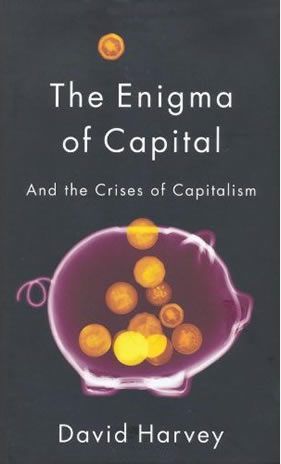
David Harvey is an internationally renowned social geographer, author of numerous books and a Marxist. He began his academic career in the U.K., spent decades in the U.S., and has taught in France, Korea and China.
In The Enigma of Capital he makes the case that the capitalist drive to accumulate wealth and maximize profits leads to recurring financial crises. He also argues that capitalism is now reaching its environmental, spatial and social limits.
To increase profits, capitalists are driven to expand production. They are also driven to cut labour costs, to replace workers with machines, and to move production to places where labour is cheaper. As production capacity expands, the income of workers, the majority of consumers, stagnates and declines. Every boom and bust is distinctive. After the 2007-08 financial crash, governments responded by bailing out big capital. For right-wing populists this is evidence of a conspiracy. For Harvey it is capitalism in action.
Despite the myth of the individual in the market, capitalist development is based on close ties among entrepreneurs, governments and big capital. Without the backing of state power and financial and landed wealth, developers could not have dispossessed peasants, indigenous people and the otherwise marginalized.
They could not have constructed and reconfigured urban spaces, or developed coal, oil, metal, forest and agricultural resources. They could not have paid workers to build the ships, weaponry, canals, railroads, highways and communication facilities that allowed capitalist markets to expand.
Income from finance and real estate has always been more important to capitalism than its supporters admit. Even after the 17th century “rents around London appear to have contributed far more to augmenting the wealth of the upper classes than did the rise of the factory system.” In the U.S., the early 20th century social critic “Thorsten Veblen surmised that the wealth of what he called the leisure class depended as much on speculation associated with land and urban development” as it did on industrial profits. In 2005 financial corporations made nearly 50 per cent of U.S. corporate profits; manufacturing accounted for less than 10 per cent.
In capitalist theory a benevolent invisible hand regulates markets. In the actual capitalist world markets are dominated by a few corporations. During the last housing boom, Wall Street firms like Lehman Bros. and Goldman Sachs provided real estate developers with credits to build homes. They underwrote mortgages for people buying homes. Profiting from the construction, sale, and purchase of residences, it is not a surprise that they pushed the boom until it crashed. It is not a surprise that governments tied to big capital then bailed out these firms.
Harvey’s main point in The Enigma of Capital is that the system is now reaching its environmental, spatial and social limits. Supplies of arable land and clean water, as well as petroleum and mineral resources have peaked and are declining. It is becoming increasingly obvious that the continued burning of fossil fuels at current levels will have increasingly damaging environmental effects. How can capitalist markets and profits continue to expand?
Until the present, profits have been increased by cheapening labour, by moving production from higher wage cities to lower wage towns, across borders and continents. Regional, national, ethnic, linguistic, gender, cultural and occupational differences have been used to fragment and divide workers. Now, with globalization completed, capitalism has no major place left to occupy.
Strikes in China, India, Indonesia and Bangladesh are frequent. Around the planet, movements for the rights of women, racialized minorities, indigenous people and immigrants are gaining broader support. In all continents, people are demanding fair elections as well as freedom of speech, assembly and association, threatening the exclusive minority entitlements on which capitalism rests. Electronic communication makes immediate common action practical.
Like Marx, Harvey sees class struggle as largely initiated by capital. “It is capital that has to struggle to render labour subservient.” Capital does so because production is actually in the hands of workers. Capitalists can impose terms and conditions by state or private violence, but to maximize productivity and profits, they need cooperation. And coercion is only effective when workers can be easily replaced.
When that is not practical, capitalists look to “social organizations that entail trust, loyalty, and subtle forms of interdependency. . . .conceding to the labour movement certain powers, to say nothing of material advantages.” But for capitalists that is practical only so long as “capital continues to be produced and reproduced.”
Can the system survive? Harvey makes no prediction. If it does, he writes, people will have to “give generously of the fruits of their labour to those in power.” Capital will demand that workers give up past gains in wages, working conditions, hours of work, and social benefits. Communities and people everywhere will have to accept worsening environmental degradation.
Harvey, following Marx, holds that the working class is the only realistic agency of anti-capitalist change, but he does not defend dogmas that came to be identified as Marxist. He doesn’t advocate top-down state control of economies. He sees the democratic direction of economic activity by people in their communities and workplaces as the alternative to capitalism.
He doesn’t privilege the industrial proletariat. For anti-capitalist movements to succeed, the entire working class must be mobilized. This includes workers in factories, resources, transportation, trade, services, as well as technical and professional employees, the self-employed, pensioners, students, the marginalized and the unemployed.
Workplace organization will play a critical part. So will community and environmental mobilizations. The system will have to be challenged in all the spheres it now dominates: in labour processes, in social relations, in relations to nature, in technologies, “in the configuration of state structures” and in capitalism’s “mental constructs.”
That may seem overwhelming, but the working class already works at everything. Ending capitalism means doing what we do for our communities, for humankind, not for a capitalist minority.
Allan Engler is a Vancouver trade unionist. His Economic Democracy, the working-class alternative to capitalism was published in 2010 by Fernwood Publishers.
Support rabble today!
We’re so glad you stopped by! Thanks for consuming rabble content this year.
rabble.ca is 100% reader and donor funded, so as an avid reader of our content, we hope you will consider gifting rabble with a donation during our summer fundraiser today.

Whether it be a one-time donation or a small monthly contribution, your support is critical to keep rabble writers producing the work you’ve come to rely on as a part of a healthy media diet.
Become a rabble rouser — donate to rabble.ca today.
Nick Seebruch, editor
