

Parliament resumes today and Canadians could be forgiven if they decided they would rather stick pins in their arms than watch another round of Stephen Harper's cynical manipulation compete with Michael Ignatieff's inept political meandering. I haven't seen a recent poll on whether or not people want an election but it wouldn't surprise me if 75 per cent put an ‘x' beside "I couldn't care less."
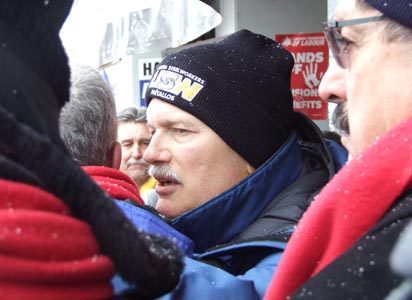
Our democracy is suffering from multiple chronic ailments with the overall effect being that it can't even get out of bed -- it is gridlocked in an absurd standoff where one national party is led by Stephen Harper, who is obsessed with dismantling everything decent ever done by government, the "natural governing party" is headed up by a right-wing snob who has no idea what he would do with power if he got it, and the "third" party is led by Jack Layton, who is far away the most trusted and well-liked leader in the country but cannot break through 18 per cent support for his party.
Layton is far ahead of the other three party leaders according to data provided by Angus Reid. The poll asked people to rank the four leaders by getting them to respond to nine key political terms, giving each man 1 to 4 points for each. The popularity index which resulted saw Jack Layton graded "A", Stephen Harper "C+", Bloc Quebecois leader Gilles Duceppe "D", and Michael Ignatieff "F". In terms of total points: Layton received an amazing 34 out of a possible 36 points (94 per cent) while Stephen Harper finished second with 25 out of 36 (69 per cent). Gilles Duceppe got 18 out of 36 (50 per cent). The hapless and mistrusted Michael Ignatieff was an also ran with just 12 out of 36 (33 per cent).
One of the chronic illnesses of our system is revealed here and that is the nearly pathological aversion for many people to making the leap from other parties to the NDP, the coinciding of their values notwithstanding. It's almost as if people look at the party and say well they're low in the polls so there must be something wrong with them. The corporatization of politics -- that we must sacrifice everything for the amorphous "economy" -- plays out here, too. When, 40 years ago, the popular culture saw the economy as serving people and communities, things were different. But two decades of mass media posing the question -- "Is it good for the economy?" (a euphemism for what is good for large corporations and banks) has changed all that.
And the NDP suffers most from this reframing of the role of the economy in Canadian politics because the pro-business parties and their media promoters have successfully framed the NDP as "not be trusted on the economy." It has become a self-fulfilling declaration -- reluctant to go out on a limb on the economy, people don't know what the NDP would do and hence, don't fully trust them.
But into this stale and suffocating mix of politics comes a rogue element, delivered, oddly enough, by Stephen Harper himself -- through Finance Minister Jim Flaherty. The decision by Harper to throw down the gauntlet on the issue of more tax giveaways to the coddled corporate sector is bizarre. He already has the sector behind him and if he really wanted to broaden his base what better way than to take away -- temporarily -- a tax cut that will barely improve their bottom line anyway ($6 billion could provide the start of a national childcare program, but divided between thousands of corporations it's not that much). Polls show Canadians opposed to the cut by a margin of 3:1, something the Conservatives had to know through their own polling.
Here is the opening the NDP could use to take on the issue those close to the party know they want to lead on: the need for tax increases to meet the revenue needs for all the things Canadians say they want. The caucus is eager but the party staff grows peaky at the mere thought -- understandably. There are, so far, no civil society voices engaging the public on the subject, and legitimizing it, a fact that will go down in history as the social and labour movements' biggest failure of the era.
But now it's out there. Taxes are the price we pay for a civilized society -- and people know it. When asked if they could be assured revenue from a tax increase would go to any number of public goods -- education, childcare, reducing poverty -- two-thirds to three-quarters of Canadians say they would be willing to pay higher taxes. Its one of the many contradictions facing progressive politicians: people no longer trust government as it is, but know the importance of government as it could be.
The latter is the base upon which the NDP must build if it is to make a breakthrough in the next election -- which it must achieve if it is going to confront the intransigent Michael Ignatieff with the need for an accord or coalition government.
Both the Liberals and the NDP are trapped in the current gridlock and it is largely their own doing. The first part of the trap is the failure to recognize that there is little more to be gained electorally from further demonizing Stephen Harper. That strategy is in fact at the root of the deadlock. Harper can't get beyond 38 per cent and stay there for any length of time because almost two-thirds of Canadians already know what he is about. They know of his contempt for democracy, his freakish obsession with controlling every aspect of government and party, his coldness, his dedication to the tar sands, his blind support of Israel and on and on. They know it because he doesn't even hide it. It is already factored into people's view of the federal scene.
The other side of the trap is a consequence of the first: convinced (as I am) that Harper wants to dismantle the country they pursue the strategy of exposing him with scant attention to actually telling people that a better world is possible. But that is what people want to know. Right now they are convinced that things are going to get worse and that no one out there has the will or the imagination to provide the support they need.
I repeat: Canadians know the value of government as it could be and should be. They hunger for someone with the guts to take a risk and engage them honestly about what is possible and what the price of that possibility is. The first party to be bold and take a risk, say what they mean and mean what they say will make the breakthrough in the next election.
But the resistance to such a strategy is enormous. Fear of failure -- fear of the attack ads, and of a media leaning strongly to the right and to Harper, keeps political staffers up at night. For the Liberals it is simply a matter of strategy and tactics. The party of opportunism which has historically done well by running from the left and governing from the right (uh, that's lying) simply does the calculus of policies. It has no soul -- only a craving to be in power once again.
But for the NDP it is a terrible dilemma to be in: they don't trust the people who are looking for bold leadership with good governance at its core, the people who say year after year that their values are indeed progressive and aligned with the NDP. But instead of taking a risk and challenging people to take it with them, the NDP has gradually become less progressive and more cautious. That's not just a pity for the rest of us; it will prove disastrous for the party. Most pollsters (even sympathetic ones) say the NDP will have to fight like hell just to hold on to the seats it has.
The corporate tax issue -- and the door it opens to the broader issue of the need for more tax revenue, not less -- is not the ideal issue to lead with. It's sort of the cart before the horse. A handful of carefully chosen, bold new policies (or even some of the old ones) could be used to engage people about the tax issue: Here's what you say you want and we do, too. Here's what it will cost. Risky, maybe reckless? Sure. But otherwise who the hell will care about the next election? Millions will stay home -- among them the people who want the incredibly popular and trusted Jack Layton to return their trust.
Murray Dobbin's column runs every other Monday in The Tyee and on rabble.ca. He also blogs for rabble and publishes articles on his website.
A few dollars is a small price to pay for news for the rest of us. Please donate to rabble today.
Support rabble today!
We’re so glad you stopped by! Thanks for consuming rabble content this year.
rabble.ca is 100% reader and donor funded, so as an avid reader of our content, we hope you will consider gifting rabble with a donation during our summer fundraiser today.

Whether it be a one-time donation or a small monthly contribution, your support is critical to keep rabble writers producing the work you’ve come to rely on as a part of a healthy media diet.
Become a rabble rouser — donate to rabble.ca today.
Nick Seebruch, editor
