

Columnists

Hennessy's Index
A number is never just a number: The sustainability challenge

| September 4, 2012
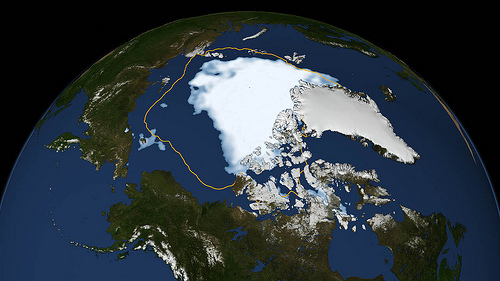
Image: Scientific Visualization Studio, NASA Goddard Space Flight Center/Flickr

75,000

Square kilometres of Arctic sea ice that melted every day in August 2012. That's like losing ice the size of New Brunswick every 24 hours. (Source)

10

Number of years in which Arctic sea ice could vanish. "Very soon we may experience the iconic moment when, one day in summer, we look at satellite images and see no sea ice coverage in the Arctic, just open water." (Source)

2050

The year leading water scientists say humans may be forced to shift to a vegetarian diet due to population growth and limited water supplies. (Source)


2

Percentage of Canadians who doubt climate change is happening. (Source)

16

Percentage of Americans who deny climate change is happening. (Source)

32

Percentage of Canadians who believe climate change is happening because of human activity. Only nine per cent believe climate change is occurring due to natural climate variation. (Source and source)

#4

Canada has the fourth highest greenhouse gas emissions, per capita, in the world. (Source)

22

Tonnes of carbon dioxide equivalent emitted per capita in Canada in 2008. America emitted 22.8 tonnes per capita that year. (Source)

51

Percentage of Canadians who believe electricity production in Canada will still rely on fossil fuels by 2050. That belief is highest in Alberta (66 per cent) and lowest in Quebec (37 per cent). (Source)

#3

Due to the tar sands, Canada's proven oil reserves are now the third largest in the world, behind Saudi Arabia and Venezuela. (Source)

10

Number of years Canada's proven crude oil and natural gas reserves are expected to be entirely depleted. (Source)

14.3

Percentage by which Canada might fall short of its promise to cut greenhouse gas emissions by 2020. Canada committed to a 17 per cent reduction by 2020 but will likely only cut emissions by 2.7 per cent. (Source)

The Canadian Centre for Policy Alternative's Trish Hennessy has long been a fan of Harper Magazine's one-page list of eye-popping statistics, Harper's Index. Instead of wishing for a Canadian version to magically appear, she's created her own index -- a monthly listing of numbers about Canada and its place in the world. Hennessy's Index -- A number is never just a number -- comes out at the beginning of each month.

Image: Scientific Visualization Studio, NASA Goddard Space Flight Center/Flickr

What's Harper up to? Award-winning journalist Karl Nerenberg keeps you in the know. Donate to support his efforts today.

Comments

Quote:

14.3

Percentage by which Canada might fall short of its promise to cut greenhouse gas emissions by 2020. Canada committed to a 17 per cent reduction by 2020 but will likely only cut emissions by 2.7 per cent. (Source)

Fun With Percentages!

First of all, this doesn't accurately reflect what the "Source" (Marc Lee) actually said. He didn't say, for example, that Canada will "likely" only cut emissions by 2.7 per cent (below 2005 levels) by 2020; he said that the government's present projections of emission trends, based on reduction efforts made to date, result in a forecast of a 2.7 per cent emissions reduction by 2020. That can be considered a "likely" scenario only if (a) one assumes that no further emissions reduction efforts (at either provincial or federal levels) will be made before 2020 and (b) one assumes the accuracy of the Harper government's projection.

Second, Canada's pitiful, revised-revised emissions reduction target for 2020 was (is) a level that is 17 per cent below 2005 levels. If it achieves only a 2.7 per cent reduction by 2020, that's a shortfall of 14.3 per cent out of 17 per cent, but that means Canada falls (14.3 ÷ 17 = .84) 84 per cent short of its "promise to cut greenhouse gas emissions by 2020".

Quote:

2050

The year leading water scientists say humans may be forced to shift to a vegetarian diet due to population growth and limited water supplies. (Source)

An excellent response to this dubious claim was published two days later in the Guardian. An excerpt or two:

Priyamvada Gopal wrote:

While there are strong environmental and health reasons to reduce our dependence on animal farming and for the better-off to drastically cut meat and dairy consumption, we must resist the temptation to abstractly denote a universal vegetarian lifestyle as the sole or simple answer. At stake are also tenacious problems of overconsumption and the inequitable commandeering of global resources, neither of which will be solved merely by passing the braised tofu....

The predictable argument that overpopulation is the main problem remains a red herring. When one person can consume or waste between two and five people's share at a time when per-capita food production has increased, inequity, not human numbers, and the richer, not the poorer, are still the problem.

Overconsumption and the corporatisation of food supply chains also underwrite the factory farming responsible for unconscionable levels of animal suffering and the depletion of marine ecosystems. When they can afford to do so at all, the poor have eaten meat sustainably and relatively humanely through small numbers of livestock or by fishing in limited quantities. The irony of vegetarianism or veganism as a lifestyle choice in wealthier countries is that it correlates with the relative affluence of being able to choose to spend your food budget on good-quality fruits, vegetables and grains. The less affluent remain condemned to buying whatever is cheapest, whether stale vegetables, processed foods or factory-farmed chicken.

A serious discussion about food security and natural resource usage must emphasise redistributive social justice and not just lifestyle choices in the abstract.

Quote:

22

Tonnes of carbon dioxide equivalent emitted per capita in Canada in 2008. America emitted 22.8 tonnes per capita that year. (Source)

Updating these numbers to 2010:

Canada's 2010 emissions: 692 Megatonnes (Mt) of CO2 equivalent

Canada's 2010 population (est.): 34,149,200

Canada's per capita emissions: 20.26 Tonnes CO2e


USA's 2010 emissions: 6,821.8 Mt CO2e

USA's 2010 population: 308,745,538

USA's per capita emissions: 22.09 Tonnes CO2e

Login or register to post comments