

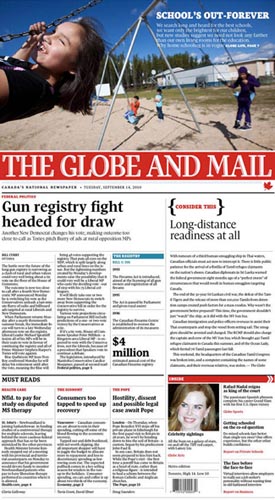
The new tarted-up, glossy, all-colour Globe and Mail is many things, but it is not a real “news paper.”
It has been “dumbed up” and robbed of much of its news content.
The result is a hybrid never before seen in North America. It is some of the old Globe of course. But is also part Maclean’s magazine and The Economist. It is part National Geographic, Sporting News, Vanity Fair, and Women’s Wear Daily.
The front page of this new Globe looks more like a magazine then a newspaper. Interesting, but not riveting, features outnumber solid news stories. Many pieces are very long, and some of the best articles are reprints from news syndicates. Large and luxurious pictures abound.
The Report on Business, while still die-hard right-wing, has more features than before. Lengthy features also dominate the Sports section. The Saturday book section continues to be one of the most disappointing (and that is all about loss of advertising from the beleaguered book trade). The work of the Globe’s outstanding journalists is sometimes diminished and lost amid the glitter. The Travel and Style sections, aimed only at the wealthy, are the two most disgusting parts of the paper.
But Globe Editor-in-Chief John Stackhouse claims it is not really like that.
“We wanted to celebrate the beauty of print,” Stackhouse told CBC Toronto Metro Morning Host Matt Galloway. ” . . . and also make it thought provoking. One of the great things about newspapers is that [they] should inspire the mind, inspire the heart . . . .”
“Our passions and concerns have not changed,” Stackhouse claimed in an editorial, but this is clearly not the case.
“It’s Globe-lite,” jokes John Miller, former chair of the Ryerson University of Journalism. He had felt the Globe needed a radical change, but now he things readers are “in for a shock.”
Clearly this new hybrid Globe is mostly about marketing. The content is massaged to appeal to an up-scale demographic that has the bucks to buy the posh products featured in the glossy colour ads: Porsche, Rolex, Cartier, Yves Saint Laurent, etc.
No ‘edge’ to new Globe journalism
This Globe has been around for less than a week, but so far most of its journalism shows a noticeable lack of edge. There are many features about money, prominent people, and sex, but not much that speaks honestly or sympathetically to the bulk of Canadians about their problems and concerns. Moreover, it is unlikely we will see any investigative journalism in the new Globe that will probe corporate corruption or how the rich manipulate the tax system to their own advantage.
Stackhouse says that the Globe has added new journalists, implying that this means there is a greater diversity of voices. But this is untrue. When it comes to political, economic, or ideological views, following the dismissal of Rick Salutin, the only non-compliant voice at the Globe is economist Jim Stanford.
The only new interesting voice belongs to Irshad Manji, who has been given Salutin’s Friday column spot. She is a harsh critic of Islamic radicalism who often sympathizes with Israel, which perfectly fits the pro-Israeli position of the Globe and the Harper government.
Old Globe was the best of a bad corporate lot
I have long been critical of the Globe because of its blatantly biased news coverage and its pro-corporate, free enterprise agenda. But the old paper was still the leading news outlet and the main touchstone for news and information. It has long been known as the ‘paper of record.’ While I strongly favour the creation of public funds to pay for publicly responsible media, as is being done in parts of Europe, including Norway where five such dailies exist, the old Globe was by far the best of a bad corporate lot.
So the important question is whether this new Globe can follow in the footsteps of the old one and be the country’s most important and most influential news source.
The answer has to be a firm no.
The sleek paper and the beautiful pictures may dazzle some people — particularly those who don’t read very much — but the lack of attention it will give to important stories, particularly the lack of pay-attention-to-this headlines on its front page, will almost certainly damage the paper’s reach and credibility. I can’t see it being nearly as important and influential as the old Globe.
While nearly all mainstream media is being battered by free online news sites, gadgets such as BlackBerrys and iPads, free dailies, and because of the loss of advertising to companies providing services on the Internet, the Globe had been doing fine, according to Stackhouse.
“We’re doing very well. We’ve just come off one of our best years ever,” Stackhouse told CBC’s Metro Morning. “We’ve had a significant increase in print revenue. Our circulation is growing at about five per cent over the past year . . . . We see a fairly strong future for print.”
In the U.S., the Wall Street Journal is thriving because of its financial and business niche. Here in Canada, it seems to me that the old Globe had an important niche — its presence and impact as the country’s national newspaper.
Thomson family abandons ‘newspaper of record’
Unfortunately, by targeting the new Globe toward a high-end audience and dramatically altering the content, the Thomson family, has abandoned its’ “newspaper of record”, the country’s only national newspaper. The Thomsons bought back most of the shares in the Globe just last month, but the sale must have been “in the bag” for some time and the family was likely in favour of the major make-over.
With assets of $19 billion, the Thomsons are the 20th wealthiest group in the world and by far the wealthiest family in Canada. In view of such astronomical wealth, perhaps the family could have continued to publish an upgraded version of the old Globe, even if the paper might have to return a profit of less than the 20 per cent the industry has come to expect.
After all, patriarch Roy Thomson, who died in 1976, amassed his first billion by squeezing exorbitant profits from dozens of small newspapers in one-paper towns. Having worked for a Thomson chain newspaper for $32.50 a week in the 1960s, I speak from personal experience.
The family is spending a wad on its new, risky venture. They have already pumped millions into the paper’s design and planning before getting the new project off the ground. They signed a $1.7 billion contract to print the Globe on new, state-of-the-art German presses for the next 18 years. And there is the cost of publishing two sections of the paper with glossy paper six days a week.
Instead, the Thomsons could have made a different kind of business decision — one that would have been much better for the country. They might have come up with a way of having the Globe continue in its role as an important national institution. Perhaps they could have leveraged a small part of their fortune to re-build and reshape the old Globe and not turn it into a coffee table display for the rich. One key step would have been to re-hire the many reporters the Globe has fired in recent years, thus returning the paper’s journalism to earlier higher standards.
We can’t be sure why the Thomsons have gone for the big, flashy project. It’s impossible to know with corporations. Perhaps this is just the way of third generation corporate head, the eccentric David Thomson. Even though a national newspaper is hugely important to the public, decisions about its future are made privately. Obviously, as we have seen from past experiences, media corporations cannot be trusted to do what is in the public interest.
While the content of the old Globe had been censored more and more in recent years to satisfy the right-wing agenda of the business community, what is happening with the new Globe constitutes a further, considerable shift to the right. Content is heavily filtered to exclude stories and ideas that would rankle the uppity crowd that the executive powers hope will buy the Globe.
Go ahead, cancel your subscription
I know people who are cancelling their subscriptions to the Globe to get back at the paper because of the dismissal of columnist Rick Salutin. But unless the people quitting have a lot of disposable income, the Globe probably doesn’t care very much. What is important to them are readers who live in well-off neighbourhoods. It will cost the Globe more money to deliver the new, more expensive paper to rural areas and poor communities where there are few sales. If the paper follows the example set by The National Post, as well as some high-end audience-targeted publications, they probably will quietly discontinue service in some areas of the country after a while.
I can’t foresee see any existing news organization in the country that will be capable of filling the void that will be left by the disappearance of the old Globe. The CBC National news has been badly dumbed down, CTV is not capable of filling the role, and The National Post cares little about the Canadian public.
The question remains as usual: are Canadians getting the daily paper they deserve?
Sidebar: The scoop on international coverage
I wanted to get a sense of what has changed about The Globe and Mail in a quantitative way, so I spent a little time studying its handling of my own main interest area: international coverage.
Clearly, the Globe is abandoning traditional news coverage of important international events in favour of soft features and lots of colour photographs. This is the pattern that has been established during the first few days of the new paper.
To illustrate the new foreign Globe, I measured the space given to the various categories of coverage. For instance, on Monday, October 4, the Globe carried only three international news stories, which together occupied 52 column inches. These pieces were supplemented by 11 tiny, one-paragraph news briefs.
In comparison, the Globe devoted 70 column inches to interesting but not outstanding feature stories — one was a half-page staff article about a 76-year-old Japanese grandfather who was the world’s oldest porn star.
Here is what the Globe provided on Monday, Oct. 4, in international coverage in column inches in, along with the number of items in brackets:
Foreign News — 52 col. Inches (3 items)
Foreign News Briefs — 37 col. Inches (11 items)
Foreign Features — 70.5 col. Inches (3 items)
Opinion Columns — 51 col. Inches (2 items)
Colour photographs — 200 col. Inches (10 photos)
I also wanted to compare the international news that the Globe covered on that Monday to what it chose not to cover.
Its 11 news briefs covered some important stories, but of course news briefs provide no depth and no analysis. Here are the three stories that the paper did adequately cover:
• Paris: Document shows how France’s wartime leader targeted Jews
• New Delhi: Against all odds, Commonwealth Games get under way
• Brazil: A woman on the verge of power (candidate for president)
To get a sense of what the paper rejected that it could easily have carried, Sunday evening I scanned the websites of three of the news services that the Globe can draw on for its international content: The New York Times, Reuters, and The Guardian. Here are some of the stories that the Globe passed up:
• ‘Slavery’ uncovered on trawlers fishing for Europe: Violence and incarceration for months or even years found on ships off coast of West Africa.
• Strings attached: what the Venezuelans are doing for British kids: A revolutionary project from Venezuela is getting Britain’s poorest children off the streets and into an orchestra.
• New York: Park51 drawings prove how far ‘Ground Zero mosque’ claims are from truth: Plans for $120m project suggest building will be a multi-faith community centre, including gym and playground.
• Body Shop drops supplier after report of peasant evictions in Colombia: Christian Aid welcomes ‘very strong signal’ from Body Shop about unacceptable behaviour of its palm oil supplier.
Nick Fillmore is a Toronto-based freelance journalist who also helps develop community radio stations in poor parts of Africa. Last winter he wrote a series of articles for rabble.ca dealing with the failures of mainstream media. The first article can be found here.
Support rabble today!
We’re so glad you stopped by! Thanks for consuming rabble content this year.
rabble.ca is 100% reader and donor funded, so as an avid reader of our content, we hope you will consider gifting rabble with a donation during our summer fundraiser today.
Whether it be a one-time donation or a small monthly contribution, your support is critical to keep rabble writers producing the work you’ve come to rely on as a part of a healthy media diet.
Become a rabble rouser — donate to rabble.ca today.
Nick Seebruch, editor