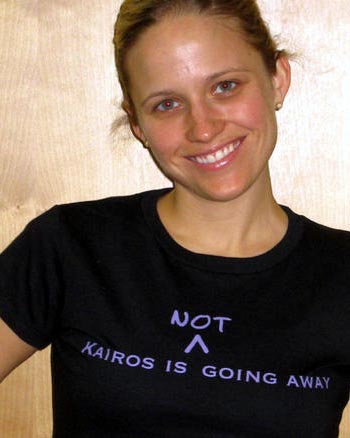
Lost in the politics around the now-infamous “not” which cost my organization Kairos its funding is the impact on Kairos’ programming and partnerships overseas.
The debate raging in the Canadian Parliament and the media — while teaching interesting lessons to Canadians about parliamentary procedure, including the possible censure of a member of the government — isn’t directly helping women in the Democratic Republic of Congo, or children in Colombia, or citizens in the future state in South Sudan.
In fact, the decision to cut funding to our overseas work is doing the opposite.
Here is an example of how Kairos can help:
In South Sudan, from where I’ve just returned, people are jubilant over the results of the referendum on self-determination. Nearly 99 per cent of registered voters chose separation over continued unity with the rest of the country. Now what?
In July, South Sudan will become an independent nation. It will need to develop the institutions of democracy for the first time, including a constitution and representative government. Kairos’ partner there, the Sudan Council of Churches (SCC), wants to help.
Throughout South Sudan’s troubled history, the people have turned time and again to the churches to help preserve peace and reconcile communities. The 1972 Addis Ababa agreement, for example, was brokered by the churches of Sudan and Africa, supported by the World Council of Churches.
The people-to-people peace initiatives of early 2000s (supported by Kairos) are widely recognized to have paved the way for the Comprehensive Peace Agreement, establishing peace between the two major warring parties in Sudan.
Early in 2011, ie., right before the referendum, the people of South Sudan turned once again to the leadership of the churches to re-establish peace between conflicting groups within the southern peoples liberation movement. Religious leaders representing different denominations worked hard to win a commitment by the South Sudan president (Salva Kiir) to undertake peaceful dialogue and reconciliation initiatives with a rebellious army commander.
Today, the The Kairos-supported SCC is increasingly looked upon to develop democracy and promote improved governance throughout the south. The SCC recruited observers to monitor both the elections (2010) and referendum on self-determination (2011). SCC observers were deployed as part of SUNDE (the Sudanese Network for Democratic Election), the largest non-partisan domestic monitoring organization in Southern Sudan. With support from overseas partners, SUNDE helped train and deploy over 3,000 workers to observe the polling, counting, and tabulation processes.
Still, there is much left to do.
What happened when the money was denied
To further entrench democratic practices, Kairos had applied for funding to help the SCC develop the skills to monitor the use of oil revenues from South Sudan’s massive oil deposits. Speak with anyone in Sudan and they will tell you that corruption remains a big problem. The SCC is anxious to ensure that oil revenues (which make up 98 per cent of the South’s budget) be used for good public initiatives, including building roads, hospitals, schools, etc, so that the international community doesn’t have to.
There are many, many other initiatives that have been jeopardized by Minister Oda’s cut. In all, 21 partner organizations were hurt, and some had multiple initiatives of wide-ranging variety and importance to those they helped.
For example, in the Democratic Republic of Congo, we wanted to fund two initiatives, one related to gender-based violence — a legal clinic for victims of rape in the Congo — and the other related to training newly elected officials.
Our other projects include a community support organization in Colombia, an Indonesian human rights group looking into past military abuses and urging the government to compensate victims, Israeli and Palestinian peace groups, and other projects throughout the world’s troubled spots. In terms of Sudan, the churches there are keen to play a role in development of a new constitution, and we would like to be part of this.
Our global partners page can be visited by clicking here.
We now know that after a thorough review CIDA wanted to support our program. We believe that Canadians do, too, but we cannot fully implement a program that CIDA and Canadians want without the government’s help.
John Lewis is the International Human Rights Co-ordinator of Kairos, a pan-Canadian ecumenical partnership working to promote human rights, justice and peace, viable human development, and ecological justice around the world. He went South Sudan in January to monitor the self-determination referendum called for in the 2005 Comprehensive Peace Agreement in that country. His blog from that trip can be read here.
Support rabble today!
We’re so glad you stopped by! Thanks for consuming rabble content this year.
rabble.ca is 100% reader and donor funded, so as an avid reader of our content, we hope you will consider gifting rabble with a donation during our summer fundraiser today.
Whether it be a one-time donation or a small monthly contribution, your support is critical to keep rabble writers producing the work you’ve come to rely on as a part of a healthy media diet.
Become a rabble rouser — donate to rabble.ca today.
Nick Seebruch, editor