

rabble.ca is a reader-supported site — we count on donations from people like you. Please join us as a paying member (click here) or send a one-off donation (click here) to help us continue our work.
Postal service in Canadian cities is in jeopardy from next week if last-minute negotiations between Canada Post and the Canadian Union of Postal Workers (CUPW) do not succeed in coming to an agreement.
The possibility of a strike by the union or lockout by management comes into effect on midnight May 24, with a 72-hours notice being given before any such action is taken.
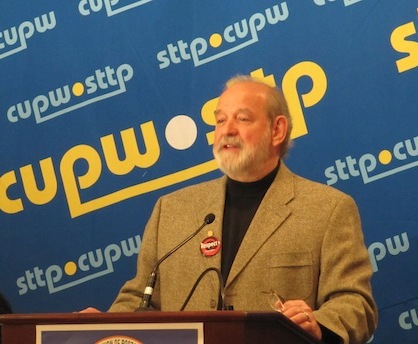
At a press conference yesterday, CUPW national president Denis Lemelin announced an agreement that would ensure cheques from the federal government for pensions, old age security and child benefits would still be delivered in the event of a strike, along with social assistance cheques in some provinces and territories (other provincial and territorial governments opted out of the deal). “For us, it’s important because the fight is not between us and the public, the struggle we have is with Canada Post. We want to assure the people who are living on cheques, that they will receive their cheques.”
But in terms of agreeing on a new collective agreement for CUPW urban operations members, there wasn’t much good news. Canada Post say that the changes they are trying to bring about “are needed to keep [us] financially viable and secure the future of the postal system in this country.” This, despite 16 straight years of profits at the crown corporation.
“We’re proud of the work we’re doing,” says Lemelin. “That’s why we have that [‘Respect’] button, to respect the fact that we are the workers who made this corporation profitable.”
“We are at the final stage of this negotiation,” he says. “We tried for the last six months to negotiate a collective agreement with Canada Post but there’s a lot of issues [where] we’re still far apart.” adding that “We have seven days left to achieve this agreement.”
But Canada Post spokesperson John Caines says “that’s just a date, that’s when they get in the legal position, that doesn’t mean anything’s going to happen that day. We can negotiate up until then, and beyond then if things are going well, and we might have a deal before then.”
When asked on Winnipeg’s CKUW community radio (listen: May 16 link, interview starts at 22min22sec) what a strike would mean for average Canadians, CUPW representatives Arlyn Doran and Darren Steinhoff said, “The union will determine what type of strike it conducts. It doesn’t necessarily mean there’s going to be a full blown general strike on the 24th.”
“We don’t want a strike, what we want is a negotiated collective agreement. So we’ll employ the type of strategy that we think will best assist us in that regard. First off, it could be a rotating strike wherever, taking out two or three communities and locals at a time, and sort of mixing it up. You have the element of surprise in a rotating strike, which minimizes the impact to the public, it minimizes the impact to our members, and puts the employer in a weakened position. A general strike would mean basically a shutdown of the entire operation — we are currently 70 per cent of Canada Post’s workforce and our bargaining unit goes from coast to coast to coast.”
CUPW members voted 94.5 per cent for a strike mandate if required, with the highest level of participation for the secret ballot in the union’s history.
One of the main issues relates to Canada Post trying to create a new two-tier system of employees, that CUPW states would result in all new employees earning 30 per cent less pay, along with reduced benefits, an inferior pension and weaker job security. Caines states, “It will be a different package, but it will be very attractive and we don’t think we’ll have any trouble hiring new people in the future.”
Lynn Bue, CUPW’s 2nd national vice-president, has a different perspective: “This is a fight against an ideology from the government, from banks, that big businesses should make more, and people should live on poverty wages. I have wages that could help my children go to university — not pay for it, not those kind of wages — but help my children be able to get higher education. What they’re talking about now are wages that are just for survival, they’re not a wage to support a family.”
As well, Canada Post is proposing a new ‘short term disability plan’ in place of the current sick leave system, an issue especially relevant to postal workers due to the hazardous nature of the work that results in higher than average rates of injuries on the job, including disabling injuries. Caines considers it “a better sick plan for everybody” but CUPW describes it as “complicated and inferior.”
Plus there is modernization: “Canada Post is in a process to change all the technology. We are in the transition process to have big changes happening. We feel this negotiation is so important to put in place the basis for the future,” says Lemelin. “In our view, it’s about what can Canada Post do with this new technology is really expand services.”
“What we want to achieve [is] a good postal service for all of the country, and for that this postal service has to change and adapt to the new realities.”
There seems to be two very different directions that postal services can go in this country.
One is to provide new services to communities throughout the country, especially rural and remote communities that are underserviced, using the tremendous infrastructure that Canada Post already has as a public institution. Possibilities include electronic mail services, issuing passports, financial services (‘postal banks’), and remittance services. “They should be providing remittance services for people that have come in from other countries that are sending a lot of their paycheque home to support their families. There should be a kind of service that doesn’t rip them off, because currently they’re being ripped off,” says Bue.
Providing additional services would not only benefit the general public, but provide even more good jobs in communities across the country.
The other direction is towards lower wages, poorer benefits and possibly even privatization and deregulation, something CUPW has been fighting against for over four decades (the Harper government deregulated international letters by including it in the 2010 budget, but says that domestic mail is safe).
Bue speaks about the situation in the Netherlands where “a system that worked very well has been destroyed through privatization and deregulation,” citing less-than-minimum-wages for (non-unionized) delivery people who work less than a full day a week, and a lack of security and consistency in delivery of the mail.
It appears that CUPW members aren’t going to let that happen. The support for an ‘if-necessary’ strike over these negotiations is strong, and recently militant workplace actions have taken place.
Of note, there was a wildcat strike in Winnipeg in November. Another wildcat strike took place last month on the outskirts of Edmonton. And earlier this year in Edmonton, job action was successfully taken to force a solution to problems with forced overtime, without waiting for national arbitration.
“I think CUPW has a long-standing history of being militant, and we will continue to be,” says Beverly Ray, president of local 730 in Edmonton. “In Edmonton, I think we’ve got some great activists and leaders here, that have been able to inspire people and help them realize that the workers have the power to actually create change, and I think you’re seeing that building right across the country. I believe we’re militant right across the country … I think what Edmonton’s done is maybe being a bit of a model on how worker-, organizer- and union-supported actions can actually have an impact that’s actually going to make a difference.”
In terms of the current national situation, she states “We’re not prepared to take a roll back from where we are now around working conditions, around wages, around guaranteed sick leave, around pensions – it’s everything right across the board that they are rolling back and saying, ‘We’re going to take more away from you so we can put more money in the federal government coffers’. And at the same time right now, the public and the people that work for Canada Post are not seeing the benefits of any of the postal transformation or anything that Canada Post has been doing for the last fifteen years. They’re closing rural post offices, they’re getting rid of street letter boxes – that’s not providing improved customer service to Canadians. We’re still a public entity, and Canadians have a right to deserve good quality public postal service.”
Greg Macdougall is an educator, organizer and writer based in Ottawa. More of his writings and other good stuff can be found at EquitableEducation.ca.
Thank you for choosing rabble.ca as an independent media source. We’re a reader-supported site — visited by over 315,000 unique visitors during the election campaign! But we need money to grow. Support us as a paying member (click here) or in making a one-off donation (click here).
Support rabble today!
We’re so glad you stopped by! Thanks for consuming rabble content this year.
rabble.ca is 100% reader and donor funded, so as an avid reader of our content, we hope you will consider gifting rabble with a donation during our summer fundraiser today.
Whether it be a one-time donation or a small monthly contribution, your support is critical to keep rabble writers producing the work you’ve come to rely on as a part of a healthy media diet.
Become a rabble rouser — donate to rabble.ca today.
Nick Seebruch, editor