

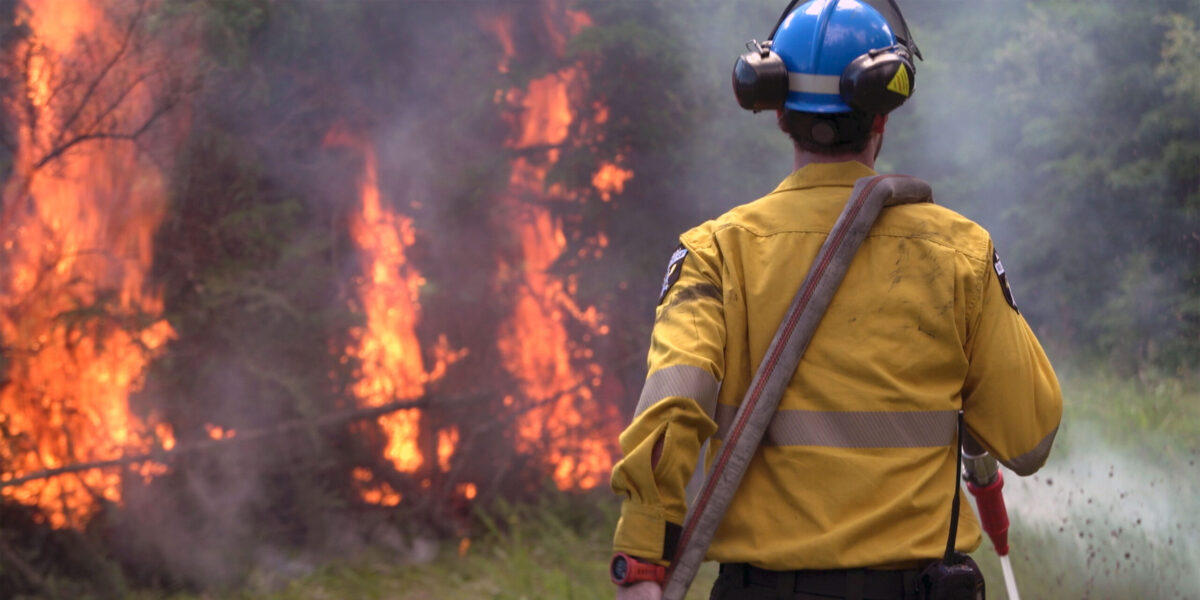
Wildland firefighters are navigating wildfire season without access to the same pension and benefits that other public safety professionals get. The National Union of Public and General Employees (NUPGE) has been pushing the government to change the National Occupational Classification because it currently excludes wildland firefighters from the firefighter classification.
NUPGE president, Bert Blundon, emphasized that this misclassification does not only affect wildland firefighters on paper. Since they are not considered public safety workers, wildland firefighters do not get access to higher pension accrual rates or earlier retirement options.
“[Wildland firefighters] work in the most harsh environment that anybody can imagine, exposed to all kinds of toxins and smoke,” Blundon said in an interview with rabble.ca. “It’s really about protecting communities as well as our forests. Those firefighters, they may be battling a fire for months. This is not a fire that happens, and in a day you have it under control.”
Public Safety Canada’s June wildfire report said wildfire season started more slowly this year than it did last, but the current forecast indicates that wildfire activity will intensify over the coming months. Blundon said the lessons from past intense wildfire seasons have shown the need to have wildland firefighters ready but misclassification creates a barrier to this.
READ MORE: Climate change fuels wildfires worldwide
In March, a petition was sent to the House of Commons calling for the reclassification of wildland firefighters but the government said they will not change the NOC immediately. In their response to the petition, the government said that NOC had no bearing on pensions.
The government said they had met with stakeholders to identify whether NOC impacted pension accrual, pensionable earnings and health-related benefits and coverage.
“The federal government as well as several provinces, including Ontario, Manitoba, Saskatchewan and British Columbia, have all implemented legislative changes to extended health coverage to wildland firefighters,” the government response reads. “With regards to pensions, the Canadian Revenue Agency has confirmed that the National Occupational Classification has no bearing on eligibility of occupations to the public safety occupation provisions and have indicated their availability to review and assess applications to register a pension plan or to amend an existing registered pension plan for wildland firefighters.”
Randy Boissonnault, former Minister of Employment, Workforce Development and Labour of Canada, wrote a letter to the Standing Committee on Public Safety and National Security in 2024 that made a similar argument.
Boissonnault wrote that the CRA processes applications to register a pension plan or amend a registered pension plan from employers on a case-by-case basis. This means employers of wildland firefighters are responsible for applying to get the benefits of early retirement and higher accrual rate.
Blundon said that saying NOC has no bearing on pensions is false. He said employers look at the NOC to determine how they will compensate employees. This has impacted bargaining.
“We would argue that employers are using the wrong variables here when they determine what this group of workers should be paid compared to the rest of their employees,” he said. “That is an issue.”
In the Fall, Prime Minister Mark Carney said his government would amend the Public Service Superannuation Act to ensure CBSA officers and other frontline first responders receive benefits that reflect the weight of their responsibilities. However, without the reclassification of wildland firefighters, they run the risk of being left out of any new changes.
NUPGE director of communications, Jeanne d’Arc Umurungi, said it was important to note that there are other places in the world that classify wildland firefighters as firefighters. She highlighted that the European Commission, for example, lists forest firefighters as an example of those who should be included in the classification.
Blundon said addressing the misclassification of wildland firefighters in Canada is a matter of fairness for people who have protected Canadians as wildfires become more intense amidst climate change. He also noted that the proper classification of wildland firefighters could improve recruitment and retention, bolstering a service that is needed now more than ever.
“I believe every Canadian sees the value of and recognizes the huge safety concerns around firefighters now,” Blundon said.
“Provincial governments and federal governments haven’t responded effectively to that new reality caused primarily by climate change,” he added. “Fires in Canada has increased dramatically over the last 10 years, but we haven’t increased our response.”
Support rabble today!
We’re so glad you stopped by! Thanks for consuming rabble content this year.
rabble.ca is 100% reader and donor funded, so as an avid reader of our content, we hope you will consider gifting rabble with a donation during our summer fundraiser today.
Whether it be a one-time donation or a small monthly contribution, your support is critical to keep rabble writers producing the work you’ve come to rely on as a part of a healthy media diet.
Become a rabble rouser — donate to rabble.ca today.
Nick Seebruch, editor

