
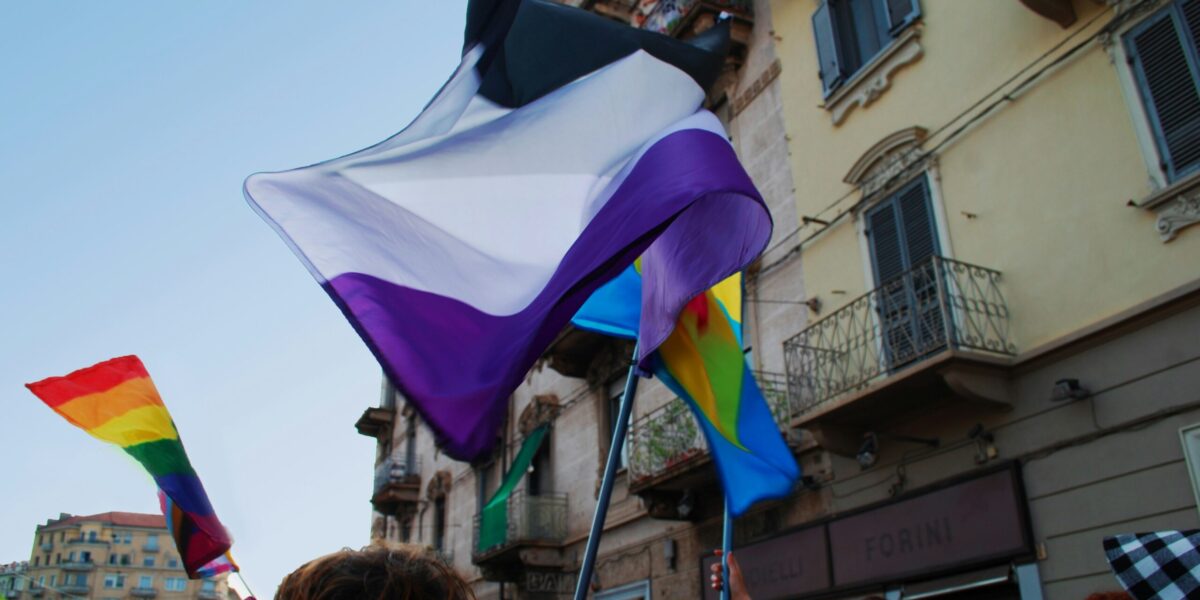
As an asexual, I always find myself rather conflicted during Pride Month. On one hand, I’m eager to revel in queer and trans joy. Our resilience in these trying times deserves to be celebrated. But on the other hand, I have a handful of people on the internet reviving the same outdated discourse about asexuality all month long.
In case anyone is unaware, asexuality is defined as a lack of sexual attraction. It exists on its own spectrum, comprising anyone who experiences sexual attraction to a lesser intensity or frequency than the norm. Some aces experience a repulsion to sexual activity alongside their lack of sexual attraction, while others still feel interested in sex or (like me) are neutral to the idea.
I’ve been hearing the same acephobic comments since I started identifying as asexual a decade ago: Should asexuals be included in the LGBTQ+ community? Are asexuals even queer? Do asexuals even exist?! (The answer to all three is yes, by the way.)
Some folks out there hate asexuals with a passion, such as J.K. Rowling, who got in on the acephobic action during International Asexuality Day last year. Typically, they’re spewing microaggressions and invalidations, such as debates as to whether we even exist, insisting that we haven’t found “the right person” or that we’re somehow “late bloomers.” These comments are (unfortunately) very common.
But acephobia can show up in a lot of different ways. It shows up as a lack of institutional protection and validation. Did you know that marriages in Canada can still be annulled on the grounds that they haven’t been consummated? It happens rarely, but the legality is still there. So, in a legal sense, a marriage is not seen as valid unless there is sex involved, which would cause a problem for the approximately 60 per cent of asexuals who have little to no desire for sex in the case they want to get married to a romantic (or even platonic) partner.
Pathologization is another common way for acephobia to show up. Asexuality was considered a mental disorder in the DSM until 2013, and “lack of sexual interest” is still pathologized as Hypoactive Sexual Desire Disorder or a symptom of other mental disorders. A 2025 study from King’s College London found that around one-third of British people believe that asexuality can be “cured”, and one-quarter believe that it is a “mental health issue.”
Acephobia also shows up in the belief of biological essentialism. Asexuality is not seen as legitimate because it is not “human nature” to be disinterested in sex, thus stigmatizing us as robotic, alien, or inhuman.
After seeing the cycle of acephobic discourse come back around this June, it got me thinking… Where does acephobia even come from?
Of course, it’s a difficult question to answer. There’s a lot of overlapping factors that go into hatred and ignorance. But through my research, I found that there was a pretty clear throughline causing the social landscape necessary to perpetuate acephobic ideas, as well as to form the asexual community as it stands today: the patriarchy.
For starters, most people who identify as asexual are women. According to a 2016 survey of 9,294 asexual individuals, 63 per cent of the asexual community identifies as women, with another 26 per cent identifying as nonbinary and around 11 per cent identifying as men.
Does this mean that women have some natural, innate disposition to be asexual? Not in the slightest. It’s more than likely due to a difference in socialization.
In our patriarchal society, those raised to be men are taught that their libido and their masculinity are tied together. Men’s sexuality is an expectation. The more experience they have, the more their masculinity is affirmed. Men are given a clear blueprint and an objective, never needing to reckon with their own thoughts unless they choose to engage with them. And with empathy and emotional literacy discouraged, it makes not engaging the more appealing option.
Meanwhile, those raised to be women under the patriarchy are constantly fed contradictory narratives about their sexualities. You can’t have too much sex or you’re promiscuous, but you can’t have too little sex or you’re a prude. You should wait until marriage, but also shouldn’t be a virgin in your twenties because that’s just sad. This constant back and forth forces women to sit down with our own thoughts and determine for ourselves how we feel about sex.
There is also the cultural assumption that women are generally “less sexual” than men — read as: white women are “less sexual” than men — that allows some women to come to terms with asexuality more easily than men would since a lesser desire for sex is already expected. However, in the cases of women of colour who are already desexualized by racist stereotypes, such as East Asian women’s infantilization or Black women and the “mammy” caricature, a discovery of one’s asexuality can sometimes cause distress and be more difficult to accept due to fear of “playing into” those stereotypes.
Overall, the oppression of the patriarchy, while it affects both men and women in discovering their asexuality, makes it an easier conclusion to draw for women and allows them to make up the majority of the known community.
Secondly is the issue of sexual essentialism. In the narrative of Western society, there is one “right” way to live: the nuclear family structure of a heterosexual spouse and children. You are expected to have sex with your partner and expected to build a family through biological means, because that is what healthy couples do. In this structure, sex is viewed as a core piece to a happy and healthy lifestyle.
These sex-essential narratives are shoved upon both men and women in different ways under the patriarchy. A single man is viewed as a bachelor — a free man who can have sex without being tied down. Coupling is not essential to be a happy man, but sex still is (returning to the idea of sexual experience being tied to masculinity.) A single woman is viewed as lonely. Her joy is unfathomable unless she is in a relationship — since that keeps her where the patriarchy wants her: in submission to a man. To have a relationship without sex, or no relationship at all, is to disrupt the narrative that coupling and sex are essential to fulfillment.
This is where asexuality comes into play. Asexuality forces us to rethink these accepted societal structures of what relationships and family can look like. In a U.S.-based poll of sexual minorities, it was found that while asexuals were significantly less likely than allosexuals (non-asexuals) to have had sex within the past five years (falling at around 47 per cent and 10 per cent respectively), there was virtually no difference between demographics when it came to being in relationships, both falling at about 60 per cent. In that same 2016 survey from earlier, 53 per cent of ace respondents claimed to have experienced a significant relationship, with 34.2 per cent claiming to have had a significant relationship that was non-romantic. There was also no difference in terms of life satisfaction.
Decentering sex and creating more acceptance for asexuality opens up so many doors for what is accepted as fulfilling lives, relationships and family dynamics. Relationships with romance but without sex. Platonic partners in a commitment to each other, viewed as seriously and profoundly as a marriage. Life-long singlehood without stigma. Community-based child rearing rather than partnered parenthood.
For acephobia to exist is to find opposition to this wider way of thinking, prolonging the myth of the nuclear family structure as ultimate and allowing for us all to remain constrained by this patriarchal ideal. But through destigmatizing asexual ways of being, we broaden the options for all of us.
Finally, there is the issue of rape culture. Under the patriarchy, sex is not just viewed as essential, it is viewed as something owed.
In an interview with Noctis, asexual activist and model Yasmin Benoit described her experiences of not “looking asexual” due to the hypersexualization of Black women.
“I see other asexual people, particularly white asexual people with platforms, who can wear shorts, or crop-tops, and make-up, and style their hair, and no one thinks it’s a problem,” Benoit said, “but when I do it, it’s practically porn.”
White news anchors also called her lips “too pouty” and “inviting sexual attention.”
Even among the asexual community, where the whole schtick is a generalized disinterest in sex and lack of attraction, clothes and skin colour are still being viewed as indicative of one’s sexual interest. The idea of a woman dressing as, what Benoit describes as, “a life-size WWE Bratz doll who stole from an 80s rocker’s wardrobe” for herself is seen as impossible. If there’s skin to be seen, surely it’s for the “male gaze.”
But the issue of asexuals owing sex doesn’t end there, unfortunately. According to the 2016 Ace Community Survey, approximately 37.5 per cent of asexuals have experienced sexual assault, with 12.9 per cent specifically describing their experiences as rape. Approximately 85 per cent of asexuals who experienced this violence had at least one male perpetrator, with 19.4 per cent having at least one female perpetrator and 2.7 per cent having at least one nonbinary perpetrator. Around 49 per cent of aces experienced assaults that were perpetrated by at least one intimate partner, while 64.6 per cent of aces experienced assaults that were perpetrated by someone who they were not intimate partners with.
While not always the case, it’s common for these assaults to be “corrective”, meaning that the perpetrator is attempting to “convert” the victim from one sexuality (asexuality) to another (allosexuality/heterosexuality) with the belief that the assault will “awaken” them.
Asexuality as an identity is not taken seriously. Our word is not seen as enough, or is seen as irrelevant. We’re told to “just try it” or that we haven’t found the right person yet. We are viewed as immature or naive, not knowing what we truly want — in need of someone else to show us how we should be feeling. It’s infantilizing.
Our desires are not viewed as equal to that of allosexuals. In the same way that women under the patriarchy are expected to owe sex to male partners, asexuals are expected to owe sex to allosexual partners.
The consequences of allowing this standard to continue are already being weaponized. Asexuality was just outlawed for the first time, with Niger threatening up to 10 years in prison and a fine for “asexual practices.” The definition of “asexual acts” is kept vague, but I don’t think it’s too far of a leap to suggest that this new law could be used against women who dare to deny sex to men. After all, asexuality is a sexuality of lack, so I can’t think of another possible way to enforce it other than to deter women from withholding consent under the guise of acephobia.
Ultimately, acephobia stems from a hatred of not conforming to patriarchal sexual and societal expectations. While the act of having sex has become a form of feminist liberation (and rightfully so,) the act of not having sex has become associated with repression or purity culture, leaving those of us who simply don’t want sex behind. But in order to demolish the patriarchy, we need to be mindful of asexuality in feminist conversation. In order for asexuals to experience true liberation and for gender equality to truly exist, we need to remove the idea of sex as an expectation for everybody. Only then will we be free to determine how we want to engage with sex on an individual level rather than a societal one, build the relationships and family structures that feel right for us without stigma, gain the ability to truly give consent, and have asexual identities seen as valid ways of living.
Support rabble today!
We’re so glad you stopped by! Thanks for consuming rabble content this year.
rabble.ca is 100% reader and donor funded, so as an avid reader of our content, we hope you will consider gifting rabble with a donation during our summer fundraiser today.
Whether it be a one-time donation or a small monthly contribution, your support is critical to keep rabble writers producing the work you’ve come to rely on as a part of a healthy media diet.
Become a rabble rouser — donate to rabble.ca today.
Nick Seebruch, editor