

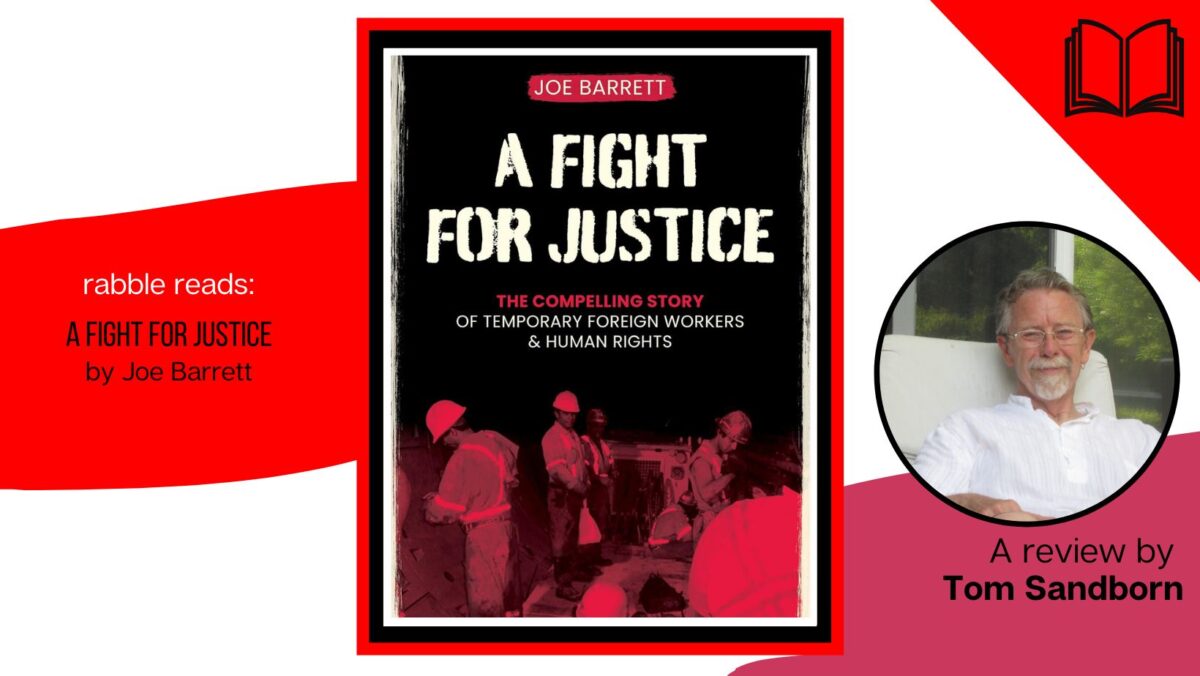

In the workers’s movement, we have (and at our best we live by) a few beloved slogans: “This is What Democracy Looks Like, The People United Can Never Be Defeated, Solidarity Forever,” and my own particular favourite, J.S. Woodsworth’s resonant “What We Desire for Ourselves, We Wish for All.” These are aspirational sayings that survive and continue to inspire despite the way they are often scuffed up in actual practice. The Woodsworth line serves as the epigraph of Joe Barrett’s A Fight for Justice and it introduces a wonderful example of that inspiration being acted out, literally in the trenches of the class struggle.
In 2006 members of the BC labour movement heard rumours that a group of temporary foreign workers (TFWs), brought to Canada to bore the tunnel portion of the Canada Line that runs under Vancouver’s False Creek, were being paid illegally low wages by the ornately complex international joint venture (SNC Lavalin/SELI). In response to that news the BC labour movement mobilized and began an epic multi-year struggle that led to the first successful union certification among TFWs in Canadian history, and eventually to some partial but real justice for the exploited workers. Sometimes the magic works.
The union local at the centre of this moving story, Local 1611 of Construction and Specialized Workers Union, more recently known as LiUNA local 1611, put its resources at the service of marginalized TFWs and did much to redeem the labour movement’s earlier spotty record on treatment of temporary foreign workers.
In 2006, Barrett, trained as a Spanish teacher, was working for the BC Building and Construction Trades Council (BCBCTC) as a researcher. Barrett, in his typical modesty, properly credits the success of the campaign first of all to the TFWs who had the courage to fight for their rights, and also to his own employer, the BCBCTC, which freed him up to play a role in organizing those workers, and also to union officers like Mark Olsen and union side labour lawyers like Kevin Blakely and Charles Gordon, who took the fight to the employer in court and tribunal.
Barret himself also clearly made a huge contribution. That impulse to selfless service runs in the family. Barrett is the son of BC’s legendary first NDP premier, Dave Barrett, to whom the book is dedicated. (Full disclosure. I wrote about this struggle while it was ongoing as part of my labour beat for The Tyee online, and I got to know many of the characters depicted in Barrett’s book, including the author.)
This book is a master class in how much we can accomplish as workers when we stand together and do not fuss about who gets the credit.
Barrett tells this complex story with admirable clarity. It begins in the mud and danger of underground work, brings to life the human complexity of the organizing drive, and provides a full adult dose of courtroom drama, including disclosures of document tampering and intimidation campaigns by the employer. The book closes with a joyous trip by Barrett and other Canadian union figures to Costa Rica in 2013 to deliver the cheques for damages awarded to the tunnel workers by the BC Human Rights Tribunal.
It is a memorable story of human suffering and human triumph, told without a moment of sentimentality or condescending workerism. Every character we meet in this splendid book is portrayed in full human complexity, warts and all, on both sides of the class divide. Moments of failure, distrust and temptation to surrender are illuminated by Barrett’s fierce commitment to the truth and to solidarity with those who are being exploited.
The author’s dedication to factual accuracy is reflected in how deeply researched this book is, and includes a helpful cast of characters list. Barrett also provides a guide to the bewildering storm of abbreviations and acronyms that blows through any account of a legal and/or bureaucratic struggle, acting against the tendency for the readers’ eyes to glaze over in the storm.
Although this story is embedded in complex legal and jurisdictional issues, which are lucidly explained, Barrett never loses sight of the tunnel workers. The reader gets to know the men who were labouring underground for less than the minimum wage in filthy, exhausting conditions, and sees them at home in Costa Rica with their friends and families. Workers like German Caro, who told Barrett when the battle was won: “Joe, I have only one thing to say to you…thank you. Ever since the Vancouver project, the world has changed for tunnel workers. Latin American workers are treated properly and paid higher wages.That court decision changed everything for us.”
Some of these characters are stunningly courageous and kind, others are more flawed, but all are fully human and presented in all the imperfect complexity that goes with human life and our struggles to make it more decent and fair.
Even figures that a lesser writer might have been tempted to present as unidimensional villains, like the alarmingly deft and supple employer-side (some would say dark-side) lawyer Peter Gall, who has played a key role in reducing union density and influence in the BC construction industry during his career, are presented in an even handed manner. Barrett, having both the facts and justice on his side, feels no need for polemic, and his book is improved by his measured tone.
This is an important book and anyone who cares about justice for workers should read and learn from it. This spring, Barrett told The Tyee labour reporter Isaac Phan Nay one of the lessons he had learned:
“The whole drive was the education of Joe Barrett. I didn’t know that my outrage and my moral indignation meant nothing. It’s up to them — all you can do is stand beside the workers.”
Words to live by.
Support rabble today!
We’re so glad you stopped by! Thanks for consuming rabble content this year.
rabble.ca is 100% reader and donor funded, so as an avid reader of our content, we hope you will consider gifting rabble with a donation during our summer fundraiser today.

Whether it be a one-time donation or a small monthly contribution, your support is critical to keep rabble writers producing the work you’ve come to rely on as a part of a healthy media diet.
Become a rabble rouser — donate to rabble.ca today.
Nick Seebruch, editor
