

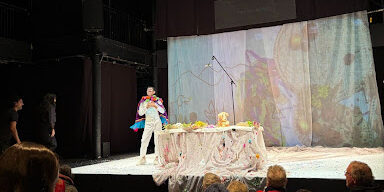
The audience takes their seats to face a mountain range of draped cloth. Snow-covered peaks are fluorescently lit. The stage lights dim to the sound of encroaching bells. A man in a vibrant purple shawl walks onto the stage, crouching surreptitiously behind the mountains. Tiziano Cruz’s Wayqeycuna has begun.
Wayqeycuna was presented in Canada at Theatre Passe Muraille on January 24 and 25, 2026, as part of the theatre’s fourth edition of the #BeyondTO Series, in Spanish with English subtitles. Following its Toronto run, Wayqeycuna went on to be presented at the PuSh International Performing Arts Festival in Vancouver in early February 2026.
Cruz is an interdisciplinary artist from the northern Argentinian province of Jujuy, nestled within the Andes. Wayqeycuna is the final installment of his trilogy Tres Maneras de Cantarle a una Montaña (Three Ways of Singing to a Mountain), a series that is at once a chilling critique of neo-colonialism, and an unfeigned homage to his Indigenous family history and his childhood amongst the mountains.
Wayqeycuna, in Quechua, translates to “my brothers and sisters”. What transpires is a poetics of naked grief and an ode to indigeneity, as Cruz navigates the passing of his sister. He stands on stage wearing a t-shirt printed with the words ‘THE GIRL WITH NO TEETH’, his sister’s alias within their community. Although little context is given regarding his sister’s death, little more is needed. Her toothlessness, her premature passing, gesture towards institutionalized poverty and the material consequences imposed on Andean Indigenous communities by decades of colonization.
Andean native communities have long been displaced by the influx of a white and wealthy population. Racial hierarchies became entrenched, casting indigeneity as synonymous with danger and deprivation in the colonial imagination. As for the province of Jujuy in particular, this area has been a target of mass lithium mining, leading to the pollution of local rivers and waterways. These histories echo as the English translation is projected behind the stage, while Cruz voices his community’s anguish:
‘Water carried away the hope of a better life. Politics is a matter of life or death’.
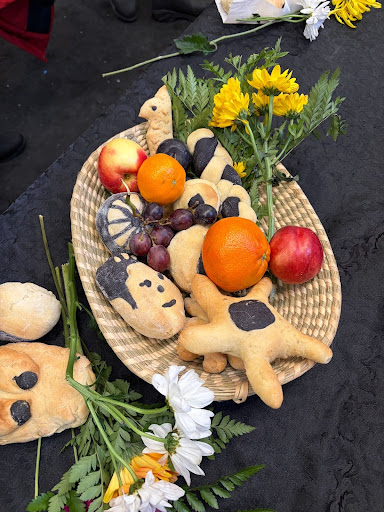
Throughout the performance, baskets of colourful arrangements line the stage. One can make out some flowers, some fruit and perhaps, some bread? These remain permanent fixtures until the performance concludes and Cruz invites the audience to distribute these baskets amongst themselves, each taking a piece of what is in fact bread, baked into the shape of animals, braids and faces. Take, eat, Cruz requests, positioning us within an ancient ritual of honouring the dead.
In many of Latin America’s Indigenous communities, these figurative breads are baked to honour loved ones and to celebrate their transition into the ancestral plane. Here, a moment of initial hesitation amongst this Canadian audience elapsed into a joyous and collective feeling. A confrontation of communal emotion in our neoliberal society: this grief exceeded private feeling, we celebrated Cruz’ love for his people, together.
Cruz’s performance circles a central tension: How Indigenous cultures fight to survive in a world built upon their erasure. In part of the performance a film is played, showing Cruz’ return to his home village of Santa Bárbara, Jujuy. He is walking with his father across a gently undulating green landscape. Both men are dressed in boldly-coloured shawls, embellished with fabric flowers – recall how Cruz first entered the stage in his purple attire.
The performance, as it is described by Cruz, was inspired by the “Quipu,” an Andean system of memory and knowledge-keeping through embroidery. The Quipu are famously difficult to decode, evading translation from colonizers despite such devices being stolen and reduced to museum artefacts. Similarly, the shawls that Cruz and his father are wearing hold a language of memories. Each colour represents a different family and each flower represents the misfortune or sorrows that the family has endured. When Cruz is dancing joyously at the curtain call, we see that dozens of flowers adorn his shawl.
Despite the pain, Cruz’s message is ultimately one of enduring love. His homage to his people, “the ones that always greet you” and to his homeland, “a land that speaks of me and gives me voice,” stays with you long after leaving the theatre. Through performance, Cruz resists institutional erasure and reclaims memory as a shared, living practice – one rooted in the Indigenous worldview of collaboration and continuity. His call extends beyond Jujuy, reaching Latin diasporas and Indigenous communities across the world: a reminder that those whose lives are shaped by displacement and erasure are not alone. The way forward will always be collective.
Support rabble today!
We’re so glad you stopped by! Thanks for consuming rabble content this year.
rabble.ca is 100% reader and donor funded, so as an avid reader of our content, we hope you will consider gifting rabble with a donation during our summer fundraiser today.
Whether it be a one-time donation or a small monthly contribution, your support is critical to keep rabble writers producing the work you’ve come to rely on as a part of a healthy media diet.
Become a rabble rouser — donate to rabble.ca today.
Nick Seebruch, editor