


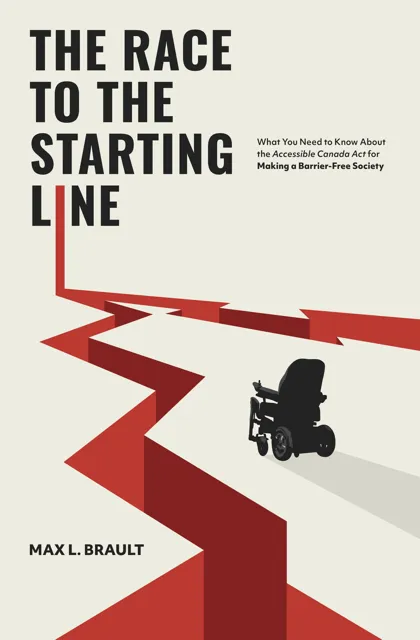
Activist/ consultant Max L. Brault’s The Race to the Starting Line, his account of the process that led to the creation of the Accessible Canada Act ( ACA) in 2019 and its implications for Canadians living with disability, is an important book about the flawed but still historic progress made in Canada since then.
Brault, who lives with a rare condition called spinal muscular atrophy, has been a federal civil servant and was one of the architects of the ACA. He currently works as a consultant to bodies interested in making their operations more open to people with various kinds of mobility and other challenges.
His book tells the ACA story in competent, lucid prose, which is in itself a victory over the turgid language usually found in government and NGO circles, and is a valuable resource for anyone interested in human rights in Canada.
In a recent online interview, Brault introduced himself thus:
“So as a young man, when I first started this journey around 40 years ago, I realized with having spinal muscular atrophy, which we commonly call as SMA, I realized I was going to be entering into a workforce with the world that’s not prepared for people with disabilities. So at first, I chose to take the entrepreneurial route, which most of my family was, in an entrepreneurial spirit, and then eventually working with disability organizations, getting into the federal government and helping to influence a lot of key people to look at people with disabilities as a particular angle for dealing with the unemployment that’s been happening around the country, that there’s a lot of talented people with disabilities, and I was helping the Federal Government and hiring a lot of people with disabilities, and then moved into changing policies and all that kind of fun. At the very end of my term in the federal government, I ended up working on something called Bill C 81 and I worked about four years on that particular front, which would end up becoming the accessibility Canada Act. And then I left there, and I went and worked for the, what I jokingly say the dark side. I went and worked for corporations, for BDO Canada at the time, and learned how to be a consultant, and took everything I learned from being a federal public servant and created a very successful business line with BDO Canada.”
There is an enormous need in Canada for the kind of practical work that Brault has done. According to Stats Canada, 27 per cent of all Canadians over 15 have at least one disability- about eight million of us.
The Stats Can report goes on to note that “…Disability rates increased with age: one in five (20%) youth aged 15 to 24 years had one or more disabilities in 2022, compared to one in four (24%) adults aged 25 to 64 years and two in five (40%) seniors aged 65 years and over.”
I first became aware of the problems faced by people living with disabilities when I spent 20 years driving a HandyDart vehicle in Vancouver, providing transit services to folks who could not use public transit because of the challenges they face.
One of my regular passengers in those days cheerfully referred to the so-called “able bodied” as the “future disabled.” She was right. Although the bias against those living with disabilities works to make them invisible, they are everywhere, and they represent our collective future. The argument for supporting the kinds of reforms that Brault has spent his life advocating is not only one from human decency and solidarity. It is enlightened self-interest for us all.
The goal set by the ACA was to see Canada barrier free and accessible to all by 2040. The act and its ambition built on earlier progress. The Charter of Rights and Freedoms, in 1982
was the first government document in the world to explicitly protect the disabled. Its language in section 15 clearly states that Canadians should not face discrimination on the basis of disability. In 1983 the United Nations announced a Decade of Disabled Persons. In 2020, the UN updated its Convention on the Rights of Persons with Disabilities (CRPD) to denounce the involuntary detention and drugging of “mental patients “ as torture. To its shame, Canada has refused to recognize this human rights abuse and many Canadians still experience the agonizing impacts of this torture.
This failure to reform abuses against those viewed as psychiatric patients is not the only way that Canada has failed the promise of the ACA. Too many “disabled” Canadians still faced discrimination and obstacles to mobility and access across the country, and, as noted, some are tortured by involuntary psychiatric confinement and treatment- the torture the UN has denounced.
To add insult to injury, the first cabinet formed by our current prime minister did not even include a minister responsible for people with disabilities. This effective demotion of the issue to less than ministerial status was properly denounced by disability activists. One, disability rights professor David Lepofsky told the CBC
“For the prime minister to do this is a real slap in the face to eight million people with disabilities in Canada,” he said. The move signals to people with disabilities that they are not a priority.
Brault’s book reminds us of the role of grass roots organizing in driving reforms, and of the limits of reform. He reminds us too of the crucial importance of the principle “Nothing about us without us.” Highly recommended
Support rabble today!
We’re so glad you stopped by! Thanks for consuming rabble content this year.
rabble.ca is 100% reader and donor funded, so as an avid reader of our content, we hope you will consider gifting rabble with a donation during our summer fundraiser today.

Whether it be a one-time donation or a small monthly contribution, your support is critical to keep rabble writers producing the work you’ve come to rely on as a part of a healthy media diet.
Become a rabble rouser — donate to rabble.ca today.
Nick Seebruch, editor
