

Auden got it right in his searingly powerful poem September One, 1939.
Those who survive great evil are, all too often, the next generations of perpetrators. Victimization does not guarantee sound morals or improved behaviour on the part of the victims.
Two heart-scalding examples (out of many) come to mind: First, the ship loads of pilgrims who arrived in North America fleeing religious persecution and promptly began persecuting others for their differing faiths and stealing the lands of the continent’s original inhabitants. Second, some survivors of the Nazi Holocaust settled in Palestine after World War II under Zionist leadership and imposed an ethnic cleansing attack (known as the Nakba, “the catastrophe” on the territory’s indigenous Palestinians, an attack that has persisted for over seven decades and is in full malevolent flower today. News feeds around the world show us every day the murderous attacks on Palestinians in Gaza and the West Bank by the Israeli “Defense” Forces and heavily armed settlers.
People of conscience who oppose this bloody genocidal violence are frequently accused by supporters of the Israeli state of being antisemites or, depending on their own ethnic background, “self-hating Jews.” Israel, these pro-Zionist voices insist, has the most moral army in the world and any violence against Palestinians is, by definition, self defense, and hence acceptable. It all started, they say, willfully erasing decades of history, with the Hamas led attacks on October 7, 2023.
This duplicitous and a-historical Zionist apologia is voiced not only by the Israeli state and its proxies, but also by the Western nations, including the US and Canada. that prop-up, arm, rationalize and finance the Nakba-state of Israel and its current anti-Palestinian genocide.
On July 13, 2025, Al Jazeera reported that Gazan health authorities were reporting over 58,000 Palestinian deaths during the current attacks, a number that is probably a dramatic underestimate. The prestigious medical journal The Lancet has estimated that official figures from Gaza probably undercount war casualties by a factor of 40 per cent. No matter whose figures you use, that’s a lot of dead Palestinian civilians and children! Their deaths and the ongoing agony of the survivors under Israeli bombs present a moral challenge to us all.
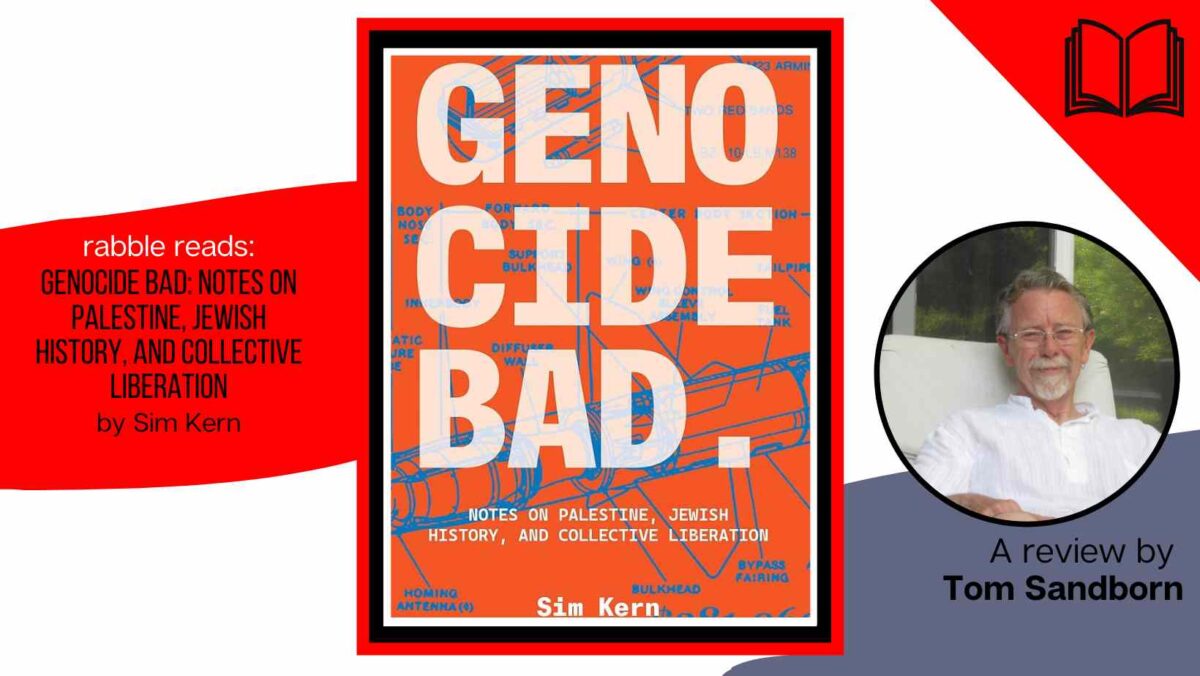
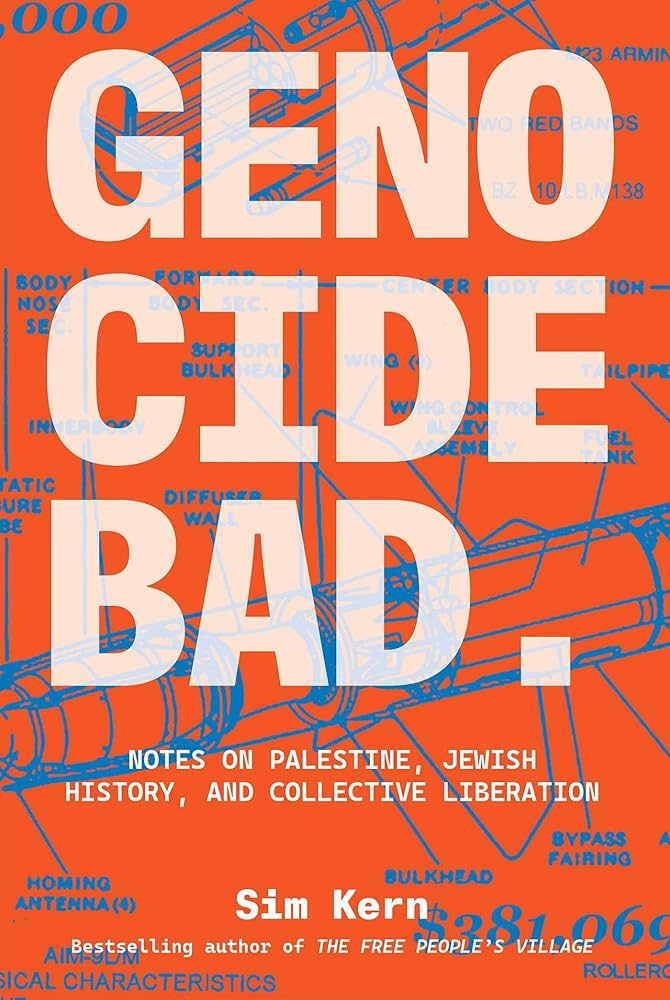
Sim Kern’s new book, Genocide Bad is a brave, lucid and well written response to that challenge. Kern, who is of Jewish descent, first came to public attention as an author of science fiction and an online influencer fighting antisemitism. Their commitment to fighting racism has led to a critical view of Zionism and an active role in supporting its Palestinian victims.
The debates about Palestine do not necessarily bring out the best in writers who try to address these fraught and painful issues. Too often, on all sides of the debates, we hear far too much strident certainty and anger, and far too little self-reflection and humor. Kern is a remarkable exception. They are unrelenting in making criticisms of Israel and its supporters, but also honest about their own personal failings as an activist and seldom miss an opportunity for humor. Kern’s tone is charming and conversational (no doubt reflecting an extensive career in online educational videos), witty and self-effacing, without ever falling away from the moral clarity and demand captured in their book’s title. Genocide is bad, and it is being committed in Palestine, and we all have a moral responsibility to speak out against it, especially those of us who live in Western comfort and privilege while our tax dollars support the deaths of Palestinian children.
Think of this remarkable and important book as an introduction to the problem of white settler colonialism on Palestinian land, and as a point-by-point refutation of the main claims of Zionist Hasbara (propaganda). Kern responds to nine main contentions of the apologists, ranging from “Who are you to speak on Israel?” to “But the Holocaust” to “But Hamas” to the old chestnut “Criticizing Israel is antisemitic.” To each of nine such arguments Kern provides eloquent and compelling responses. If you are new to the issues involved, this is a wonderful introduction, and even if you have spent a lot of time and energy trying to understand the tragedy, this book will teach you things you didn’t know. Kern also recommends a rich list of books and articles by Palestinians, whose voices, Kern properly believes, should be centered in any debates about their land and future.
One of the Palestinian works Kern commends to our attention is Rashid Khalidi’s The Hundred Years’ War on Palestine: A History of Settler Colonialism and Resistance, 1917-2017, reviewed in these pages last year. I echo Kern’s admiration for this magisterial history of Palestine and urge all readers to check it out. Here is a taste of Khalidi at his best, speaking to Jacobin Magazine:
“Changing the demographic balance in Palestine in favor of settlers, at the expense of Palestinians, has always been the intention of the Zionist project — from Herzl, through [Chaim] Weizmann, up to Ben-Gvir — not to create a bi-national state. The conviction of those early Zionists was that Europe would not let them live in safety. Their vision of a Judenstaat required a demographic transformation. A process of ethnic cleansing, of squeezing the indigenous population into smaller and smaller areas, similar to what happened in Ireland under Oliver Cromwell or with the Indian reservations in North America. That’s what’s attempted here.”
The Israeli human rights organization B’Tselem has worked to lift up Palestinian voices. Here is a selection of those vital quotes
Another group that highlights the voices of Palestinians is Connect Gaza. On their website you will find many accounts of life under genocide, and opportunities to donate direct aid to families in Gaza. You can also sign up for their informative newsletter. (Full disclosure. This organization is led by a group that includes my friend Rabbi David Mivasair and my son Jesse Frank, and I am a supporter of their work.)
A final and important note about Genocide Bad. In addition to its many virtues as a primer on Gaza and genocide and a link to pro-Palestinian voices and organizations who could use our support, this book also includes a generous and hopeful essay on the connections between ending genocide in Gaza and the larger project of collective liberation for all. At a time when authoritarianism is on the rise globally, usually fueled by various forms of racism, Kern’s adamantine commitment to collective liberation is a welcome reminder that we are all in the same boat, and some days our fragile vessel seems to be sinking. There is still hope, but it will take enormous collective work and commitment to realize that hope.
To give Auden a last word, he tells us in the poem cited at the head of this review that “We must love one another or die.” Add to that the wisdom of American philosopher Cornell West, who tells us “Justice is what love looks like in public, just like tenderness is what love feels like in private,” and we have some guidelines about how to respond to the daunting challenges we face. We all need to keep paddling and bailing, as Kern’s wonderful volume reminds us.
Support rabble today!
We’re so glad you stopped by! Thanks for consuming rabble content this year.
rabble.ca is 100% reader and donor funded, so as an avid reader of our content, we hope you will consider gifting rabble with a donation during our summer fundraiser today.

Whether it be a one-time donation or a small monthly contribution, your support is critical to keep rabble writers producing the work you’ve come to rely on as a part of a healthy media diet.
Become a rabble rouser — donate to rabble.ca today.
Nick Seebruch, editor
