

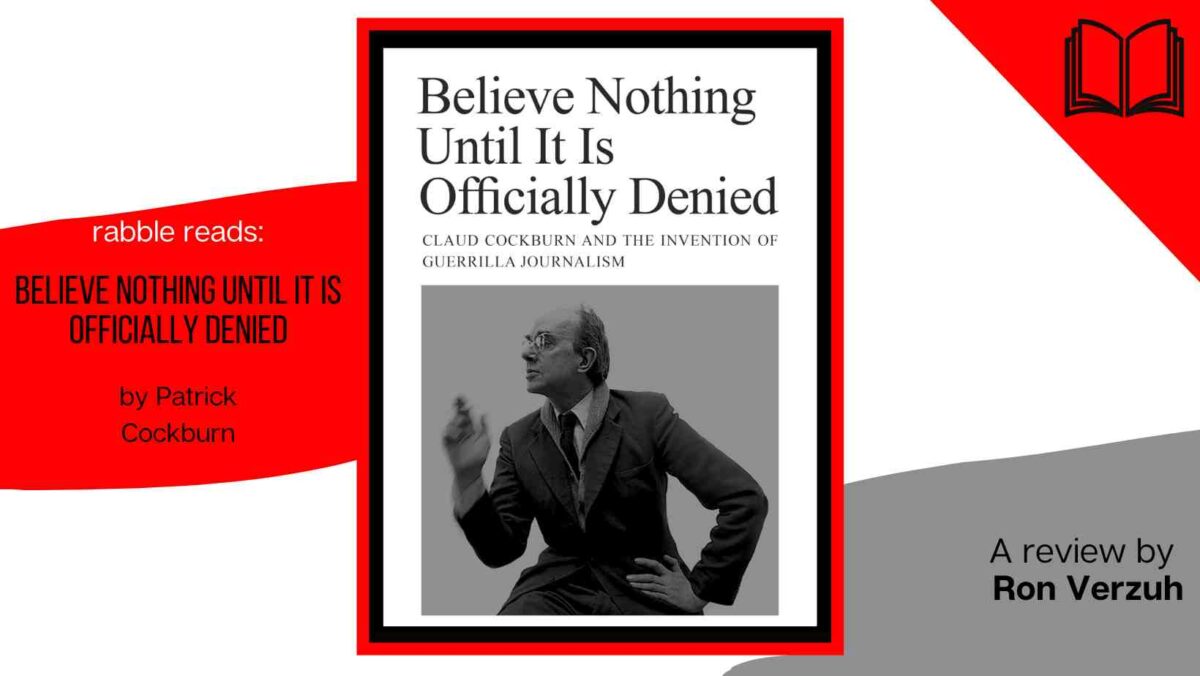
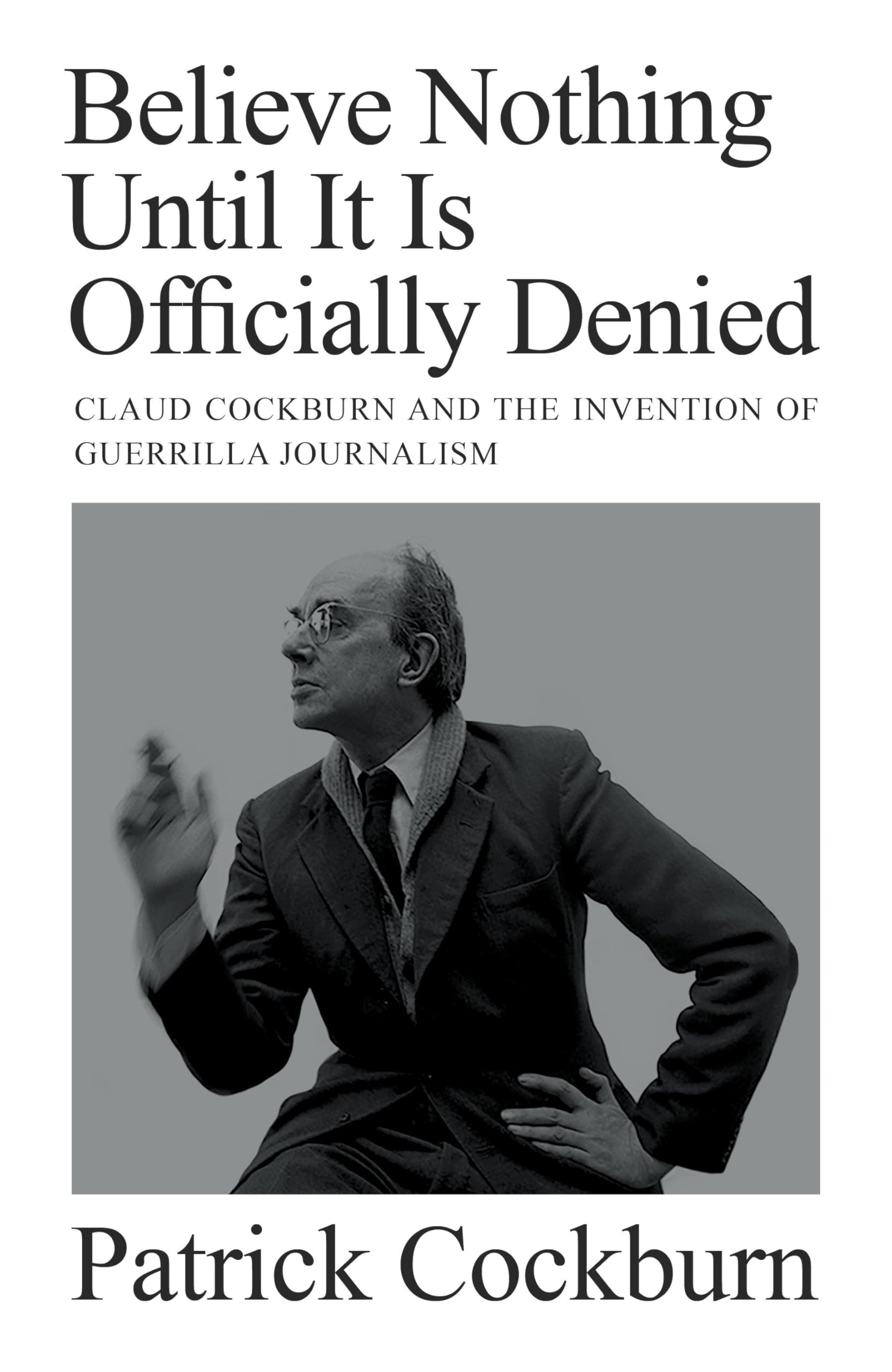
Chances are you’ve never heard of Claud Cockburn and yet he was at the inside edge of some of the most cataclysmic events of the 20th century. Long before Woodward and Bernstein of Watergate fame, the British muckraker set the bar high on investigative reporting aimed at taking down the bad guys. That Cockburn is fully revealed here by his youngest son Patrick.
Cockburn was perhaps best known for founding The Week, a small but influential London newsletter, a few months after Adolf Hitler took power in 1933. Disgusted with the appeasement attitude of his former employer, The Times of London, he began to wage his private information war against the Nazis and fascists that were about to blitzkrieg Europe.
Believe Nothing offers some of the same irreverence that made Cockburn’s reporting so valuable to the world of investigative journalism decades ago. I respected the end result, occasionally power shaking, but I also enjoyed this glimpse into the sometimes unconventional antics of the man. Cockburn was a one-of-a-kind writer that I admire and for me the book only adds to his appeal as a journalist who held strongly to his principles and his politics. As an added bonus, son Patrick doesn’t shy from providing a candid portrait replete with all his father’s oddities and idiosyncrasies. For those, like me, who remember the post-Watergate demise of exposé journalism, this is a reminder of what is missing in today’s social media frenzy.
During the 1920s, Times assignments in Europe and the United States had sharpened his reportorial skills and his hunger for the scoop. Both were essential if The Week was to survive in the competitive pre-television news world. It was a one-man show that gave him a platform to be “untiringly combative, never admitting defeat and convinced that, even if the powers that be were momentarily victorious, their excesses might be curbed and their self-confidence punctured if they knew they were in for a fight.” This became his reporting credo and he followed it into endless battles with “arbitrary power.”
He came by his combativeness from his father Henry who encouraged his children to engage in intellectual exchanges as if they were adults. He was a diplomat in Beijing during the anti-foreigner Boxer Rebellion around 1900. Claud was born in Beijing in 1904 but was soon sent back to England with his Chinese amah. Henry, a.k.a. “China Harry,” was sent to the more dangerous Korea which the Japanese occupied as a result of the 1904-1905 war with Russia.
He attended public school under the guidance of headmaster Charles Greene, father of novelist Graham Greene, who became Claud’s schoolboy friend. They also entered Oxford together in the early 1920s where Cockburn was often visited by his cousin novelist Evelyn Waugh.
A Europhile from an early age, Claud would later roam the continent living in Paris, Budapest, Prague, Vienna and Berlin where he enjoyed the lingering fin de siècle good times followed by the post-war zaniness that many of us saw portrayed in the TV series Babylon Berlin. Joining him was Greene who later became the great spy thriller novelist. Both young men got involved in several escapades while at Oxford. One took them to eastern Europe on a personally financed study of the effects of the Treaty of Versailles on the vanquished states. “Claud was already sympathetic to people from the defeated powers,” his son Patrick writes. He viewed them as “victims of collective punishment unjustly inflicted by the victorious.”
It was a view he eventually abandoned when he landed a job at the Times office in Berlin and began to witness firsthand the rapid rise of Nazism among those he once thought deserved his sympathy. In debt and uncertain how to get out of it, Claud surfaced in the German capital as an assistant to the Times correspondent. The pay was low but he had won a travelling fellowship from Queens College Oxford to supplement his income.
The Times job gave him access to “the upper strata of German political life” at a time when the Weimar Republic was disintegrating. It was also tailormade for a young man thirsting for a scoop. One came with a disastrous flood in Saxony. Claud was the sole eyewitness reporter to file an account.
He had found his journalist’s legs, or rather his typewriter keys, but by the late 1920s he was whetting his appetite for freelance journalism, publishing articles in The Dial, a popular New York literary magazine of the day. He would even freelance to Forbes, the business magazine.
Berlin opened many doors, including that of an artist’s retreat set up by a Jewish philanthropist. At that time, he met Madame T., a sobriquet for Berta Polz, a young revolutionary who heavily influenced the young journalist. He immersed himself in communist literature and eventually joined the Communist Party of Britain, but first New York beckoned and a new job as assistant correspondent with the Times, a newspaper he once called “the best newspaper in the world.”
As he watched Wall Street collapse and the Depression quickly enveloped the world, Claud learned some journalistic basics from senior Times reporters. “I think it well to remember that when writing for the newspapers,” cautioned William Lewis, “we are working for an elderly lady in Hastings who has two cats of which she is passionately fond. Unless our stuff can successfully compete for her interest with those cats, it is no good.” It was a lesson in journalism that Cockburn never forgot. Lewis also advised him “not to take a square meal entirely for granted.” Still in debt from his Oxford days onward, and sometimes scrambling for his supper, Cockburn would come to understand the advice intimately.
While in the U.S., he interviewed the gangster Al Capone, but decided not to submit his piece, arguing that Capone was “a murderous buffoon whose views he saw no reason to publicize.” He had come to America “to see if its version of capitalism made Karl Marx irrelevant and social revolution unnecessary.” He concluded that it did not as he watched the Depression ruin lives.
By 1931 he had recrossed the Atlantic. Two years later, another buffoon, clawed his way into the German Chancellor’s chair, summoning Cockburn to journalistic arms back in Europe. His resignation from the Times was difficult but he had realized that his politics were moving in exactly the opposite direction, for the newspaper had subscribed to British Prime Minister Neville Chamberlain’s appeasement strategy. Cockburn needed his own “pirate craft” to use as “a pistol firing back at the heavy artillery of the rich and powerful.” For the foreseeable future he aimed his “one-man band” at fascism.
Matching Cockburn’s path, both as a skilled mainstream reporter during the Depression, then a blacklisted one during the Cold War, was American muckraker I.F. Stone. His Weekly played a similar role to The Week. Both publications offered readers raw, hard-hitting investigative journalism that favoured no newsmaker and dug dirt on anyone who happened to be dirty. “All governments are run by liars and nothing they say should be believed,” Stone said and Cockburn concurred.
He struggled to build a small but influential subscription list of diplomats, disaffected politicians and well-placed sources that soon allowed him to break major stories, as he kept tabs on fast-moving Nazi crimes against Jews, communists and anyone who questioned the Fuhrer’s authority. Then came the Spanish Civil War in 1936.
Many big-time writers got involved. Ernest Hemingway and Martha Gellhorn were prominent American names. So was John Dos Passos. Ted Allan, Dr. Norman Bethune’s assistant, was from the Canadian side. On the British side, George Orwell stood out. And somewhere in the body-strewn cow paths of rural Spain or the blood-stained hills around Brunete near Madrid, we find Cockburn, portable typewriter clacking away, ducking for cover as he reported on the war for the communist Daily Worker under the nom de plume Frank Pitcairn.
Pitcairn was a good fit for the moment since he had joined the party, seeing it as “the one serious political movement with the commitment and organization capable of fighting” the Nazis with any hope of success. Using the Pitcairn byline, he would write a book called Reporter in Spain at the party’s insistence.
With Cockburn in Spain was Jean Ross, his friend, sometime lover and news associate reporting on the war for The Week. Ross was the model for novelist Christopher Isherwood’s cabaret dancehall girl Sally Bowles in Goodbye to Berlin, and then for Truman Capote’s Holly Golightly in Breakfast at Tiffany’s. Finally Liza Minelli played her in the 1972 Bob Fosse film Cabaret. But was Ross really Isherwood’s care-free, apolitical, free-loving woman of fiction? No. We learn that she was a politically savvy Nazi fighter who married Cockburn in 1939 and had a child by him.
All wars are information wars intoned Cockburn, “since people who are trying to kill each other will not hesitate to tell lies about each other.” Among the most vulnerable were the war photographers Cockburn worked with on the ragged front lines. Gerda Taro, for example, was a 26-year-old German Jew who joined two others to invent the collective name Robert Capa. In this way, they were able to charge much more for their combat photos. The book does not mention the celebrated Hungarian-America war photographer Robert Capa. Perhaps Cockburn’s friend was riding on the coattails of the more successful photog?
When the civil war ended in 1939, Cockburn jumped into the fray at home with his usual adventurous spirit. His exposure of Lord and Lady Astor and the pro-appeasement group known as the Cliveden Set was a major scoop that also tainted the Times editor, Cockburn’s former boss, and other elite Britons. “The reputation and political influence of the Astor family never recovered from Claud’s attack on them,” Patrick writes.
A second target of attack was Joachim von Ribbentrop, Hitler’s ambassador to Britain. Cockburn viewed him as heartless, writing “What was terrifying about this man was that he was a damn fool – and could only be employed by a regime of, basically, damn fools who could blow up half the world out of sheer stupidity.”
Dodging Nazis, pro-appeasement advocates and spies at MI5, who called his reporting the “Cockburn Machine,” he would also find himself on the outs with the ever-more-controlling communist party. At one point, they tried to get him fired from the Daily Worker for failing to adhere to the party line as dictated by Soviet leader Joseph Stalin.
Early in the war, when Stalin signed the non-aggression pact with Hitler, it “effectively dynamited everywhere all the Popular Fronts, the vague but comforting alliance between Reds and the anti-Nazi Conservatives” that Cockburn had supported. He transferred his support to General Charles de Gaulle in London and backed the Free French underground.
When the war ended, he settled into his third marriage to one-time geographer Patricia Arbuthnot, moved to Ireland and raised sons Alexander (The Nation), Andrew (Harper’s) and Patrick (The Independent), journalists all. He tried his hand at fiction in the 1950s with the novel Beat the Devil which Hollywood director John Huston made into a film starring Humphrey Bogart. But his journalism days were not yet over. His best friend Malcolm Muggeridge hired him at Punch. So did Richard Bennett at Lilliput. He also produced a series for Richard Ingrams at Private Eye on spying and the private lives of politicians. The series hit newsstands at about the time of the Profumo sex scandal that brought down the Conservative government in the early 1960s.
The Week was long dead by then, but these publications allowed Cockburn to follow his two core beliefs. First was skepticism about all authority. Second, he thought decision makers “were weaker, more incompetent, more divided, more self-destructively corrupt than they like people to understand and hence more vulnerable to journalistic attack.”
Claud Cockburn seized every chance to expose that hypocrisy. Some people may have seen his work as “romantic knight-errantry on behalf of the poor and needy,” Patrick writes, “but he had very practical ideas about how information wars might be fought and won.” He died in 1981, after suffering for many years from advanced Tuberculosis.
As I watch the mass media owners of today capitulate to Donald Trump, with his chants of “fake news” and his demands for abject obedience, I see the even greater need for the journalistic guerrilla warfare Cockburn practiced so fearlessly. The book documents Cockburn’s method impeccably. He had no time for his critics, saying “I can write. They can spit. Let us see which is more effective.” Nor did he have time for the axiom about speaking truth to power. “Much more effective, he believed, is to tell truth to the powerless so they have a fighting chance in any struggle against the big battalions.”
Support rabble today!
We’re so glad you stopped by! Thanks for consuming rabble content this year.
rabble.ca is 100% reader and donor funded, so as an avid reader of our content, we hope you will consider gifting rabble with a donation during our summer fundraiser today.

Whether it be a one-time donation or a small monthly contribution, your support is critical to keep rabble writers producing the work you’ve come to rely on as a part of a healthy media diet.
Become a rabble rouser — donate to rabble.ca today.
Nick Seebruch, editor
