


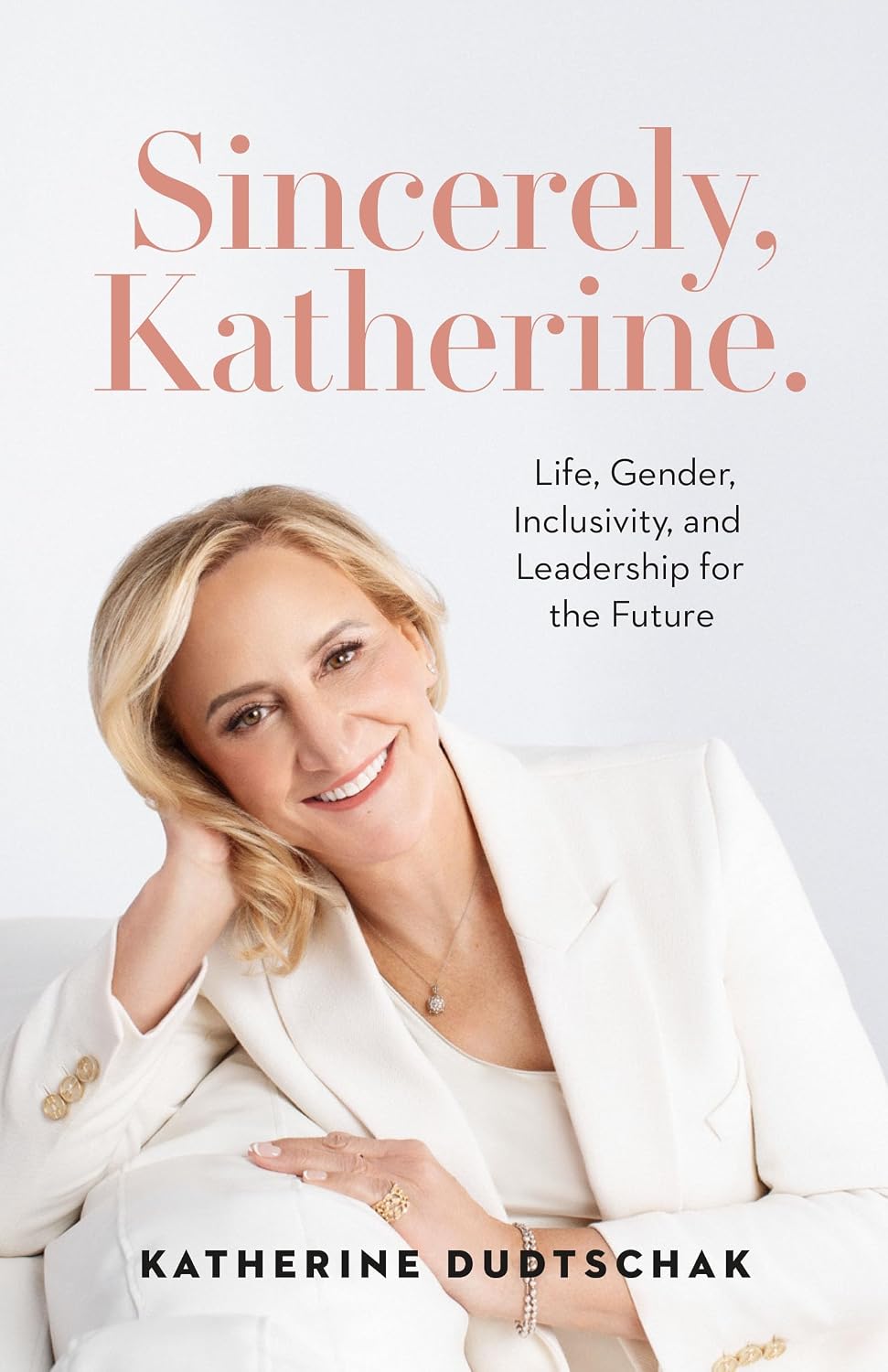
She was always Katherine Dudtschak or Katie at heart, but it took her five long and arduous decades to recognize who she really was and find ways to affirm that identity.
Her assigned gender at birth was male, and growing up in a wounded working class family in rural Ontario, she learned to repress her sense of being different and to perform social masculinity persuasively. Her performance of masculinity meant, among other things, drinking beer with the boys and riding snowmobiles, marriage to a woman and a successful career with one of Canada’s largest banks.
It was only when she saw a poster about gender inclusivity at her daughter’s college dorm that she began a long process of exploration that freed and affirmed the woman she had always been internally. (Katherine notes that although she sometimes uses the term “transgender” in her book, her preferred term is “gender affirmation, “which better reflects her sense of having always been a woman living in masculine disguise. She didn’t so much transition as affirm what was already her truth, she argues.)
Sincerely, Katherine tells the story of the author’s path to affirmation and some of the steps she has taken in her new public and private life as Katherine.
At a time when many loud.poisonous and influential voices around the world are promoting hatred against trans people and their rights to medical treatment and full participation in public life, (looking at you, Fox News, MAGA Republicans, the BC Conservatives and your whole squalid global gang) it is important to be reminded of their full humanity and for us all to stand in solidarity with those being attacked. We must oppose the political opportunists who are trying to lift their boats on a flood of hatred. This lucid, well written book contributes to that vital call to solidarity. We should all be listening.
The rising tide of anti-trans hate has real life and death consequences. According to one Canadian source two out of three trans kids between 14 and 18 have considered suicide. The lifetime prevalence of attempted suicide for trans people is estimated to be between 32 per cent and 41 per cent. From 2016-2023, police-reported hate crimes motivated by sexual orientation have increased a staggering 388 per cent. As noted by Statistics Canada, police-reported hate crimes have risen sharply for the third time in four years.
It is important to remember when dealing with police report statistics that it is almost certain that they represent an undercount of the actual levels of violence, due to many survivors’ well merited skepticism about whether the policeman is truly their friend.
Marginalized groups need more enforcement of basic safety protections, as these figures demonstrate, and trans people need access to appropriate gender affirming medical care.
An American study found a 73 per cent decrease in suicidality among transgender youth and non binary youth who receive gender affirming care, the kind of care that Katherine was able to access and transform her life, and the kind of care that is currently criminalized in 13 countries, 27 US states and in Alberta and Saskatchewan. Katherine had some advantages in her self discovery and affirmation, advantages she is quick to acknowledge. Her immediate family was supportive, which is not the case for many.
One of the most moving passages in her book recounts the scene when she and her then wife told the grown children about Katherine’s impending changes. Both daughters were matter of fact and accepting, with one asking what pronouns Katherine wanted to use now, and the other asking for reassurance that she and Katherine could still ride snowmobiles together!
Another moving passage tells the story of Katherine coming out to her superiors at the Canadian bank where she had been a highly successful executive leader, and to her tens of thousands of colleagues she supervised. Both leadership at the bank and her colleagues were accepting and warmly supportive. And because Katherine had climbed the corporate ladder, she had financial resources that made the process much easier, which she also acknowledges.
She has clearly found ways to leverage her privilege to support others going through the transformations she experienced, and to speak out in favour justice and environmental sanity. This is, in many ways, the record of a life well lived and full of genuine compassion and service for others.
Even with all her class privilege, family and corporate support, bringing her identity as Katherine out into the world had its anguish and obstacles, difficulties that would have been compounded if she had been-non white or poor.
And that leads me to my only real criticisms of this otherwise moving, smart and important book. One is a question of tone and the other a matter of substance. On tone. Some readers may find Katherine’s tone occasionally over earnest and too inflected by therapy and spirituality talk, with a few too many slogans. This may be off-putting for some readers, but it would be a mistake to let an occasional tonal lapse shape your response to the many important human values and issues Katherine espouses. Read on and learn.
My caveat about substance is perhaps best captured by Katherine’s invoking with approval the motto that “the market is always right,” and suggestion that because of the flexibility of business, which can “turn on a dime,” the business sector is the best advocate for sustainability and gender justice. This makes sense in the context of Katherine’s own positive coming our experience with her big bank employer, which occurred at a time when many business leaders championed the rhetoric of inclusion and diversity, largely influenced by grass roots activists and by courageous advocates like Katherine inside corporations leadership and much to the dismay and frenetic rage of the racist and sexist right. But we are now seeing too many big corporations “turning on a dime” to surrender to anti diversity rhetoric and policies.
We cannot count on business leadership, no matter how temporarily enlightened, to guarantee justice or to protect the precious and threatened environment that Katherine so clearly loves. Katherine’s promotion of business as the main agent of sustainable change rings a bit hollow in the context of the daily news, which too often these days brings accounts of big business oligarchs lurching to the right on crucial issues to curry favour with bigots and polluting industries.
This book provides an important and moving story of one human life in transformation, but we may need to look elsewhere to develop public movements, tactics and policies that make the anguish the author lived with and triumphed over less hurtful to the next generations.
Nonetheless, I urge you to read and engage with this important book. It is full of human wisdom and compassion, and in these often evil times, we can use all of that we can find.
Support rabble today!
We’re so glad you stopped by! Thanks for consuming rabble content this year.
rabble.ca is 100% reader and donor funded, so as an avid reader of our content, we hope you will consider gifting rabble with a donation during our summer fundraiser today.

Whether it be a one-time donation or a small monthly contribution, your support is critical to keep rabble writers producing the work you’ve come to rely on as a part of a healthy media diet.
Become a rabble rouser — donate to rabble.ca today.
Nick Seebruch, editor
