

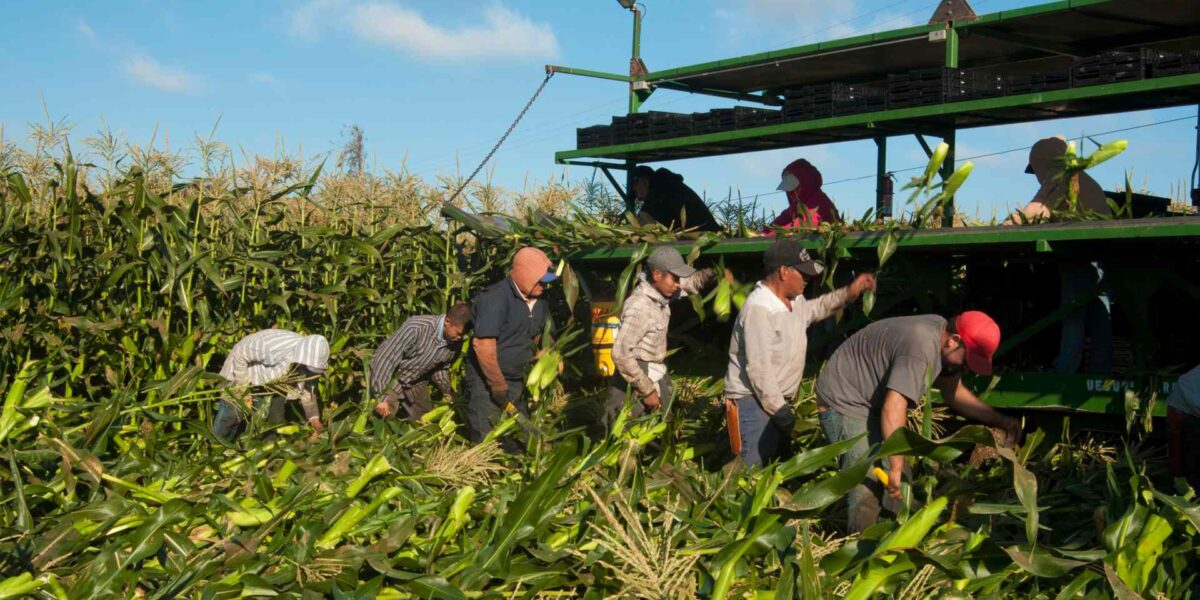
They come to Canada to harvest our crops, tend our children and elders and work the hardest jobs in the country. Then we throw them away like garbage.
For far too long the Canadian ruling class has used temporary foreign workers like spare parts for their profit-making machine. Employers import these workers when it suits their business plans and heartlessly discard them when their reptilian bottom-line calculations suggest cutbacks. The Canadian economy, built on stolen Indigenous land and powered by worker exploitation, has been particularly brutal in its treatment of these disposable human spare parts.
Recently, there has been a spate of mainstream media attention to refugee and immigration issues, but most of that coverage in the mainstream press has amounted to debates about setting caps and limits for how many temporary slaves Canadian business can most profitably import and then discard. (The United Nations has called Canada’s temporary foreign worker regime “modern slavery.”)
The real human rights and human decency arguments against our current system are noted, if at all, parenthetically in the mainstream media, and most of the “reforms” implemented by government cut against the interests of workers. Instead of fretting about profit levels and desirable levels of exploitation, as Canadians we should be worried about the moral bankruptcy of our refugee, immigration and Temporary Foreign Worker (TFW) regimes.
According to the Library of Parliament’s blog Hillnotes: “ Since 28 June 2002, the Minister of Citizenship and Immigration is required to table an annual report to Parliament on the immigration initiatives and actions of the previous year. The report to Parliament must also set the department’s targets for the number of immigrants to be admitted to Canada the following year. The targets for the second and third years are forecasts and can be adjusted in the following year’s plan when the next report to Parliament is submitted.”
In 2024, for the first time in over two decades of reporting to Parliament, the Minister of Citizenship and Immigration posted targets for admissions that were significantly lower than those posted in previous years. As the Hillnotes blog reports: “In the previous two plans, a target of 500,000 new permanent residents was set for 2025, and in the 2024–2026 plan a target of 500,000 new permanent residents was established for 2026. However, the 2025–2027 plan reduced these targets to 395,000 (a drop of 105,000) for 2025 and to 380,000 (a drop of 120,000) for 2026. This plan also sets a target for 2027 of 365,000.
These cuts take place against the backdrop of a global swerve to the right, with wannabe autocrats like US president Donald Trump and Hungary’s prime minister Viktor Orban inflaming anti-immigrant sentiment as part of their toxic populism. And yet much of the world economy depends on super exploitation of often racialized foreign workers.
The Economist Magazine notes: “ The number of short-term visas offered to working migrants rose by nearly 1m between 2014 and 2023, to 2.5m, with no sign of slowing.”
So, there is a tension between the hatred and fear of the Other promoted by this era’s right-wing populism and the way that the economy’s profits are supercharged by the savage exploitation of that same Other. Within the jaws of that contradiction, innumerable human lives are crushed. Canada’s most recent budget and the recently announced cuts in immigration targets represent those jaws closing against our sisters and brothers who might want to come to Canada.
On November 4 of this year, the Migrant Rights Network responded to the closing of the jaws saying: “— Budget 2025 and the accompanying immigration levels plan represent a retreat from Canada’s humanitarian obligations and a doubling down on the scapegoating of migrants for the housing and affordability crises.”
“By not increasing permanent residency targets, Budget 2025 continues to deny rights and protections to the people who sustain our communities and who are already living and working here,” said Syed Hussan, spokesperson for Migrant Rights Network. “The government is slashing refugee spots by over 10,000, cutting international student numbers in half, and introducing co-pays that will deny refugees basic healthcare—all while keeping migrant workers trapped in conditions the UN has characterized as modern slavery.”
“While permanent residency targets remain at 380,000, this represents only a fraction of the 3 million people currently in Canada on temporary permits,” his statement goes on to read. “The vast majority are excluded from equal rights and protections because they do not have PR ( permanent residence status), creating a two-tier system that facilitates labour exploitation. Rent inflation went up 4.5% year over year, despite a massive reduction in study permit in 2023 and 2024 – but the federal government continues to cut study permit spots further.”
Organized labour in Canada has a mixed record on treatment of refugees, immigrants and TFWs. Too often in the past we have been encouraged to see foreign workers as our competition, and to buy into ruling class narratives that blame new arrivals for housing and affordability crises that are really caused by government policies and the brutal logic of capitalism.
But we also have an honorable record of speaking out for human rights and extending protection to all who work in Canada and around the world. That part of our tradition should prevail in the current crisis. Let’s redouble our efforts against attacks on immigrants. A basic reform advocated by many immigrant and human rights groups is “status for all.”
This would end the most poisonous elements of current policy, the regulations that tie temporary workers to specific employers, increasing their vulnerability while denying them a path to permanent residence and, if they choose, Canadian citizenship. That is a reform of the system we should support.
Support rabble today!
We’re so glad you stopped by! Thanks for consuming rabble content this year.
rabble.ca is 100% reader and donor funded, so as an avid reader of our content, we hope you will consider gifting rabble with a donation during our summer fundraiser today.

Whether it be a one-time donation or a small monthly contribution, your support is critical to keep rabble writers producing the work you’ve come to rely on as a part of a healthy media diet.
Become a rabble rouser — donate to rabble.ca today.
Nick Seebruch, editor
