

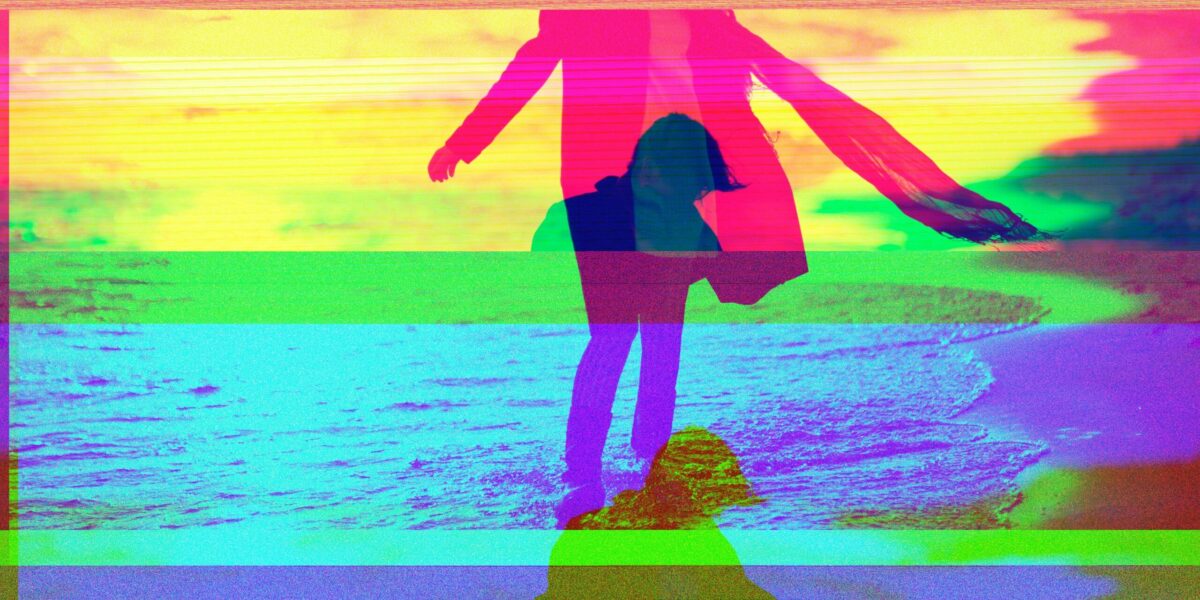
It began with a desire to avoid joining the ranks of the dead. Lying alone on my bed one night, aware that I could choose either to die as a man or to live as a woman, I chose to live.
There are some moments in life that bring into focus the choices—not all of them one’s own—that gave rise to one’s present circumstances: the death of a loved one, the birth of a child, and the joining of two lives in marriage, to name just a few of the more obvious examples. These milestones, not all of them celebratory, are markers on the path of life, each figuring, in its own way, the unrelenting passage of time and the inevitability of loss that one experiences along the way.
It is because I know that we must, each one of us, one day venture alone into death’s domain that I throw myself into my fiancé’s (soon, spouse’s) arms while life still affords me the chance. It is because I watched my father die in the cold, pale light of an ICU that I take a certain delight in those days during which I can stand in the sun.
The choice to transition my gender is, too, one that I make in the long shadow of loss: the loss of friends and family, to be sure, but also the seeming inevitability of my own early demise through the slow destruction of the person that transphobia effects. There is an arc to the transgender life, the conventional narrative tells us, and it bends towards death.
Perhaps that is why, each day, I choose to live. Perhaps that is why, each day, I choose to be trans.
A legacy of loss
“There is,” literary theorist Henry Staten tells us in his monumental book Eros in Mourning, “in European intellectual history a strong, perhaps dominant, tendency that pushes to transcend all merely mortal loves, loves that can be lost.”
And to stand in that intellectual tradition, as I do, is to feel the pull of eternity.
Achilles longed to overcome, through the vengeful enactment of violence, the fact that he and Patroclus were, like all mortals, men born to short lives. The first Christian disciples longed to overcome death’s singular finality through the universal death of their messiah figure. And I, too, long for a life that will endure; for a life that stretches out across the transcendent landscape of forever, immune from decay and destruction.
There is a kind of futurity that animates this longing. I know that the present is insufficient to sustain me. So I desire a better—indeed, a perfect—tomorrow.
Call it heaven. Call it utopia. Call it the horizon from which I cannot avert my eyes.
Call it whatever you want because the harsh reality of mortal life is that I will never reach it; not on this side of death, at least, and I’m not certain on the other side, either.
But perhaps I am looking in the wrong direction.
There is a principle in leftist theory, captured by Marxist literary theorist Frederic Jameson’s injunction to “always historicise,” that to build a better present we must allow the past to shape our visions of the future. We are called—as activists, as writers and thinkers, as people who desire the world to be different, perhaps better—to look for what could be in what has been, not only in what is. We are called to build communities of relation with those who came before us so that we might leave a legacy worth bequeathing to those who will come after us.
Now, the past is a terrain of death and loss, to be sure. AIDS devastated our elders’ generation, to name just one relatively recent example of what I mean. And we queers find ourselves, now, living amidst the graves that that crisis left behind—the graves that it is still leaving behind. So, too, will our children live amidst our graves, all too many of them produced by the legislated transphobia that is sweeping the North Atlantic world.
And yet, there is a future to be found in the past all the same—in our past and, one day, in our children’s past. There is a hope to be found in what we have lost and will continue to lose. There is life to be found amidst ubiquitous and quotidian death.
Waltzing amidst the graves
Dancing holds a special place in queer culture: Through its movements and gestures, we figure new worlds.
Perhaps that is because each dance must, inevitably, come to an end. The music must stop and, with it, the movement. And yet we have the opportunity, each time we step onto the dance floor, to start it again and, for an all-too brief moment, to lose ourselves in the rhythms that bring us together.
Utopia is an aspiration we move within as well as towards. It is a moment that rests suspended between a violent past and a peaceful future. And it is one that we are not alone in inhabiting.
Queerphobic politics derive their power from the lie of their own necessity. They assert that the queerphobic present is the way it has to be because this is the way it has always been. In this way, they depend for their power on short memories, indeed, on causing us to forget. For what we can remember, we can imagine; what we imagine, we can dream; and what we dream, we can enact.
And in some respects, what the anti-queer movement asserts is correct: in our North Atlantic world, queerness has long been singled out for violence and suppression. But we queers also know that we have always found the strength and resources to build communities of belonging in which our lives can flourish.
Perhaps that is why, in its latest authoritarian flourish, the anti-queer Government of Alberta has begun targeting queer literature for censorship in the province’s schools: because if gender-diverse children can be prevented from accessing queer storytelling, they might be prevented from recognizing themselves in, and choosing to become inheritors of, their queer heritage; because they might thereby be prevented from growing up to become queer adults who are conscious of the transformative and subversive possibilities of queer citizenship.
We queers dance amidst the graves of those who danced before us because we know that their ghosts dance with us. To be queer is to inhabit a memory and a lineage that started before our own dance began and that will continue after our dance ends. It is not to shun death, not exactly; rather, it is to embrace a life that only has meaning because loss circumscribes its boundaries. It is to stand amidst the dead, in solidarity, arms locked with all those others who have shared our hope that this life can mean something when it, too, comes to an end.
Maybe there’s more to choosing to be trans than the bare desire to survive, after all, even if there is certainly not less.
And, so, I begin each day anew: choosing to be trans in a time of anti-trans hate.
Support rabble today!
We’re so glad you stopped by! Thanks for consuming rabble content this year.
rabble.ca is 100% reader and donor funded, so as an avid reader of our content, we hope you will consider gifting rabble with a donation during our summer fundraiser today.

Whether it be a one-time donation or a small monthly contribution, your support is critical to keep rabble writers producing the work you’ve come to rely on as a part of a healthy media diet.
Become a rabble rouser — donate to rabble.ca today.
Nick Seebruch, editor
