

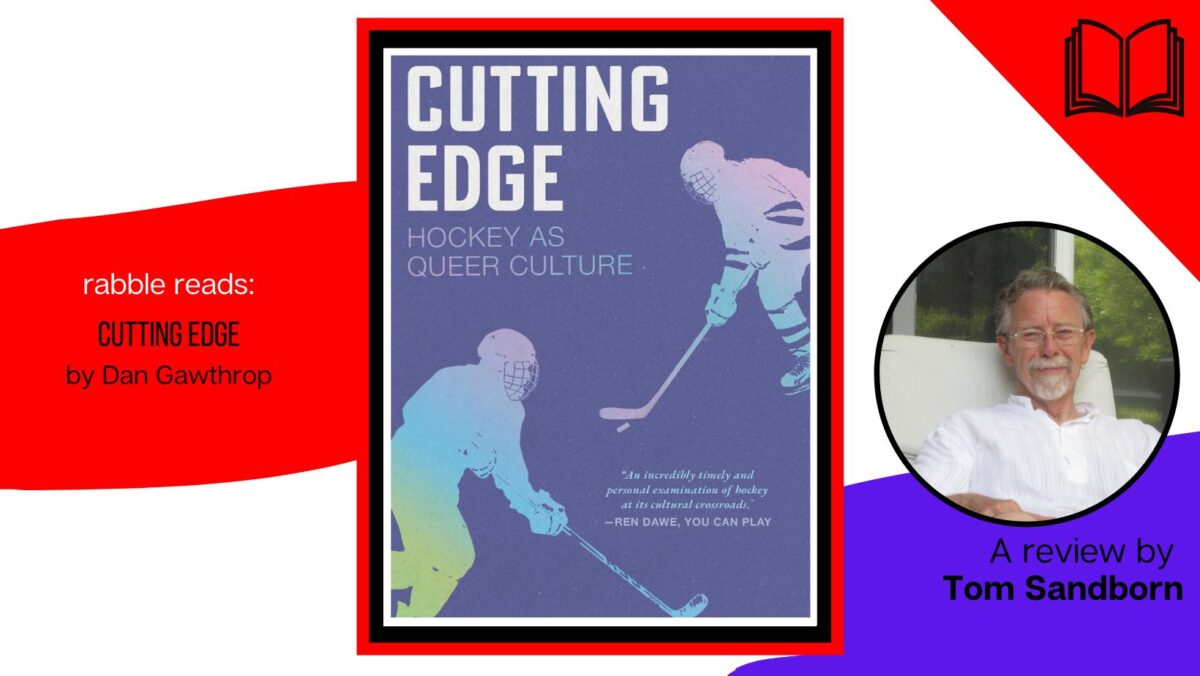
Think of BC writer Dan Gawthrop as a queer Renaissance man. (He would probably be among the first to point out that many of the original geniuses of the Italian Renaissance were queer too.)
He has been a journalist, and editor, a trade union communications representative, traveller, an organizer and advocate, and a life long lover of the game of hockey. Full disclosure: I have known Gawthrop since he first arrived on the Vancouver journalism and literature scene and I wrote for him when he edited Xtra West decades ago. I have reviewed some of his earlier books.
His splendid new work. Cutting Edge: Hockey as Queer Culture is a celebration of the game he loved long before it loved him back, and an account of his role in organizing and playing in Canada’s first openly gay hockey team the Real Puckers, later the Cutting Edge, a team formed to participate in Vancouver’s history making 1990 Gay Games.
The Vancouver games, formally known as Celebration ’90 Gay Games III & Cultural Festival, occurred between August 4 to 11 that year. The event was the world’s largest sporting event that year, attracting over 7,000 international participants.
Although the prospect of thousands of queer people coming to Vancouver to participate in this historic event, (the first time the Gay Games was celebrated outside the US) , was met by some predictable pearl clutching and alarmism from pious bigots, who referred to the impending event as a “sodomite invasion,” the games were a huge success.
And the team Gawthrop helped organize (with the organizationally deft and hard working partnership of Kevin Griffin, another gay journalist and athlete) has gone on to flourish to this day. But the Gay Games were not the first act in the complicated drama of hockey and gay people. Gawthrop provides a useful survey of earlier instances when these two alleged solitudes overlapped, including the delicious suggestion that the world’s first big hockey celebrity, American college player, Hobey Baker, a star at Princeton before WWI, was a closeted gay man or bisexual, who enjoyed the attentions and largesse of a wealthy sugar daddy. Baker, an early inductee into the Hockey Hall of Fame, was viewed by some observers as “the best player to have never played in the NHL.” He was mythologized after his early dearth as a thinly disguised character in F. Scott Fitzgerald’s Jazz Age novel This Side of Paradise.
Baker, needless to say, never explicitly declared his erotic preferences, and little wonder. He, and hockey, came of age just as advanced capitalism and a new American empire required a buffed up version of toxic masculinity as the culture’s default version of acceptable manhood, especially in contact sports like hockey. And that version, with its attendant brutality on the ice and in the dressing room and rape culture after hours is only being critically disassembled in the last few decades, a much needed reassessment driven by gay and feminist critics, investigative journalists and activists.
Another delicious moment in this book that will be resonant for those readers old enough to remember Don Cherry, the flamboyantly red-necked host for years of Hockey Night in Canada. Gawtrhop records an almost civil exchange with Cherry after the Vancouver writer suggested in an interview that he had never worn drag as campy as Cherry’s ostentatiously ugly sports coats!
Gawthrop’s book is a valuable addition to the growing literature advocating for a new and non-toxic approach to sports. Another recent addition to that literature, Canadian volleyball icon Betty Baxter’s Outspoken, reviewed earlier this year in rabble, would be a great companion read with Cutting Edge. Baxter and Gawthrop were both involved in the organizing that led up to Vancouver’s Gay Games and have continued to be important queer voices in our long overdue national discussion of sports and justice. Both books are highly recommended.
Gawthrop’s book is more than a useful history of hockey viewed through an anti-sexist lens. In addition to providing historic context, he tells his own moving personal story of loving hockey as a kid, playing it for a while and then moving away from the game as he formed and accepted his own identity as a gay man and recognized just how hostile hockey’s culture was to him and the people he loved. From the Vancouver Island suburbs where he grew up to his uneasy distancing from the hostile and toxic atmosphere of end the the 20th century Canadian hockey, the author records a life story that will be familiar to many queer Canadians.
He also provides an illustration of how activism can heal the wounds inflicted by homophobia by helping create the inclusive sports culture he and Baxter so eloquently champion. This healing, in the case of hockey, will entail an end to the gladiatorial hockey fighting and misogyny too often found festering at the centre of the game. It also demands that hockey rinks and leagues be open to women and people of colour, issues that get attention in this remarkably generous and comprehensive book.
Support rabble today!
We’re so glad you stopped by! Thanks for consuming rabble content this year.
rabble.ca is 100% reader and donor funded, so as an avid reader of our content, we hope you will consider gifting rabble with a donation during our summer fundraiser today.

Whether it be a one-time donation or a small monthly contribution, your support is critical to keep rabble writers producing the work you’ve come to rely on as a part of a healthy media diet.
Become a rabble rouser — donate to rabble.ca today.
Nick Seebruch, editor
