
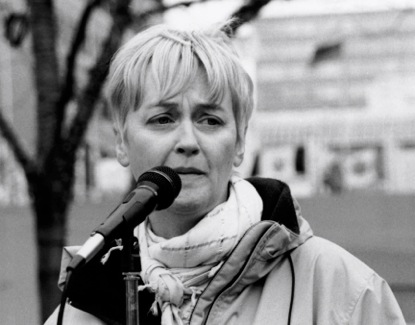

Full disclosure: almost every idea for my rabble column comes to me in the middle of the night. A friend, who aspires to be a writer, said to me “Cathy, that’s wonderful!”
No, it’s not.
The ideas sometimes come from haunting dreams (nightmares) that mirror reality: homeless people forced onto buses by officials, a disease outbreak in a post-apocalyptic period ravages a community, unhoused people with their belongings in a shopping cart crisscross the city in search of shelter, a military force battles people in their camp. The ideas can also come from an issue I’m lying awake stewing over – who took Indigenous artist Sam Ash’s painting?
I write my column to witness, and I hope that my columns contribute to make a difference.
The City of Toronto did stop its using six transit buses for shelter for the winter season, governments introduced layers of pandemic protections for people who were unhoused, the City’s Ombudsman report signalled the systemic injustice in the city’s policing approach to encampments, and after a two-year search the Sam Ash painting, I gifted has been repatriated to its proper home at the Atkinson Foundation.
My latest middle of the night awakening? A dream where Prime Minister Mark Carney was speaking with White House press secretary Karoline Leavitt.
I will leave you to analyze that, but in my mind it’s like an epic David and Goliath story between Trumpian global dominance and Canada, represented by the Prime Minister, elbows up and all. But the dream did coincide with what can only be described as a remarkable Liberal TV ad hyping a housing promise which finally sparked some policy debate in the election, so dominated by Trump’s economic war on the world.
In the 30 second video, Carney is sitting at a kitchen table hearkening back to Canada’s post-World War II efforts to solve a housing crisis. Images flash on the screen: returning veterans debark a naval ship, a newspaper ad declares a housing shortage followed by archival images of government builds of prefabricated homes. He gestures in the kitchen, “those homes are still here.”
Carney announces his intent to launch a new housing program. Billed as ‘Building Canada Strong’, he tells us Canada will repeat this wartime housing effort by creating a new crown corporation Build Canada Homes (BCH) that over the next decade will build 500,000 new homes per year.
I was pumped. I’ve always been fascinated by Canada’s post-war housing story. I have a file of photos of wartime (some say peacetime) homes that I’ve seen across the country (yes, many are still there) and a box of research including a tape from the CBC radio archives that tells the story of a riveting period in Canadian history through the voice of veteran Franklyn Hanratty,
In every speech I’ve ever given I’ve told the story that few knew to inspire that we can do it again.
You may know the Tommy Douglas story of how we got Medicare, our national health program. You may not know this story—how we got our national housing program. In 1945, the federal government had declared Toronto an emergency shelter area, forbidding people from moving there unless they were starting a job deemed essential. In 1947, Toronto Mayor Saunders put an ad in the newspaper that warned: ‘Acute Housing Shortage in Toronto—do not come.’ When Canadian soldiers returned from World War II, they were met with this housing shortage. It was such a desperate situation that the veterans took to the streets to protest. In Ottawa, Montreal, and Vancouver, women’s groups joined in. They protested, they held picket signs, they demonstrated, and they even took over empty buildings like the Hotel Vancouver and the Kildare barracks in Ottawa and squatted in them. Franklyn Hanratty, the leader of the Ottawa protest, said, “Scores of Ottawa families are living under intolerable conditions.” From A Knapsack Full of Dreams. Memoirs of a Street Nurse.
This grassroots movement led to the creation of the Wartime Housing Limited which later evolved into Canada Mortgage and Housing Corporation (CMHC).
Today the concept of wartime housing is in the public lexicon. Politicians, pundits, policy nerds, even members of the public are referencing how this post-war effort led to a national housing program. At its peak, that program built 20,000 new units a year. Then it was gone, killed in 1993 – 1994 by both federal Conservative and Liberal governments.
Carney’s plan is ambitious.
But it’s perhaps what’s not in the Building Canada Strong policy that should caution us.
- No timeline or annual targets to reach a build of 500,000 units per year.
- Non-profits and co-operatives are not mentioned.
- No outline of percentage of private development versus public and not-for-profit.
- No mention of tenant protections.
- No mention of restrictions to prevent the financialization of housing.
- No guarantees for responsible and transparent spending for the public good not corporation profit.
History shows us we should be wary.
Many fear the BCH will replicate the weakness of the 2017 National Housing Strategy that was criticized by the Auditor General of Canada for lack of accountability and non-transparent spending to ensure that housing was built for those most in need.
Alison Kemper, a professor of Entrepreneurship and Strategy at Toronto Metropolitan University and who I consider a profound moral compass, recently noted that her MP Nathaniel Erskine-Smith, who happens to be the Minister of Housing, was hosting a fundraiser. Regular price tickets were $500. She cautioned:
“A great way for companies to buy blocks of tickets and make closer friends with the Minister of Housing. So, if you wondered if there was any chance that (Prime Minister) Carney’s new homes would be set up to avoid real estate speculation or exploitative ownership, I fear we need to be hyper vigilant. The Liberals’ natural allies and supporters are not middle-income renters who need secure, permanent housing. They are the companies who will buy tickets and influence. And even the best Liberal candidate is not immune to the traditional way to attain and retain power. If we want Carney’s wonderful housing announcement to result in any non-market housing, we’re going to have to fight.”
The influence of developers on government housing policy is well supported by an article by Martin Lukacs who chronicles big developer connections with the Liberal Party and even more expensive dinners with former housing minister Sean Fraser. Some of the corporate real estate developers (Bosa, Wesgroup, Aquilini) spent up to $1,725 for their rubber chicken dinner with Mr. Fraser.
However, there is an even more egregious omission in Building Canada Strong.
Prime Minister Carney needs to say “I’m sorry” for past wrongs of his government.
There is no sense of remorse for the historic role the Liberal government played in first cancelling federal funding and when it re-entered the field, so poorly funding social housing for three decades. Yes, the Conservatives should also apologize too but I don’t expect that (Pierre Poilievre was once Minister of Housing).
Hundreds of thousands of people have been unjustly left in inadequate housing or were pushed into homelessness. Intentional policy neglect traumatized families, worsened health, caused permanent mental health damage and shortened life span. Literally, thousands have died in perhaps the most significant example of social murder since colonization.
And let’s not forget the evidence that Indigenous people have been impacted by the housing crisis at a higher percentage than the rest of Canada’s population and there is yet to be mention of reconciliation in Building Canada Strong.
In my nursing memoir I quote a grandson who stated, “heart is justice.’ If there is heart in Building Canada Strong, let’s see it.
Mr. Carney acknowledge the injustices of the past, promise to do better, and begin your housing war with an apology.
Support rabble today!
We’re so glad you stopped by! Thanks for consuming rabble content this year.
rabble.ca is 100% reader and donor funded, so as an avid reader of our content, we hope you will consider gifting rabble with a donation during our summer fundraiser today.

Whether it be a one-time donation or a small monthly contribution, your support is critical to keep rabble writers producing the work you’ve come to rely on as a part of a healthy media diet.
Become a rabble rouser — donate to rabble.ca today.
Nick Seebruch, editor
