

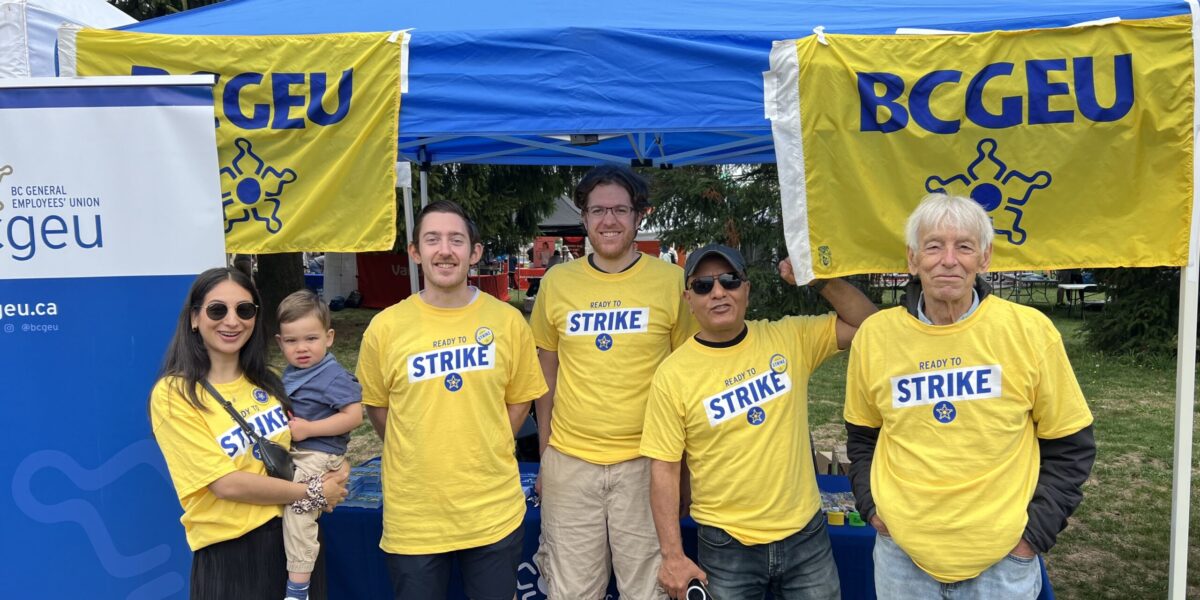
Reader, when you see this column, Labour Day 2025 will have come and gone. The September holiday, celebrated primarily in the US and Canada, is a “near beer” substitute for the much more widely observed (nearly 160 countries) and politically radical May Day. Despite its somewhat dubious background, the holiday long weekend is a welcome break for workers, and an opportunity to reflect, especially at a time when public sector unions like BC’s British Columbia General Employees’ Union (BCGEU) and other public sector unions are looking forward to what may be a long hot autumn of labour activism.
While the creation of a September Labour Day has its roots in Canada, where it was established as a national holiday in 1894, its main proponent has been the US. One American observer sums up the difference between the two holidays by saying “While socialist movements embraced May 1, Western democracies like the United States and Canada distanced themselves partly due to Cold War politics and concerns about radical ideologies…This timing was strategically chosen after the Pullman Strike of 1894, effectively separating American labor commemorations from the socialist and communist movements frequently associated with May Day.”
Despite the efforts of business class friendly voices to drown out the fundamental radicalism of a holiday for workers with trivializing fluff and worse, the holiday can be a useful moment of reflection for us all. Ask anyone who watched the recent and rebarbative spectacle of the Trump cabinet meeting in which all present competed with each other to see who could deliver the most obsequious and implausible praise for His Orangeness as a “friend of labour,” . They will understand that workers around the world are threatened by Trump and his minions.
Or ask anyone here in Canada about our current PM and his claims to be both a friend of labour and a defender of Canada against Trumpian aggression. While Carney is less obviously twisted as a personality than Trump, he is equally implausible as a friend of labour.
Carney shows every sign of being as committed as Trump to the project of breaking the power of all unions, particularly public sector unions. Criticism of his quick on the draw approach to back to work orders and his failure to include a Labour Minister in his first cabinet and then demote the issue to secretary of state status have drawn criticism from many on the left and even from the Conservative Party. When, as a purportedly progressive politician you let yourself be outflanked on the left by the Conservatives and criticized by mild mannered social democrats like Tom Mulcair you know you are in deep trouble. And so are Canadian workers.
And there is little reason to think that the NDP government of BC, led by rogue former civil libertarian Dave Eby, will deal fairly with provincial public servants represented by the BCGEU, which announced an overwhelmingly supported strike vote by its members on August 29. The press release announcing this strike mandate opens by saying:
“The bargaining committee representing more than 34,000 members of the BC General Employees’ Union (BCGEU) who work for the BC Public Service will issue 72-hour strike notice this afternoon, following the conclusion of their strike authorization vote and an overwhelming strike mandate. Members voted 92.7 per cent in favour of taking job action. Job action could begin as early as Tuesday morning. Over 86 per cent of eligible members voted.”
The Eby government seems to have adopted a divide and conquer strategy, trying to split public sector unions in the province. This strategy is clearly described in an article in Business in Vancouver (BIV), where the ruling class often “says the quiet part out loud.”
The business journal is enthusiastic about a framework agreement between the province and the Hospital Employees Union (HEU) announced just before BCGEU issued its strike vote results and clearly sees it as a successful wedge issue designed to split unions off from each other. Rob Shaw, the BIV writer, says in his opening:
“Divide and conquer. The BC NDP unveiled a new strategy in public sector bargaining on Thursday, pitting one union against another on the eve of a strike vote in an attempt to sow dissension into the ranks of the organized labour movement.”
The BCGEU is , understandably, less enthusiastic. The union’s young and militant president, Paul Finch, wrote in a press release on August 28:
“The BCGEU is very disappointed with today’s announcement of a deal framework between the Hospital Employees’ Union and the provincial government… The agreement is below inflation and undermines the very fight that public service workers across B.C. are taking on together for fair wages and respect at the bargaining table. This announcement will not undercut the strength and solidarity of BCGEU members, and the wider labour movement currently engaged in bargaining. BCGEU members are united, and we are pressing forward to win a fair deal that respects the rising cost of living and the critical work our members do every day.”
Finch may be right in saying that the HEU agreement will not undercut his members’ strength and solidarity, but the hospital worker’s deal does diminish the solidarity across the workers’ movement in the province that would be helpful in pushing back predictable attacks from governments at all levels, and will be regretted by friends of labour. We can expect a stormy season of strikes, lock outs and government austerity demands this year, and workers need to stand together, not be bought off by partial and divisive deals.
Support rabble today!
We’re so glad you stopped by! Thanks for consuming rabble content this year.
rabble.ca is 100% reader and donor funded, so as an avid reader of our content, we hope you will consider gifting rabble with a donation during our summer fundraiser today.

Whether it be a one-time donation or a small monthly contribution, your support is critical to keep rabble writers producing the work you’ve come to rely on as a part of a healthy media diet.
Become a rabble rouser — donate to rabble.ca today.
Nick Seebruch, editor
