

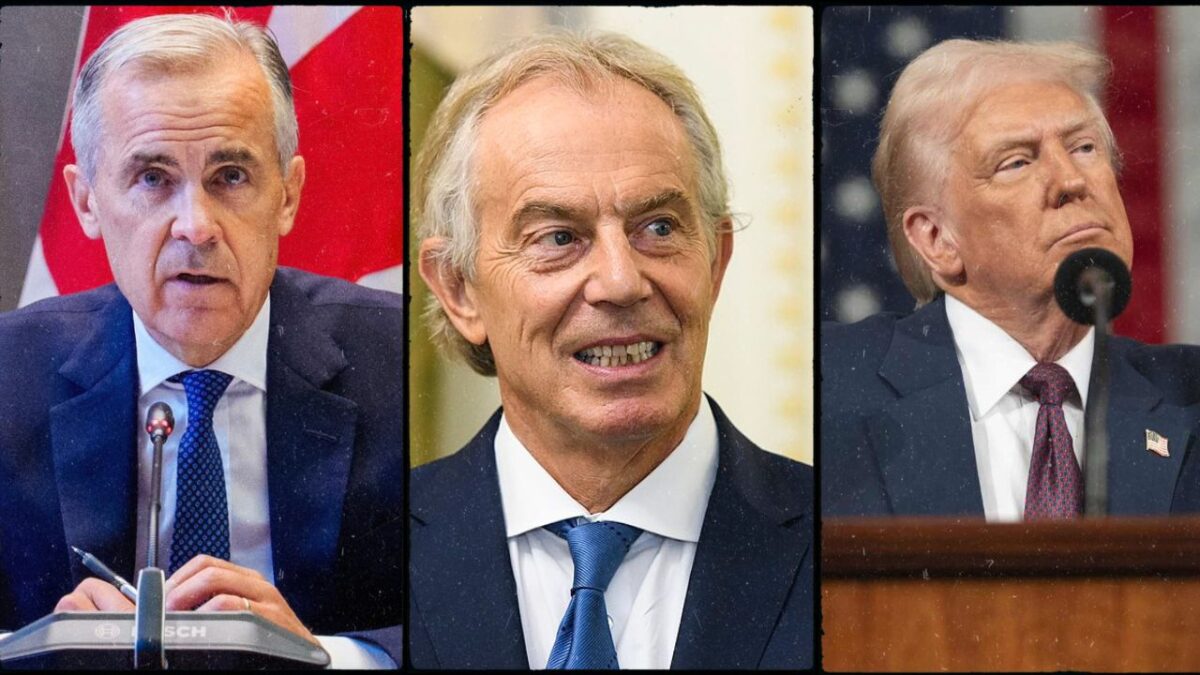
It is no secret that Mark Carney’s success as prime minister to date is related to his response to the strained relations between Canada and the US, particularly Donald Trump’s tariff policies and threats of annexation. But few Canadians know that ex-UK prime minister Tony Blair, a close friend of Carney’s, has been pulling his strings.
A March 2025 article in the UK magazine The Spectator titled “Did Blair persuade Carney to run for PM?”, says that Carney was convinced to run after a luxury dinner and stroll with Blair in West London. The Spectator quotes Emily Maitlis, co-host of the podcast News Agents. She says that in October 2024 Carney dined with two people — Blair and her anonymous source — in the trendy River Cafe. Carney was thinking about Donald Trump and Justin Trudeau, weighing his chances of winning the Liberal leadership and becoming prime minster:
“…and he thought it only works, this bit only works if Trudeau goes quickly. Because if I don’t have enough time to bed in before the election, then I can’t win an election.
…he went for a walkabout… around the whole circumference of the restaurant in West London. He suddenly looked at the two of them and… that’s when he knew he was going to run for Prime Minister…
And this person had breakfast with Mark Carney… and he said, yep, I’m going to do it. So Carney knew instantly that it was going to be Trump’s success that propelled him to a place where he was going to run. Because, and I think this feels quite unique, he doesn’t sound scared of Trump.”
Carney’s strategy was spot on. A month after his dinner with Blair, Trump won the US election. On January 6, 2025, Trudeau said he was resigning as prime minister. Three days later the Liberal Party initiated a leadership contest with a March 9 voting deadline. Carney quickly announced his candidacy, won the leadership, and claimed the April 2025 federal election.
The Spectator article notes that “Tony Blair may no longer be running Britain but it seems he hasn’t quite been able to keep his tentacles out of other democracies.”
Tony Blair’s influence on Canada isn’t limited to persuading Carney to run for Prime Minister. Blair’s Institute for Global Change provides the model for Carney’s policies, including his support for carbon capture and nuclear power in the Canada-Alberta MOU.
An April 2025 Institute paper recommends “rapid scaling of carbon capture and storage,” and calls nuclear power “essential.” An October 2025 paper, while still highly supportive of these technologies, acknowledges that they are expensive and slow to implement, and therefore calls for abandoning the UK target of “clean power by 2030.”
Conservation is anathema for capitalists like Carney and Blair. Their aim is to simultaneously ramp up fossil fuels, nuclear power, and renewables; all in the name of economic growth.
This is a dangerous form of climate change denial.
The Senate Committee on Energy, the Environment and Natural Resources held a virtual hearing on Newfoundland and Labrador’s offshore petroleum industry on November 18. Carleton University business professor Ian Lee gushed about Canada’s “unimaginable bounty of natural resources,” including oil, gas, nuclear fuel, and critical minerals. He said renewables won’t replace fossil fuels, but:
“…voracious growth in demand for electricity is using up all of the renewables we can produce and we still don’t have enough energy… we need a lot more oil, a lot more natural gas and a lot more renewables.”
Politicians, including undisguised climate change deniers, lap this up. Tony Wakeham, the recently-elected premier of Newfoundland and Labrador, says climate change and massive wildfires are not “related.” He wants Carney to designate Bay du Nord — an offshore oil development that the Norwegian company Equinor has put on the back burner— as a project of national interest (“PONI”).
A major driver for increased fossil fuel production is military use — the armoured vehicles that the Trump administration wants from Canada, tanks, fighter jets, etc. Tony Blair is well aware of this connection. His Institute calls for “a radical upgrade in defence capabilities, backed by increased defence spending.” Blair’s support for use of military force for political and economic purposes, including the 2003 invasion of Iraq, has earned him the label of “war hawk.”
In 1539, an act granted King Henry VIII the power to issue proclamations that had to be obeyed as if they had been issued by Parliament itself. Ian Richardson compares these “Henry VIII powers” to Donald Trump’s executive orders in The remarkable parallels between King Henry VIII and Donald Trump, while noting other similarities between these two individuals.
The Building Canada Act portion of Bill C-5 gives federal cabinet the Henry VIII power of exempting PONIs from federal laws. Bill C-15, the Budget 2025 Implementation Act, proposes to allow ministers to exempt individuals, corporations, and federal or provincial governments from of Acts of Parliament “with the aim of facilitating the design, modification or administration of regulatory regimes to encourage innovation, competitiveness or economic growth.”
Can anyone explain the need for this unprecedented attack on the rule of law?
More use of fossil and nuclear fuels, increased military spending, autocratic powers, walking away from climate targets: Did Canadians know they’d get these by electing Mark Carney? Were they aware of Tony Blair’s influence on Carney’s thinking? How different are Carney and Blair from Trump, or other promoters of deregulation, privatization, and the centralization of power into fewer and fewer hands?
Support rabble today!
We’re so glad you stopped by! Thanks for consuming rabble content this year.
rabble.ca is 100% reader and donor funded, so as an avid reader of our content, we hope you will consider gifting rabble with a donation during our summer fundraiser today.

Whether it be a one-time donation or a small monthly contribution, your support is critical to keep rabble writers producing the work you’ve come to rely on as a part of a healthy media diet.
Become a rabble rouser — donate to rabble.ca today.
Nick Seebruch, editor
