

The utter failure of humans to rein in climate change has led some observers to call it a “wicked” problem.
It’s a catchy term — actually used in academic discourse — that’s meant to capture the sheer difficulty of solving the climate crisis, given the centrality of fossil fuels in our lives and the world economy.
The idea is to distinguish between “tame” or solvable problems, and “wicked” or unsolvable ones.
But catchy or not, the term “wicked” is dead wrong when applied to climate change. As problems go, it’s the opposite of “wicked.”
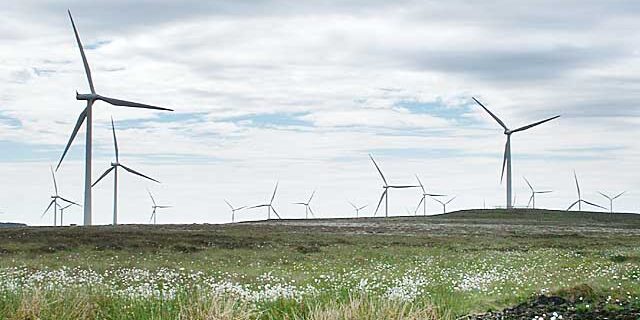
By that I mean there absolutely is a solution to climate change: renewable energy, which is safe, free and abundant — appealing features which, oddly enough, we always seem to overlook when planning our energy systems.
Furthermore, people around the globe — horrified by raging wildfires and tempestuous floods threatening their lives — are showing a willingness, even an eagerness, to transition from fossil fuels. More than 13,700 cities worldwide have pledged to cut carbon emissions as part of the Global Covenant of Mayors for Climate and Energy, including 25 Canadian municipalities.
For most of us, switching to clean energy would require some adjusting, but wouldn’t have to impact our lives all that negatively. It’s not like we’d return to pre-industrial lifestyles, getting around in horse-drawn carriages and playing charades every evening. We’d still drive fast cars and spend our lives glued to a screen.
So climate change is a solvable problem — but it can’t be left to the marketplace to solve. That’s because the dominant players in the marketplace have no interest in solving it. Indeed, their immense profits depend on blocking us transitioning from fossil fuels, and profits are what they care about.
This is where government comes in, or should come in. The best hope we have of tackling the climate crisis is for government, acting in the public interest, to create publicly-owned enterprises focused on developing clean energy alternatives.
This is happening in Europe, where governments, notably the Nordic countries as well as Spain, Portugal and Austria, have established companies that advance renewable energy.
Denmark has established state-owned Orsted, now the world’s largest offshore wind-power developer, having transitioned from fossil fuels completely.
Norway is a particularly interesting case because, like Canada, it has extensive oil reserves. But it hasn’t let private oil interests control it politically, the way they control Canada. Indeed, in addition to creating a publicly-owned oil company, Equinor, Norway has established publicly-owned Statkraft, now Europe’s largest generator of renewable energy.
There’s no reason we couldn’t be as smart and innovative as the Europeans.
Indeed, Canada had a strong tradition of publicly-owned enterprises, before we embarked on a privatization binge in recent decades.
Ontario Hydro, for instance, was established by the Ontario government in the early 1900s in response to popular demands that the hydropower of Niagara Falls be owned by the people, not by the private “water barons” who were exploiting consumers south of the border. (Hydro became the world’s largest publicly-owned power authority; it was mostly privatized in 2015.)
So far, Prime Minister Mark Carney, while professing concern about climate change, seems content to rely on the market to solve the problem — a hopeless strategy.
Indeed, his obsession with market solutions, which could perhaps be dubbed Market Derangement Syndrome, will leave us condemned to an ever-hotter world.
Carney is planning to divert billions of our tax dollars to subsidize the oil industry’s notoriously ineffective “carbon capture and storage,” and billions more to beef up our military — rather than directing major public funds to the urgent cause of doing everything possible to save the planet for our future use.
Big Oil, with Alberta’s full support and Ottawa’s acquiescence, is hell-bent on ensuring we dig up and sell all the remaining oil under our ground — despite how dirty, destructive and lethal that would be.
Maybe, on second thought, the term “wicked” isn’t so far off.
This article was originally published in the Toronto Star.
Support rabble today!
We’re so glad you stopped by! Thanks for consuming rabble content this year.
rabble.ca is 100% reader and donor funded, so as an avid reader of our content, we hope you will consider gifting rabble with a donation during our summer fundraiser today.

Whether it be a one-time donation or a small monthly contribution, your support is critical to keep rabble writers producing the work you’ve come to rely on as a part of a healthy media diet.
Become a rabble rouser — donate to rabble.ca today.
Nick Seebruch, editor

