

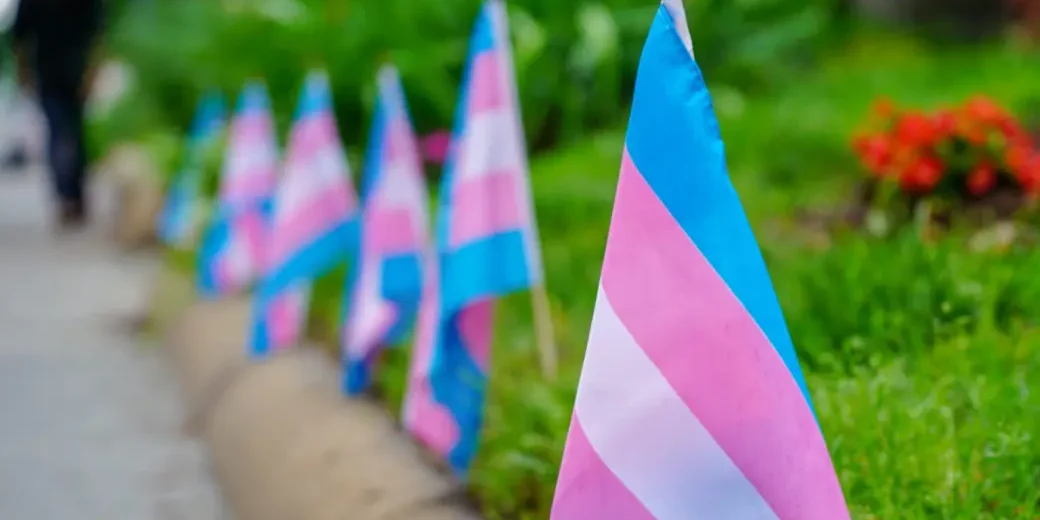
In the unfolding tragedy that is the transgender experience today, there has been a continued chorus of bigotry and hate.
Last fall saw the passage of Alberta’s Bill 9, which invoked the “notwithstanding clause” to override the Charter rights of trans youth to access life-saving medical care and supports for social transition; as well as the rights of trans women and girls to access gender-congruent sports.
Last Thursday saw the International Olympic Committee ban trans women from the Olympic Games. And the yesterdays in-between saw daily indignities inflicted on trans people across Canada and around the world: from the expulsion of trans women and girls from Girlguiding in the U.K.; to the passage of legislation in Kansas putting a “bathroom bounty” on trans persons who access gender-congruent washroom facilities in that state; to the banal forms of transphobic prejudice enacted in Canada’s prisons and on Canada’s streets every day, which range from instances of micro-aggressive misgendering to increasingly normalized assault and murder.
In the midst of all this, March 31 marks yet another International Transgender Day of Visibility: a rather curious occasion on the global social-justice calendar given just how hyper-visible transgender people seem to now be every day of the year. We’re everywhere right now, at least, that is what the alt-right trolls and their political surrogates would have us believe.
One has to wonder: given our prominence in the political consciousness at present, and the increasingly negative consequences of that prominence, do we trans people even want to be visible anymore?
What’s visible on Transgender Day of Visibility
It’s true that a certain level of political visibility is necessary, practically speaking, to achieve political goals in a democratic state. If the general population doesn’t know that a particular group exists in the first place, it is unlikely that that group will be able to persuade people to protect it at the ballot box, in the courts, or in the legislature.
For that reason, it makes sense that Canadian queer politics has largely been a politics of visibility these past decades: a movement to make the plight of queer people known to those outside this community, for instance, through Pride parades in Canada’s cities and strategic counter-protests. The goal has been to assert and secure queer rights, and queer organizers have rightly understood that that is only possible if people know that there are, indeed, queer members of the body politic.
But visibility is a double-edged sword. Because what the state doesn’t know about, it also can’t orchestrate violence against. And as we’re seeing right now, visibility is the prerequisite to co-ordinated persecution.
It works like this. First, the state singles out a particular group of people as belonging to a definable class or category, in this case, that of “transgender persons.” Then, the state takes steps to make these people especially visible so it’s easier to separate them out from the political mainstream. These people need to be simultaneously everywhere, so it’s possible to convince the majority that something needs to be done about “them;” and nowhere, so the majority doesn’t need to fear that they will topple the government in the next election. Only then can the discrimination, the dehumanization, and ultimately the physical violence against this marginalized group proceed unchecked.
That’s what we’re seeing with transgender people in places like the United States, the United Kingdom, and, now, Canada. We’re the people “normal” citizens need to fear everywhere from sporting events to bathrooms to schools, but never at the ballot box. We’re simultaneously all-powerful and powerless. And the result is an increasingly violent mass hysteria.
You would be hard-pressed, in today’s Canada, to find someone who wasn’t aware that transgender people exist.
We do exist, and people know it. That’s the problem. And it’s a problem that another year’s observance of Transgender Day of Visibility will not solve.
From trans hyper-visibility to trans invisibility
The trouble with the hyper-visibility of trans people in the international public eye is that it is dehumanizing.
We aren’t visible as people. We’re visible as problems.
When trans people are removed from sporting events, for example, what’s visible is the threat we supposedly pose to principles of fairness and equal participation. What’s lost is the human dimension of it all: the hopes, the ambitions, and the dreams that trans people bring with us when we show up to play. What’s lost is the fact that we’re people, too, who just want to participate along with everyone else.
Or take trans healthcare. People largely know by now that trans people need specialized medical care. Some might even know that, without it, we’re at a substantially increased risk of dying by suicide and other means. But when that’s all we’re known as—a bundle of complicated hormone and surgical treatments—what’s lost is the fullness of who we are as human beings: who have rich inner lives, a culture all our own, and a joyful way of inhabiting the world.
The hyper-visibility of trans people ironically renders us invisible in many ways.
We’re known as a suicide risk. We’re known as a burden on the medical system. We’re known as a threat to society.
We’re a political issue, not human beings who exist in our own right.
Lost from sight is the fullness of who we are.
Maybe we do need another Transgender Day of Visibility
The old politics of visibility—the one that drew the public’s attention to our struggles—has limited value now.
What’s needed, now, is a politics of visibility that draws the public’s attention to our joys.
The new politics of visibility that this political moment calls for is one that centres the hopes and dreams of our community over the problems we face. It’s a politics that draws attention to the ways in which our community is thriving despite the intense pressures we’re under. It’s a politics that lays claim to the transgender experience as something desirable in its own right, rather than something people should fear. It’s a politics that shines a spotlight on the whole, complete persons we trans people are.
In an age of dehumanizing hyper-visibility, we need to become activists for our own humanity. And that means changing the narrative this International Transgender Day of Visibility. It’s not just, or even mostly, that trans people deserve rights and respect because without those things we will die horrible deaths. It’s that without them Canada loses an important and beautiful way of being human.
Support rabble today!
We’re so glad you stopped by! Thanks for consuming rabble content this year.
rabble.ca is 100% reader and donor funded, so as an avid reader of our content, we hope you will consider gifting rabble with a donation during our summer fundraiser today.

Whether it be a one-time donation or a small monthly contribution, your support is critical to keep rabble writers producing the work you’ve come to rely on as a part of a healthy media diet.
Become a rabble rouser — donate to rabble.ca today.
Nick Seebruch, editor
