

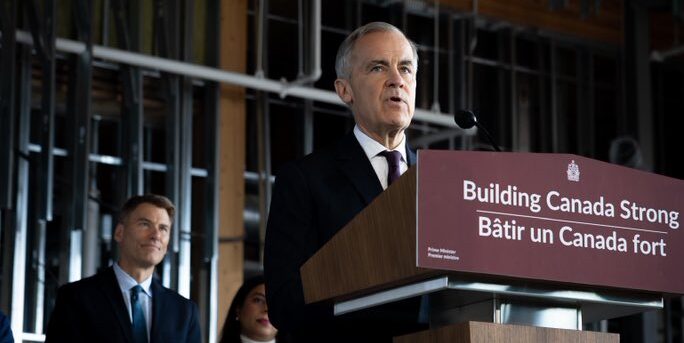
Q: Carney promised Canadians that he would deliver a deal that they could be proud of. What stands out about these negotiations in the interim agreement?
DD: It was never very clear to the Canadian public what were the red lines for tariff relief, and other key objectives of Carney’s negotiations. It was never spelled out that these were only interim negotiations and there was much more to come if you took the time to piece together his different statements. Nor was the draft of the final text ever made public. This too is another shortcoming that alarms many Canadians.
Q: Carney was elected to negotiate a new deal with ‘elbows up’. What happened? What went wrong?
DD: Team Canada made a number of fundamental errors. When Trump repeatedly attacked the Canadian auto industry, saying Americans didn’t need Canadian made cars, Carney and his team didn’t respond to this attack with the seriousness it deserved. Canadians didn’t see Ottawa adjusting its negotiating strategy and drawing a big red line. These attacks continued over the past year. Trump turned Canada into his punching bag with his taunts, vindictiveness, and insults. It was ugly to hear and humiliating to be treated like a vassal.
For Canadians the smart thing that Carney did was to support financially laid off auto and steelworkers through different programs. This helped families cope in the short term with this disaster. Many of these programs provide emergency support to troubled industries and businesses. But the bigger question remains what future do these core industries have when they are facing ruinous tariffs for the rest of Trump’s presidency or beyond?
Looking back, we can see that the Canadian public had no idea how the parameters of the negotiations were constantly shifting mainly against Canada’s interests. When Carney did speak in public he sounded like the Delphi Oracle reassuring Canadians that his team were ‘intensifying’ negotiations,’ making good progress’ and getting ‘close’ to a deal. These were stock phrases of communications specialists all spin and no substance.
Q: A lot of experts were asking why the rush to conclude the deal that Trump could use in the run-up to the midterm election boasting of his diplomatic success.
A: August was a bad time to negotiate at the end of summer when Washington was emptied out and Congress was not sitting. This raises the question of the need for ongoing meaningful accountability and transparency. Instead, in political science terms what we saw was a classic example of elite accommodation politics, elites negotiating with other elites behind closed doors with the Canadian public for most of the time trying to make sense of the rumours and leaks coming from unnamed government sources. Public opinion polls showed that Canadians weren’t intimidated by Trump’s attacks and supported a much stronger response from Carney’s team including retaliatory tariffs.
For many, taking American booze off provincial liquor shelves got Canadians involved in the trade crisis. Surprisingly it did rally Canadians behind Carney. It was a visible, symbolic target meant to hurt American producers of bourbon and wine. It wasn’t an easy ‘get’ for angry Canadian consumers. But it sure wasn’t enough pressure to change the outcome. At Davos, he said it was a new day for middle powers in global politics. But so far, Carney it doesn’t look like he has delivered on big ideas. Even so his stature has grown impressively. The world’s press sees him as Mr. Resistor for having stood up to Trump, unlike the European Union, Japan and South Korea all who caved to American projectionism.
Q: What is the biggest misconception that had been revealed during the negotiation?
DD: There is a lot of confusion about the status of these negotiations. For starters, the current round of trade talks would not have the status of a treaty like NAFTA and CUSMA which would have to be voted on by Congress and reviewed by both American legislative bodies.
Up until now the public never understood that the Trump-Carney talks were not the final agreement because this negotiation was only part one of an INTERIM agreement that Trump could alter unilaterally and impulsively. As Carney rightly said, they are signed “with a pencil”.
Part 2 deals with bigger issues such as security, strategic minerals, Canada China relations and agricultural marketing boards. Practically speaking, the agreement injects the American presidency into the heart of Canada’s public policy process. The concessions in the ‘final final’ agreement will also shock many Canadians because it will make Canada more vulnerable to Trump’s executive theory of the presidency. In the past, trade agreements were WTO compliant and, this is important, because there was a mechanism of enforcement based on its rules and institutional muscle. The present set of negotiations would make Canada exposed to Trump’s wild mood swings.
Another constant worry is that according to the information available, supposedly Trump agreed to reduce auto tariffs from 25 per cent to 15 per cent while at the same time increasing the value of American content in autos from 75 per cent to 82 per cent to qualify for the lower tariff. Certainly, that would have been a big win for Detroit’s auto assembly operations!
Canada’s auto assemblers have gone on record that they can’t operate with such reduced margins. The future of Canada’s auto industry with these punitive tariffs is uncertain to say the least. For more than two decades Canada’s auto industry export capacity has been in gradual decline and these negotiations have left red lights flashing everywhere
For policy geeks Trump has used an obscure Section 338 of the Smoot Hawley Tariff Act of 1930 to target another US $20 billion of Canadian products. Trade experts think that the American courts will likely strike down this obscure trade statute as it faces many legal challenges from Americans themselves. When the final text of the Agreement is released we will know if there are any fundamental changes to the US trade Law but there is no indication that section 338 will be struck from the final Carney-Trump deal.
Section 232 tariffs gives the Department of Commerce power to impose sectoral penalties on Canada’s industrial metals including steel and aluminum and copper, as well as forest products and autos. Rates vary by industry ranging from 10 per cent to 50 per cent depending on product category, contents origin and other considerations. All of Canada’s big 5 sectors including auto, steel, copper, aluminum and softwood lumber had been hit hard as mentioned previously by penalizing tariffs ranging from 25 to 50 per cent.
The US commerce Sec. Howard Lutnick is the trade czar responsible for overseeing the sprawling empire of U.S. Trade Law and there are new investigations presently underway against Canadian industries. American trade law is designed to protect American industries first and foremost. Nothing in this Agreement will limit the US Department of Commerce from launching new investigations and crippling duties. Section 232 tariffs are the backbone of Trump’s protectionist policies. There is nothing to suggest any fundamental changes here.
Carney says he wants an Agreement “that will ease the pain on the Canadian economy and stave off new tariffs”. British Columbia’s forest industry is facing hundreds of millions of dollars in duties. Canada’s softwood industry has been targeted for more than 40 years and so far in the negotiations, the Carney government appeared to go along with the American argument that lumber is a separate issue. Nothing in the interim agreement will prevent the U.S. Department of Commerce from investigating it once again. Here also we don’t have access to the Final Agreement but trade experts believe that these sectoral penalties will remain in effect. This would be a stinging defeat for Carney who promised a fresh start without punitive tariffs for stabilizing Canada-US relations.
Q: Canadian news reporting has focused on the frenzy-like negotiating style of Carney’s team. They have been practically camping out in Washington for the last three weeks in order to conclude a trade agreement before the August 19 deadline, after which the US threatened to impose billions of dollars in new tariffs and more economic pain.
Some critics have suggested that this rush to negotiate an interim agreement at the end of summer when Washington shuts down was a big mistake rather than pushing negotiations past Labour Day when campaigning for the midterms really begins. It now seems academic to ask the following question, did this weaken Canada’s negotiating chances before Carney broke off negotiations?
DD: Certainly, there is a highly visible psychological dimension to these negotiations and Carney’s failure to stand up to Trump. The cliché that the US is Canada’s best friend, ally and neighbour is baked into our political culture. It is also why this negotiation is so different for Canada. Trump ‘s belligerence and his vitriolic attacks on Canada from our so-called ‘best friend’ feels like a betrayal or punch in the face for many Canadians. There has definitely been a rupture between the countries as well as a lot of new thinking about geography and fate.
The belief that Canadians are victims of zero sum transactionalism has long been internalized in business, sports, education and the upper reaches of government. There is an acquiescence to defer to American power and hierarchy. Political economists have written a lot about Canada’s colonial mentality having its roots in popular culture. At a basic level it means Canadians can’t prioritize our own needs to build a more prosperous Canada. Among the elites and power-brokers, they are uncertain whether it is even worth trying to protect and deepen Canadian sovereignty with 70 per cent of our exports going to one market. After all, the roots of continentalism go back to the founding of Canada and dominate contemporary life
Canadians and Americans are very similar, watch the same television shows, see the same movies and are mass consumer societies. But the two countries are starkly different with regard to healthcare, guns, social entitlements, and the environment and the differences are starker under Trump than any time in recent history.
South of the border markets reflect a growing anxiety about Trumpenonomics and the $40 trillion US debt, the wars in Gaza, Ukraine and Iran and the AI bubble. Food inflation and the unprecedented rise in price of diesel has sent his polling numbers to record lows. Recent surveys show that Canadians are angry and in a fighting mood. Trump’s intention to hit Canada with 50 per cent tariffs on $20 billion worth of goods has catalyzed Canadian public opinion when the hammer dropped. Carney broke off talks and sent his team home.
The most recent poll found that 36 per cent thought that Carney should respond with counter tariffs to protect Canadian jobs and businesses but significantly 80 per cent of Canadians were against giving US concessions to save the talks. On the whole only 10 per cent of Canadians thought that Trump is likely to reverse course on tariffs. Had he signed he would have found himself on the edge of the political cliff. As he said at Davos, you have a fundamental choice. You are either at the table or on the menu.
Q: With a jobless rate of 6.2 per cent and weak domestic growth, there is huge pressure from Canadian business groups to sign any deal with Trump though Carney has spoken out against the appeasement option.
DD: It is relevant to look at how corporate Canada has positioned itself in these negotiations. None of the major groups such as Canada’s five big banks or the Business Council of Canada are present in the public square defending Canadian sovereignty. Of course, they are active behind the scenes. They are in constant communication with the Prime Minister’s office, lobbying, advising and threatening behind the scene for any face-saving deal. Since half their members are large American-based multinationals, they have the power to influence public opinion and other members of the elite.
Some organizations such as the aluminum producers of Québec, a professional organization, are speaking publicly just before Trump is ready to drop the hammer on August 19. They are saying that “enough is enough and things need to get back to normal and sign a deal”. Their message is any deal is a good deal.
It is deep within the psyche of corporate Canada to find a continental solution to Canada’s trade crisis. Some players such as auto assemblers have billions of dollars at stake and many professional organizations are ready to do a deal. This is because Trump’s tariff bombs impact different sectors of the economy and the business mentality is to try to negotiate individual carveouts for their own sector. The next period will be critical when the negotiations begin again. And there is a gradual build up of trade fatigue the longer trade crisis lasts and the feeling that this whole drama has to come to an end. It will be a dangerous time to lower expectations.
Q: Do you feel deceived by the Davos speech of Carney that promised a new beginning for middle power countries?
DD: This is a very good question but it is also quite complicated. When Carney said it’s a “rupture not a transition” and as a middle power you are “either at the table or on the menu” he sounds like a lefty international political economist. Of course, for much of his public life he saw himself as a neoliberal political economist overseeing markets and holding the top job at Bank of Canada 2008 – 2013 and then at Bank of England 2013-2020.
In these peak positions he was very much a Hayekian believing in the self-regulating market, but he also thought that on the environment, values, gender questions, for example, supply and demand logic could not address the big issues of our time. He accepted as true that the state had a large role to play as a counterweight to markets. I think that’s what makes him a more complex actor because he saw the critical importance of politics as an autonomous sphere from supply and demand logic.
Looking back, Carney threw us a curveball when he spoke to the global elites at Davos. It was a signature performance delivering a text he wrote himself in four hours time with the clear message that multilateralism was finished as the anchor of the global order. Collaboration, cooperation and investment on a huge scale, he said, is the best alternative to neoliberal austerity.
Partly in jest I would add he may have taken a page or two from China’s One Belt One Road initiative. Certainly, he was aware that China had been investing billions of dollars in building infrastructure projects on a vast scale in Africa, Asia, and Latin America. They financed the construction of roads, transcontinental railroads, harbors, hydroelectric projects, vast solar power farms, giant wind power projects, oil and gas pipelines. We are living in an era of scaling up that is required for transformative economic projects, big picture stuff after a brutal era of neo-liberal policies with savage cuts to regulatory institutions and transfers to individuals.
Carney’s mega plans to invest billions in infrastructure is right in step with the latest expert belief to row and steer the economy by bringing the state back in with powerful economic and institutional levers. We will see what happens to his 18 mega projects and whether there is sufficient accountability and transparency in the use of public funds by private business. So far, he is handing out billions of dollars to Corporate Canada at below market rates and generous repayment terms. It is worrisome that there is so little public information about the investment agreements between Canada’s Development Bank, recently created Sovereign Wealth Fund and other institutions and the corporate entities responsible for these projects.
Q: Canadians are facing a lot of instability over the next 18 months. How have these trade negotiations made finding a national consensus much more difficult?
DD: Carney had a mandate for tough action and approval ratings in the 60 per cent range. Canada’s economy was in reasonably good shape compared to the U.S. economic performance troubled by the steady rise in inflation, unprecedented national debt of over $40 trillion and a king-sized AI bubble.
Trump is a very unpopular president at 30 per cent approval ratings. Capt. Canada should have been able to give Trump a run for his money, but geopolitics are unforgiving. So, a trade war resembles labor negotiations. Canadians hit the picket lines and are ready to inflict economic damage on the U.S. Americans have struck Canada with punishing tariffs. The aim is to go back to the bargaining table and negotiate a new deal. This is the theory. Compromise is not part of Trump’s playbook. There will be new negotiations in Washington at some point, and they will be very ugly and difficult. The midterms might work in Canada’s favour to bring Trump back to the negotiating table, but it is not very clear.
Q: Provincial premiers have an outsized role in influencing Carney’s stance to break off break off negotiations. Do you think that the deep differences between Alberta and the rest of the provinces are unresolvable?
DD: Carney has worked hard to get all of Canada’s premiers to support his strategy for the trade crisis and at least in public, has succeeded. He emphasizes repeatedly that he is negotiating in ‘good faith’ ready to strike a deal if need be. This is the right language for Canada’s conservative premiers. But it is very fragile. Alberta is the centre of Canada’s oil and gas exports and is governed by a hard-right Conservative government. In October she is going to hold a referendum question on Alberta’s separation from Canada.
Trump has deliberately excluded Alberta’s oil and gas from his tariff war. Danielle Smith, the Premier, is adamantly opposed to any export service tax on Alberta’s $125 billion oil and gas exports to the US and publicly opposes Carney’s ‘confrontational’ strategy. The Premier of Saskatchewan, Alberta’s neighboring province, with its vast potash resources supplies American farmers with their fertilizer for growing their crops. Over 80 per cent of their fertilizer comes from this one province and it has formed a common front with Alberta, effectively limiting Carney’s leverage in his tariff war with Trump. Politically, there is more bad news. Quebec is planning a third referendum for an independent Quebec.
Carney has strong allies, particularly with Ontario’s premier, Doug Ford, a conservative populist. Ontario is home to Canada’s major car assembly plants and thousands of jobs depend on Canada’s auto exports to the U.S. He recently blasted Trump telling him “to kiss my ass” fed up with Trump’s trash talk and insults. Higher tariffs could last till the end of Trump’s presidency. Canada might get some last-minute relief from the pending midterm U.S. elections if Democrats take back the House and Senate.
Q: So are you a pessimist or an optimist? What is your view of the larger picture of Canada?
DD. Very pessimistic. Canada needs another Elijah Harper moment. When as a sitting member of the Manitoba Legislature in 1990 holding his eagle feather, he opposed giving assent to the Meech Lake Accord and later the 1992 Charlottetown Agreement because they did not adequately protect First Nations rights. The latter was defeated by the popular referendum when 54 per cent of Canadian voters rejected the deal.
There is a parallel with the present crisis. Carney’s walking out of the negotiations saved his political career. Surely, this is one of the most intense, high stakes brinkmanship in recent Canadian history. Wab Kinew, Premier of Manitoba said it best, “you can’t get a good deal from a bad man”. Canadians should not forget his words, be ready for a long, tough fight and act vigilantly.
Support rabble today!
We’re so glad you stopped by! Thanks for consuming rabble content this year.
rabble.ca is 100% reader and donor funded, so as an avid reader of our content, we hope you will consider gifting rabble with a donation during our summer fundraiser today.
Whether it be a one-time donation or a small monthly contribution, your support is critical to keep rabble writers producing the work you’ve come to rely on as a part of a healthy media diet.
Become a rabble rouser — donate to rabble.ca today.
Nick Seebruch, editor