

Ten years ago this December, global leaders came together in Paris for the historic UN climate conference known as COP21.
Nearly every country in the world signed onto the Paris Agreement to acknowledge the urgency of the climate crisis and pledge to take action. There was a clear consensus that humankind must pivot towards a low-carbon future or risk disastrous consequences.
The newly elected Liberal government of Canada proclaimed it would be a leader in these efforts. A few years later, in 2019, Mark Carney became the UN Special Envoy for Climate Action and Finance “to support the transition to a net zero carbon economy.”
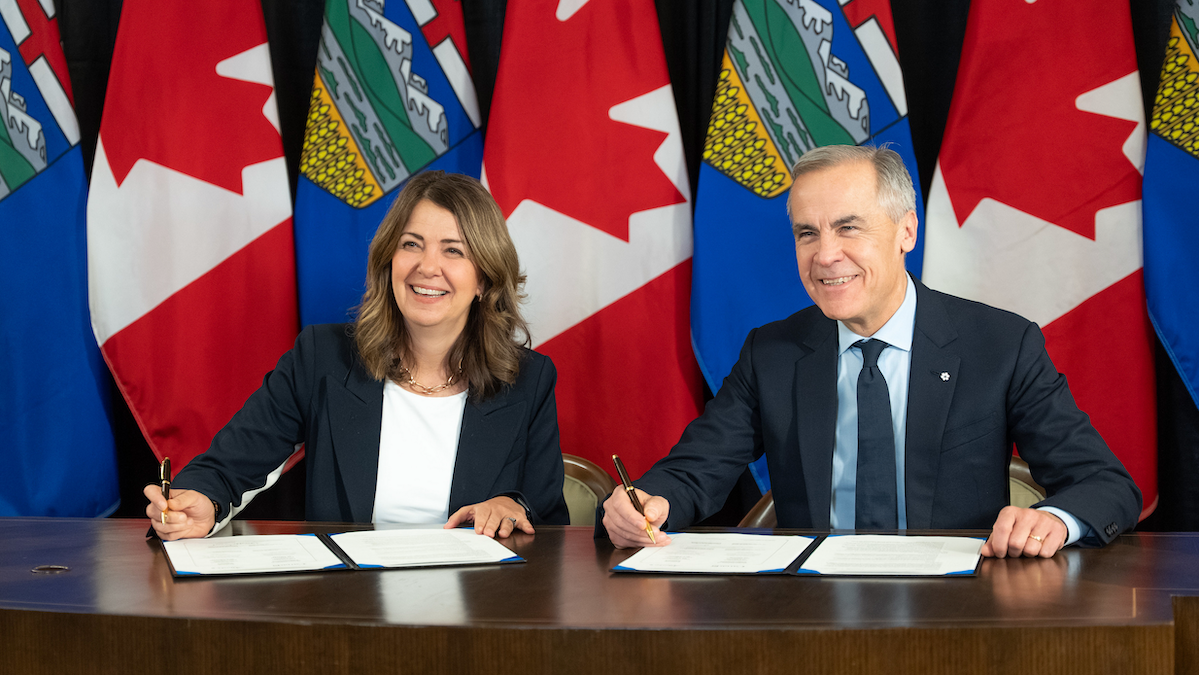
Against that background, the Memorandum of Understanding signed by Carney and Alberta Premier Danielle Smith is truly stunning. It will roll back many crucial measures needed to reduce emissions and hails a dramatic expansion of tar sands production so that Canada can become a “global energy superpower,” giving up any pretense of moving to net zero.
The headlines focused on a new pipeline to ship a million barrels of bitumen every day to the Pacific coast. It will be declared a project of national interest so it can be pre-approved and exempted from environmental laws. But there is far more involved – a list of actions that oil CEO’s and Alberta Conservatives could only dream of in the past.
The moratorium on oil tankers in the dangerous waters of Hecate Straight in northern B.C. – put in place after the Exxon Valdez oil spill disaster in 1989 – is under threat despite fierce opposition by coastal First Nations and condemnation by the Assembly of First Nations. There will also be an increase of the Trans Mountain pipeline capacity by a further 400,000 barrels a day. Ironically, the $34 billion public cost of buying and completing that pipeline was supposed to have achieved the consummate “grand bargain” between Alberta and the rest of Canada.
To enable all this, the planned federal emissions cap on oil and gas will be scrapped entirely. The requirement to reduce methane from oil and gas production will be delayed for five more years, and the target of the industry reaching net zero by 2025 is now gone.
Alberta is allowed to entirely opt out of clean electricity regulations, setting the stage for other provinces to demand the same. Vast amounts of public money will go to the carbon capture and storage operations that the oil company CEO’s keep promising but refuse to fund out of their massive profits. There is even a tax break for using carbon capture to push more oil out of the ground – the opposite of reducing emissions. A bonus is the removal of federal “greenwashing” provisions that prohibit companies from lying to the public about their environmental performance.
The document also announces a strategy of incentives for Alberta to attract a host of Artificial Intelligence data centres, which drain massive amounts of electricity and will impact on local water tables. It calls for B.C. and Saskatchewan to provide electricity for Alberta oil, gas, mining and AI, while promoting more privatization of the electricity grid.
The province of British Columbia and coastal First Nations were completely sidelined during these negotiations. The only commitment Alberta has made is a revised industrial carbon pricing system, but there is no firm date set. Based on the province’s scandalous record on cleanup of oil industry’s orphan wells and tailing ponds, there is good reason to be skeptical about how that will work out.
This deal represents a shameful surrender to the agenda of giant oil and gas companies, most of which are foreign owned. It is a betrayal of the public trust Canadians gave the Carney Liberals in April’s federal election. It’s as if the massive wildfires that displaced over 30,000 Canadians last summer never happened. No wonder Steven Guilbeault resigned in anger – every Canadian should read his open letter.
Danielle Smith, who has spent the last year undermining our national efforts to resist Donald Trump’s aggression, has declared victory. This Memorandum shows in stark relief that Canada – once a leader – is now going in the wrong direction.
Support rabble today!
We’re so glad you stopped by! Thanks for consuming rabble content this year.
rabble.ca is 100% reader and donor funded, so as an avid reader of our content, we hope you will consider gifting rabble with a donation during our summer fundraiser today.
Whether it be a one-time donation or a small monthly contribution, your support is critical to keep rabble writers producing the work you’ve come to rely on as a part of a healthy media diet.
Become a rabble rouser — donate to rabble.ca today.
Nick Seebruch, editor