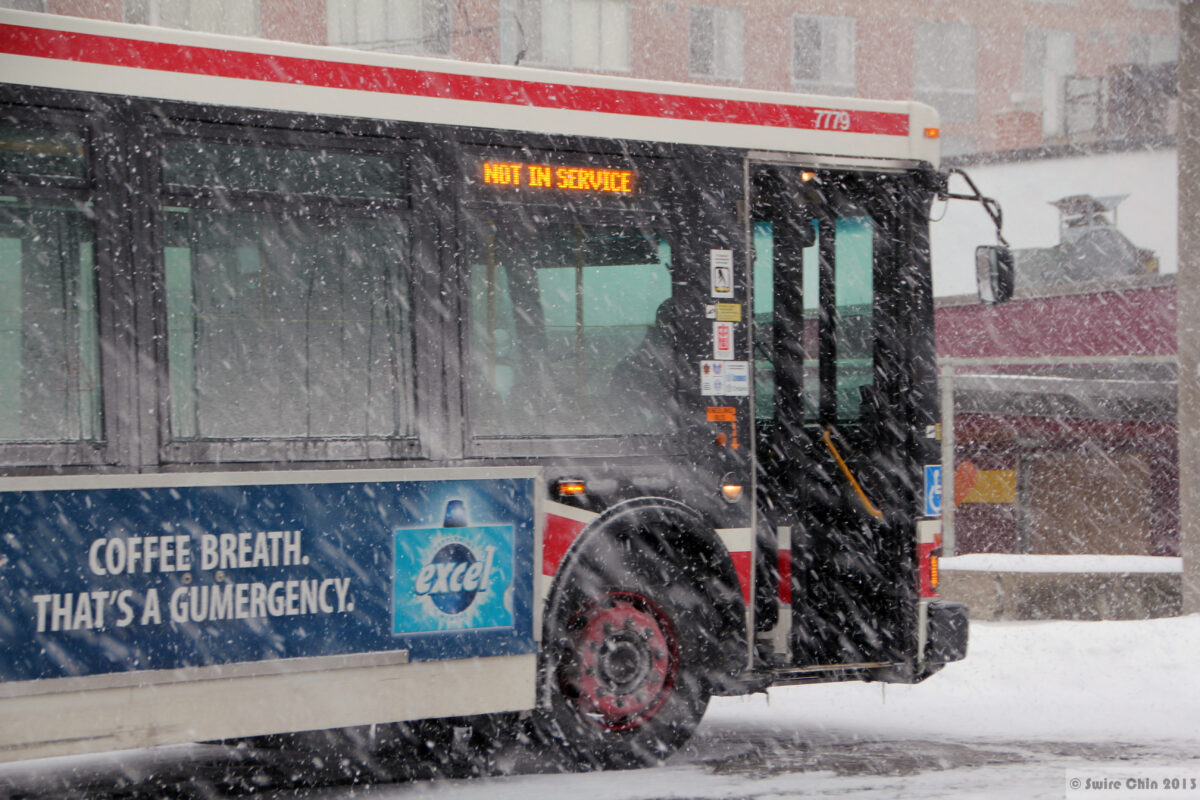
Had you been on board the northbound Bathurst streetcar, the 511, in Toronto on Christmas Day, you would have observed someone in a wheelchair outside being helped onto the streetcar’s mechanical lift. A cutting wind was sweeping off Lake Ontario and the snow was swirling, so that individual’s choice of footwear was all the more shocking: two-strap sandals, no socks. Passengers were torn between looking, and not looking. A latticework of what appeared to be white scale covered the swollen toes and feet, and from the ankles up the stubby legs took on vivid and various hues — here bruise brown, there a dark autumnal red. The bare legs were visible because the individual wore — below a hip-length winter coat — a bright, rather summery, print dress. Had you been there, you might have wondered why someone with a full beard would wear a dress in such cold, and your speculation may well have continued into the new year.
Was the dress for simplicity’s sake, because the homeless are also toilet-less, so when nature calls, a dress lifted in an alley beats a belt unbuckled and jeans lowered? Were the dress and exposed skin meant to provoke a connection with onlookers, leading possibly to an offer of food or cash? (In which case suffering is serving as strategy.) Was the dress about gender preference, or a show of defiance in the face of cruel circumstance — or winter itself? As the streetcar pulled into the station, the driver came on the intercom: “Well, we made it to the Bathurst Station. My name is Dave, and I just wanted to wish you all a Merry Christmas.”
At Union Station, the hub for rail and public transit for the largest city in Canada, travellers might have spotted that same day a young man wandering in the cold by the subway tracks and poking inside trash cans. He, too, was not dressed for the weather. His black boots were overly large with laces untied, the shorts and T-shirt all wrong. Where were the hallmarks of Canadian winter — the coat, the toque, the gloves? More speculation: drugs may have been generating their own heat and thus protection from the cold, but, if so, how long before that shield crashed? Was mental illness also driving his behaviour?
The following evening, on Boxing Day, a woman and her possessions could be seen accordioned into a window well near Bay and Bloor streets. On the other side of the glass at her back and every tall window nearby were designer clothes, high-end jewelry and other luxury items. When a passerby offered the woman a bill, her instruction — her quite particular instruction, delivered in a clear Caribbean accent — was to drop the money into one of her several paper bags with half-circle handles, all lined up neatly like dominoes at her feet. Her tone, that of a school teacher wishing not to sound impatient with a tentative student, then softened. “May God bless you.” Did the twenty bucks make any difference to her day, or her long night in that cold? Does time pass more slowly when the body is shivering?
A traveller using public transit through downtown Toronto would have encountered such scenes as 2025 drew to a close. Certain types of travellers — ones with “no fixed address” — have a hard time disguising the fact. So, by day, backpacks and buggies in tow, they are visible on streetcars and buses and subways that offer, at least by day, warm respite from the cold and admonitions to “move along.” Also highly visible are subway and billboard ads authored by the Fred Victor Mission, which has been helping the city’s poor and homeless for 130 years. Never has that task been more daunting, or the need more pressing. “What,” said one billboard, “do you get the person who has nothing?”
Another billboard announced the number of homeless in Toronto: more than 15,000 — double the tally in 2017. City officials contend that the number of homeless individuals is now declining as it builds more affordable housing, and that is both commendable and encouraging. But some critics worry that the number of men and women “living rough” is actually much higher than official figures. The number of Canadians giving to charity and the amounts they are giving, meanwhile, is the lowest it’s been in two decades. A lot of people feel pinched.
Another figure, an estimate but testament to the market’s inability to address the housing crisis, suggests that the number of vacant condos in Toronto — some purchased purely as investments — is not far off the number of unhoused individuals. What a wonderful world it would be if all those vacancies could be filled, just like that, by letting the cold folks into the cozy confines. But no, we live in a wonky world, where some eat too little and others too much (Toronto billboards on transit routes are also discreetly pushing prescription drugs, such as Ozempic and Wegovy, without ever mentioning the phrase weight loss).
Incontestable is that while the scourge of homelessness is complex, the Finns have pretty well figured it out. The basic recipe: Government intervention, housing for the unhoused, and medical help for the many with mental health and substance abuse issues. Finland, with a population of six million, currently has a homeless population of less than 4,000. Canada, with a population of 42 million, has a homeless population of between 150,000 and 300,000. (The fuzziness of that count is almost as shocking as the number itself.) Finland’s homeless numbers had fallen for 11 straight years before a recent uptick triggered by social-program cutbacks and the rising cost of living. Still, you get the picture.
If there is wisdom in the saying, “Emulate best practices” — and there is — then surely the Finnish example should inspire. Housing for all is a slow and tangled process but that should be our goal, no matter how long it takes. In the meantime, we desperately need more services, supports and shelters for men and women now living on Canada’s cold streets. Until there is housing for all, let there at least be warmth for all.
At the bottom of Bathurst St. is a lovely walkway, marked by a seawall, cheery red Adirondack chairs in pairs facing the lake, and lordly oaks that were planted in 1934. Coronation Park, as this nine-acre green space is called, was meant all at once to honour war veterans, mark the coronation of King George VI in 1937, and offer landscaping and tree-planting work to unemployed men during that decade’s Great Depression. The project’s leader, a botanist named Richard St. Barbe Baker, became keenly aware of the damage caused by deforestation in Kenya. His first community-driven tree-planting effort there in 1922 was called Watu wa Miti, or Men of the Trees, and the idea eventually spread to 100 countries around the world.
At the western end of Coronation Park today is a tent encampment, one of an estimated 283 in the city (even a single tent is counted as an “encampment”). This one features a large banner facing east, in the direction of the CN Tower. It reads, “Economic Genocide.”
The system, if one can call it that, is not working — or at least not working for those at the very bottom. For those at the very top, it’s working just fine. Nuclear Armageddon aside, climate change poses the greatest threat to life on earth, but the unchecked hoarding of wealth — and all its cruel and sundry impacts — is barking at its heels. There are proven ways to alleviate income inequality: Franklin Delano Roosevelt’s New Deal during the Dirty Thirties offers a bold lesson from below the border, and Nordic good sense from across the ocean offers another in these, the Terrible Twenty-Twenties. We need only look, not look away.
Support rabble today!
We’re so glad you stopped by! Thanks for consuming rabble content this year.
rabble.ca is 100% reader and donor funded, so as an avid reader of our content, we hope you will consider gifting rabble with a donation during our summer fundraiser today.
Whether it be a one-time donation or a small monthly contribution, your support is critical to keep rabble writers producing the work you’ve come to rely on as a part of a healthy media diet.
Become a rabble rouser — donate to rabble.ca today.
Nick Seebruch, editor