
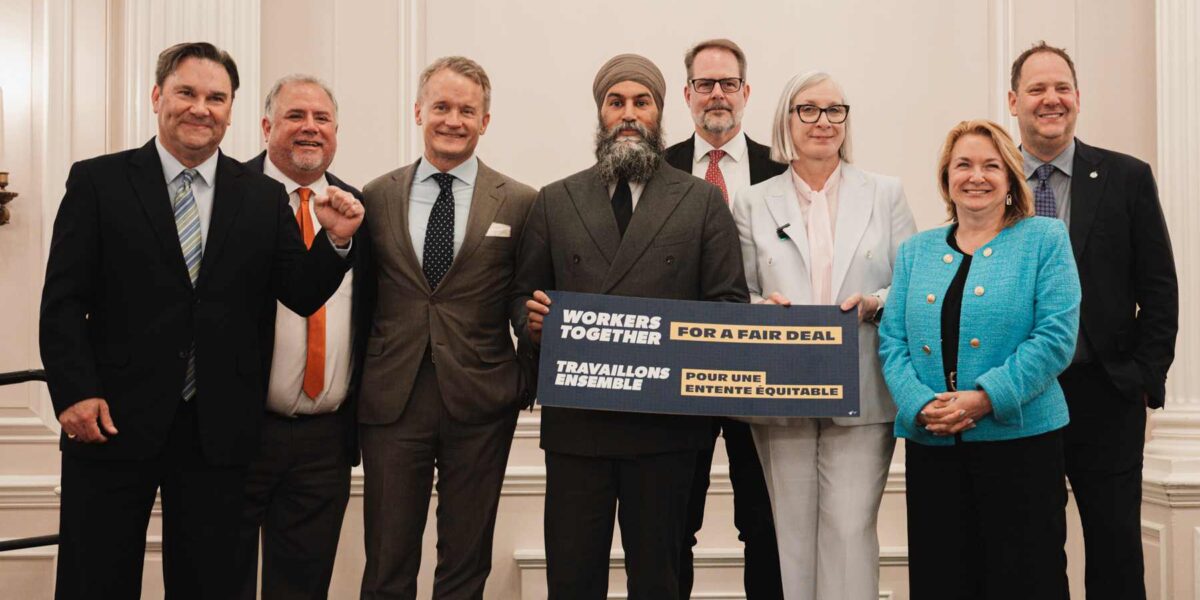
A federal bill restricting use of replacement workers came into effect on Friday morning. Major labour organizations like the Canadian Labour Congress (CLC) and Unifor are celebrating this development as the end of a practice that undermined workers’ right to strike.
Bill C-58 received royal assent on June 20, 2024 and became law a year later. The bill says that if a legal strike or lockout is in place, no federally-regulated employer or anyone acting on their behalf can employ a replacement worker, commonly referred to as a scab, to perform all or part of the duties of an employee who is in the bargaining unit on strike or locked out.
The new law applies to workplaces like banks, telecommunications and broadcasting, postal and courier services, transportation and interprovincial trucking and bus services.
In a post on X (formerly Twitter), the CLC shared voices of union members who have been affected by the use of scab labour. The CLC represents more than three million workers across Canada.
Michael Phillips, president of local 1944 in the United Steelworkers (USW) union, recounted a 2023 lockout of tech workers by Rogers in the CLC post. He said during this time, workers in Vancouver and Surrey watched scabs drive their trucks past them every day.
“Anti-scab legislation was tabled in Parliament during that dispute, and it may have helped end it after just two weeks—Rogers didn’t want to be the public face of scabbing,” Phillips said. “Now, with a strike notice issued to Rogers in Abbotsford, any dispute will happen under the new law. Employers can no longer pit worker against worker. What a long-fought and amazing victory.”
Unifor, Canada’s largest private-sector union, also celebrated the implementation of this new law.
“Today, we see that the power of collective action can achieve real, lasting progress,” said Unifor national president Lana Payne. “No employer in this country should be able to undermine negotiations with scab labour. With this new law coming into force, the right to free and fair collective bargaining is stronger today than it was before.”
While the new law is a step forward and has invited celebration from many labour leaders, work to prohibit scab labour continues. The new law only covers federally-regulated workplaces, meaning many striking workers are still at risk of bargaining being undercut by the use of scab labour.
In Ontario, personal care workers at the Villa Colombo assisted living facility who are represented by the Canadian Union of Public Employees (CUPE) Local 5525 have been on strike since May 28 for their first collective agreement. They are fighting to protect their benefits, working conditions, and sick days.
As this strike pushes into its fourth week, Villa Colombo continues to use scab labour to fulfill the duties of striking workers. Because these facilities are provincially regulated, Villa Colombo is able to continue this as Bill C-58 becomes law.
READ MORE: Toronto assisted living facility brings in scabs to replace striking staff
DHL Express, a federally regulated shipping company, is also trying to sidestep the prohibitions in Bill C-58. DHL Express drivers were served a lockout notice by their employer on June 4. Workers subsequently took strike action on June 8. About 2,100 DHL Express Canada truck drivers, couriers, warehouse and clerical workers remain on the picket line fighting for a fair collective agreement.
DHL Express CEOs Andrew Williams and Geoff Walsh wrote to Prime Minister Mark Carney on June 14 asking the government to intervene under section 107 of the Canada Labour Code to allow DHL Express to continue operating during negotiations.
“While some organizations may be able to temporarily shift production during a work stoppage, as a service provider we are either open or we are closed,” Williams and Walsh wrote. “DHL Express plays a pivotal role in the logistics sector, providing international shipping services that are indispensable for thousands of Canadians and countless businesses across the country.”
Lana Payne wrote a response saying DHL Express is trying to inflate the importance of their company. She said DHL is not even one of the top four express package delivery companies in Canada and DHL workers represent fewer than 0.7 per cent of all local delivery workers and less than 15 per cent of all courier workers in the country.
“DHL appears to be asking for a free pass to avoid having to comply with the new anti-scab legislation that is the result of years of hard work on the part of unions and workers, and which was unanimously supported by parliamentarians,” Payne wrote. “Section 107 of the Code cannot continue to be misused in this way.”
While the new law should be celebrated, the cases at DHL Express and Villa Colombo show that there are still loopholes to be closed.
Lana Payne reminded workers and activists to remain vigilant.
USW national Director Martty Warren published a statement which also called for continued action and resistance among workers.
“While this legislation represents real progress, it’s not perfect. Some provisions remain unclear and could weaken the law’s full impact. The USW will continue fighting to close gaps, strengthen enforcement and ensure that no worker is ever replaced during a legal strike or lockout,” Warren said. “This win belongs to every worker who stood on a picket line, every local union that raised their voice and every ally in Parliament who stood with us. But our work isn’t done. We’ll be watching closely to ensure this law is enforced and we’ll keep fighting to expand these protections to all workers across Canada, regardless of jurisdiction.”
Support rabble today!
We’re so glad you stopped by! Thanks for consuming rabble content this year.
rabble.ca is 100% reader and donor funded, so as an avid reader of our content, we hope you will consider gifting rabble with a donation during our summer fundraiser today.
Whether it be a one-time donation or a small monthly contribution, your support is critical to keep rabble writers producing the work you’ve come to rely on as a part of a healthy media diet.
Become a rabble rouser — donate to rabble.ca today.
Nick Seebruch, editor