
The Conservative Party of Canada yesterday handed Liberal Prime Minister Mark Carney an opportunity to do something bold that would be good for Canadian working people, improve the country’s labour relations climate, and likely be quite popular as well.
It remains to be seen if Carney is liberal enough, as it were, to take them up on it.
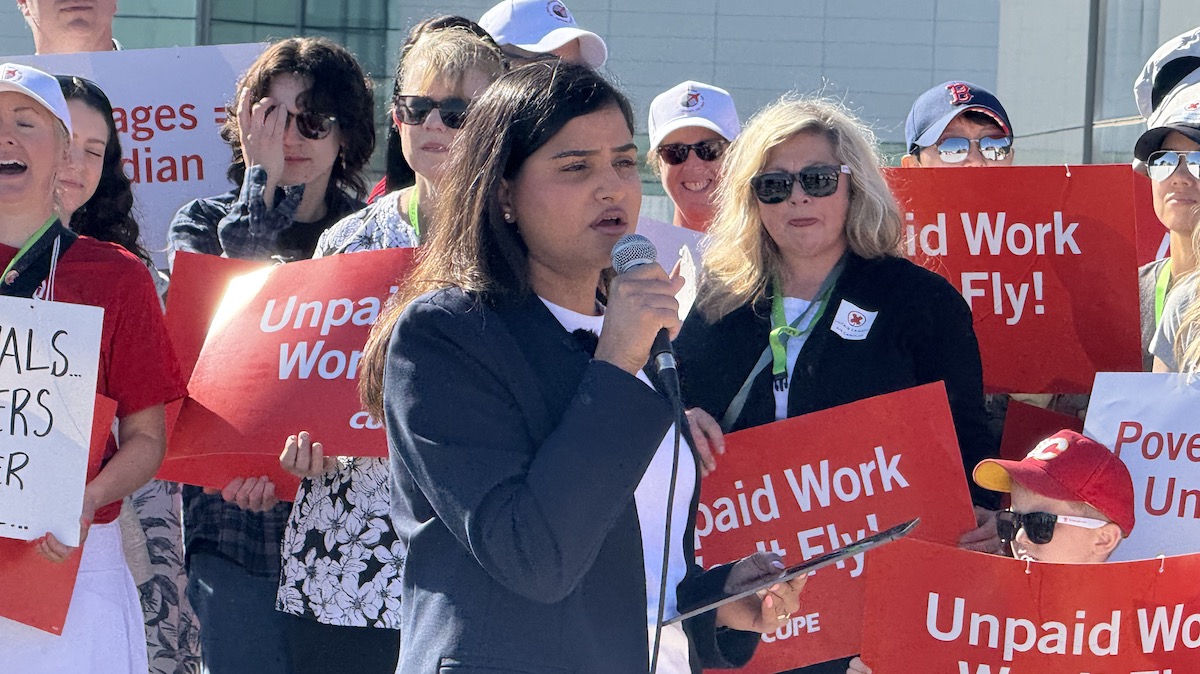
When federal Jobs Minister Patty Hadju yesterday sent Air Canada flight attendants back to work and into binding arbitration after less than 12 hours on strike, Conservative Opposition Labour Critic Kyle Seeback issued a statement calling on the government to deliver one of the strikers’ key negotiating positions through legislation.
To wit: To pass a private member’s bill given first reading a year ago, and nothing more, that would ensure flight attendants are paid for work they do when their planes are not airborne.
The Canadian Union of Public Employees, which represents the flight attendants, has made it clear that not being paid for work done when aircraft are on the ground is a major issue. “Air Canada knew they could avoid ending the abuse of unpaid work and poverty wages for flight attendants as long as they stonewalled negotiations – and the Liberals proved them right yet again,” the union said in a bitter news release yesterday.
What’s more, the union says, the vast majority of Canadians agree with them.
Seeback’s news release appeared under the headline “Conservatives Stand With Workers,” which anyone who has paid attention to the history of labour relations in Canada knows to be, shall we say, an exaggeration.
Indeed, federal and provincial Conservatives throughout this country spent a lot of time and energy during the recent prime ministership of Justin Trudeau assailing the federal Liberals for not ordering this group or that group of workers under federal jurisdiction back to work quickly enough. Or even pre-emptively—during negotiations before the workers had actually hit the bricks.
So when Seeback says, “No worker—federally regulated or otherwise—should be forced, especially by the government, to work without being paid,” he’s not wrong. Although that “especially by the government” bit is an interesting riff. But when he implies a Conservative Government led by Pierre Poilievre would not have done the same thing in the same circumstances as the Liberals just did, he is pulling our legs.
Hadju’s news release said that since it was obvious the parties were nowhere near an agreement, the already serious impact of the strike would quickly grow worse. “This nationwide labour disruption is impeding the movement of passengers and critical cargo,” she said. “In a year in which Canadian families and businesses have already experienced too much disruption and uncertainty, this is not the time to add additional challenges and disruptions to their lives and our economy.”
It is simply impossible to imagine, had Poilievre become prime minister last April, that in the same circumstances he would not have done exactly the same thing on the same timetable.
Of course, there is no way any Canadian government—even one led by New Democrats—would let such a labour dispute drag on while Parliament was recalled to pass something like Ontario Conservative MP Lianne Rood’s “Fairness for Flight Attendants Act.” Nor would any government make such a move while arbitration was under way.
It is possible that had Trudeau still been prime minister, he would have hesitated to order unionized workers back to their jobs, and would have had to suffer the catcalls and abuse from Conservatives like Seeback and from provincial parties like Alberta’s United Conservatives for not doing so.
But Carney, it is becoming quite clear, is a different breed of cat. Not only is he prepared to act more decisively, but he is very much a small-c conservative, a fact that must make the Big-C Conservatives’ blood run cold when they consider the declining popularity of their present disagreeable leader, whose tenure in that job is about to be confirmed tomorrow.
As political commentator Dave Cournoyer observed Friday, Poilievre will most certainly win the Battle River-Crowfoot by-election, the only question is by how much.
On April 28, Poilievre was humiliated by Liberal Bruce Fanjoy in his long-held Carleton riding—which is what you get for taking coffee to MAGA convoy occupiers in Ottawa when your riding is an easy commute from Parliament Hill. As a result, Poilievre had to suffer the indignity of asking a loyal MP to step aside in one of the country’s safest Conservative seats so he could hang onto his subsidized housing in Ottawa.
The result was a by-election campaign in which the winner is a foregone conclusion, which the media has tried to make a little more interesting by focusing on the campaign of an independent local challenger, farmer and military veteran Bonnie Critchley. Critchley has run a spirited and entertaining campaign in which she has accurately portrayed Poilievre as a carpetbagger with little interest in rural Alberta.
But I’m sorry to have to agree with Cournoyer that it’s not going to make any difference.
Readers can check this prediction against the results tomorrow night. Count on it, though, on Tuesday morning Poilievre will return to Ottawa and never have to visit Battle River-Crowfoot again.
But I digress.
In its news release, CUPE hammered Prime Minister Carney for what it called “a blatant betrayal” of working Canadians.
“The government’s decision to intervene on behalf of an already wildly profitable employer, while a predominantly female workforce fights tooth and nail for a path out of poverty, is not just unjust, it’s a disgraceful misuse of power that reeks of systemic bias and corporate favoritism,” said CUPE national secretary-treasurer Candace Rennick.
This is strong stuff, but it is quite obvious corporations in federal jurisdiction have been provoking strikes by their employees, then counting on the feds to force the dispute to be resolved by arbitration, which typically fails to fix serious issues such as the no-pay-on-the-ground policy CUPE is fighting.
In the United States, the practice once standard in the industry has been abandoned by several airlines, including Delta Air Lines, American Airlines and Alaska Airlines, so it’s not as if there is no precedent in the land of unbridled capitalism.
Air Canada, of course, should be re-nationalized and operated more efficiently as a Crown corporation with a capable civil servant at its head, but we all know why that’s never going to happen.
But adopting Seeback’s proposal in Parliament would give Carney a chance to repair some bridges to labour, send a message to national companies that if they fool around they may just find out, and blunt accusations like CUPE’s that the Liberals are just toadies for their corporate pals.
One would think that with Conservative support—surely required now that Seeback has weighed in—such a bill would pass nearly unanimously.
Support rabble today!
We’re so glad you stopped by! Thanks for consuming rabble content this year.
rabble.ca is 100% reader and donor funded, so as an avid reader of our content, we hope you will consider gifting rabble with a donation during our summer fundraiser today.
Whether it be a one-time donation or a small monthly contribution, your support is critical to keep rabble writers producing the work you’ve come to rely on as a part of a healthy media diet.
Become a rabble rouser — donate to rabble.ca today.
Nick Seebruch, editor