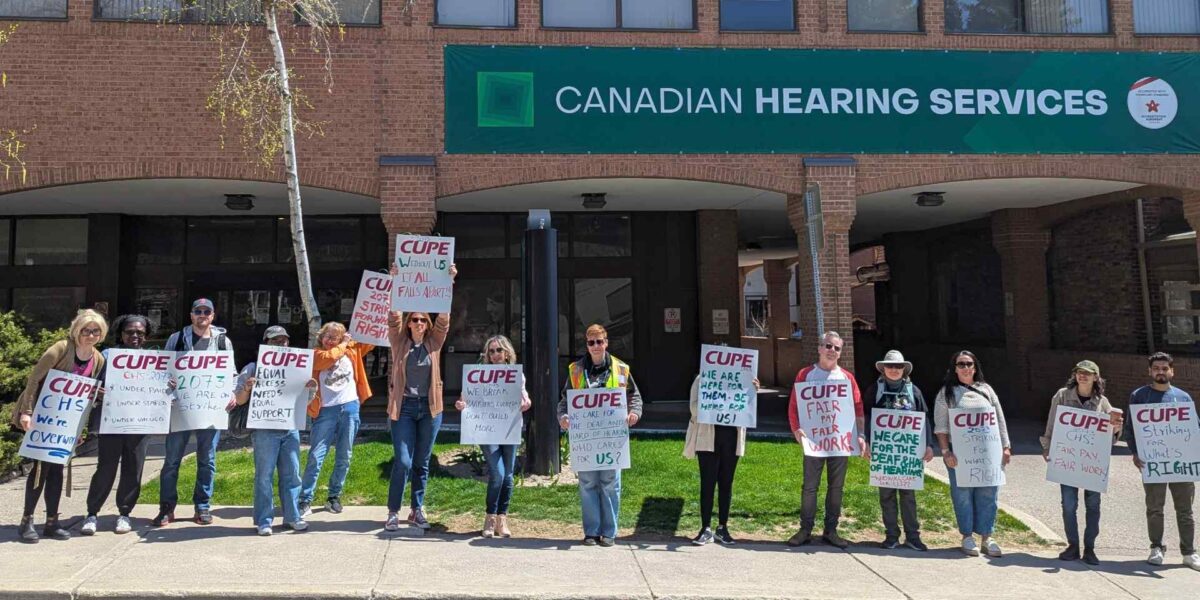
Workers at the Canadian Hearing Services (CHS), a vital community organization that provides services to diverse members of the deaf community across Ontario, have been on strike since April 28. This is the second strike under the current CEO, Julia Dumanian, reflecting a deeper crisis in the organization’s commitments and values.
Dumanian was hired in 2015. The 2017 strike, the first under her tenure, lasted 10 weeks. This strike (now in its fifth week) represents the second in eight years—a troubling pattern under Dumanian’s leadership.
Most recently, CHS came to the table not to bargain, but to demand a media blackout. CHS is trying to silence the deaf, deafblind, and hard of hearing communities. But workers, clients, and community members continue to tell the story—one of betrayal and resistance—that underlies this strike.
I joined CHS not long after that first strike, first as an Employment Consultant and later as a Literacy Instructor, working there until 2020. In my time at CHS, I witnessed the dedication of frontline workers to uplift, support, and care for their clients and community. The strike is about fair wages and working conditions as well as the systematic gutting of staff and services at CHS.
In an open letter to Accreditation Canada, CUPE 2073, which represents the striking employees at CHS, reported that since 2012, the number of workers at CHS has dropped from over 500 to only about 200 today. Many of those who left were deaf workers. With shrinking staff numbers, dwindling deaf representation, and increasing workloads, the quality of services is being undermined.
This strike also raises urgent questions about who is in positions of leadership at CHS and who determines if they are qualified to be there. Deaf communities have long fought for self-determination and control over deaf spaces, resisting hearing privilege and paternalism.
In 1988, students at Gallaudet University in Washington, D.C. demanded the appointment of the university’s first deaf president in the Deaf President Now (DPN) protest. Shortly after, the Deaf Ontario Now (DON) movement sparked a series of protests across the province, demanding deaf control over deaf education, access to education in signed language, and greater representation of deaf teachers. In 2004/5, the Friends of CHS mobilized to replace a disconnected board, once again resisting outsider rule.
Yet, today CHS appears to be cutting itself off from its community roots, increasingly adopting a medical model that sees deafness as an audiological issue, rather than a linguistic and cultural identity. By prioritizing medical interventions, this approach overlooks structural barriers—such as audist policies and practices in education, healthcare, and employment—that continue to oppress deaf people and communities.
A central issue of both strikes involves the unjust allocation of resources at CHS. In 2017 those on strike highlighted the sharp increase of salaries for the CEO and other leadership positions. In less than 10 years, the CEO’s salary has gone up 178 per cent while workers’ pay continues to lag significantly behind inflation. The inequality is even more stark when considering that deaf persons face high unemployment rates in Canada due to compounding structural barriers, including discrimination when job searching and limited pathways to promotion. This crisis is only exacerbated by staffing cutbacks at CHS itself.
Too often, non-deaf and non-disabled leadership profit off the backs of deaf and disabled workers and communities in the non-profit sector, controlling organizations like CHS while suppressing the needs of the communities they are supposed to serve. When organizations like CHS are run like businesses—when the focus is on profit—workers and community bear the costs.
We need a strong, community-grounded CHS that can advocate for deaf people on critical issues. These include language deprivation (which occurs when deaf children do not have access to a fully accessible signed language), educational inequality, and employment discrimination. But with its current trajectory, the leadership at CHS is not positioned to address the root causes of oppression and inequality. To do so requires real change, including representation at every level—starting from the top!
For CHS to truly serve the community, it must be led by those with firsthand, lived experience of the structural barriers faced by deaf people.
It’s time to ask the hard questions: How can we have faith in a social justice organization with such clear practices of exploitation? How can we stand for an organization cutting itself off from its community roots? And how long can we expect CHS workers to pay the price for a disconnected leadership?
It’s time for justice for workers at CHS and a change in leadership: Fair Wages for CHS Workers Now! Deaf CEO Now!
Support rabble today!
We’re so glad you stopped by! Thanks for consuming rabble content this year.
rabble.ca is 100% reader and donor funded, so as an avid reader of our content, we hope you will consider gifting rabble with a donation during our summer fundraiser today.
Whether it be a one-time donation or a small monthly contribution, your support is critical to keep rabble writers producing the work you’ve come to rely on as a part of a healthy media diet.
Become a rabble rouser — donate to rabble.ca today.
Nick Seebruch, editor