

Prime Minister Mark Carney launched a new industrial strategy for the automotive sector on Thursday, February 5. The strategy aims to make the Canadian economy more resilient in the face of global shocks such as the tariffs imposed by the U.S., Canada’s largest trading partner.
In an effort to encourage domestic production and investment in Canada’s auto manufacturing, the government will be allocating $3 billion to the auto industry, continuing counter tariffs on the U.S., strengthening tariff remission measures to reward companies that build and invest in Canada and launching a five-year EV affordability program to increase domestic market demand.
Unifor, the union representing the largest number of Canadian autoworkers, celebrated the new strategy but called on the government to back up their commitments with bold action.
“We need a strategy that reassures workers that automaking has a future in Canada, regardless of U.S. trade attacks,” said Unifor National President Lana Payne. “The bottom line for all automakers must be if they want to sell in Canada, they have to build and invest in Canada. The free ride must end for companies that take from Canada’s $100 billion sales market while giving nothing back.”
Unifor highlighted that the new auto-industry strategy still does not impose counter-tariffs on heavy duty trucks and the union leadership remains concerned about the strategic partnership with China that could lead to an import surge of China-made vehicles.
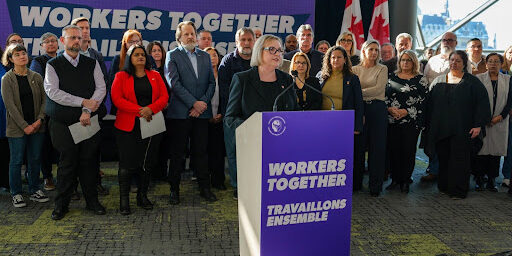
Canada’s labour movement has been vocal in their concerns around the federal government’s approach to trade issues. A group of labour leaders, including Lana Payne, held a press conference on Wednesday where they revealed that labour wants greater transparency around trade negotiations with the U.S.
“I truly believe that we can and we must develop strong, meaningful industrial strategies with workers at the table,” Payne told reporters on Wednesday. “We can take actions against companies that move their businesses out of our country. We can very clearly demand that if corporations are going to sell their products in Canada, then they must build here as well… We can reconcile the needs of working people today with a vision for a strong, resilient, competitive and caring Canada on a constantly changing world stage.”
Payne said that labour leaders are being consulted after decisions are made as a “box-checking exercise.”
Moving forward, labour leaders say they want worker’s voices to be heard throughout the decision making process. Led by Bea Bruske of the Canadian Labour Congress (CLC), the labour leaders on Wednesday called for a worker-first economic strategy that treats trade as a tool to develop Canada and not an end in itself.
“No trade deal is better than a bad trade deal,” Bruske said. “Governments must be prepared to walk away from a bad trade deal. Canadians deserve to know exactly what’s in the trade deals, exactly what their government has agreed to.”
She said trade deals cannot be struck without a proper domestic plan to support jobs and communities.
“We recognize that Prime Minister Carney is speaking about ambition, speaking about industrial renewal and Canada’s role in this changing global economy, that ambition matters,” Bruske said on Wednesday. “But if we are going to get this right, it has to be built with workers and unions at the table so that we do not repeat the mistakes of the past, growth for corporations and instability for everyone else.”
Support rabble today!
We’re so glad you stopped by! Thanks for consuming rabble content this year.
rabble.ca is 100% reader and donor funded, so as an avid reader of our content, we hope you will consider gifting rabble with a donation during our summer fundraiser today.
Whether it be a one-time donation or a small monthly contribution, your support is critical to keep rabble writers producing the work you’ve come to rely on as a part of a healthy media diet.
Become a rabble rouser — donate to rabble.ca today.
Nick Seebruch, editor