

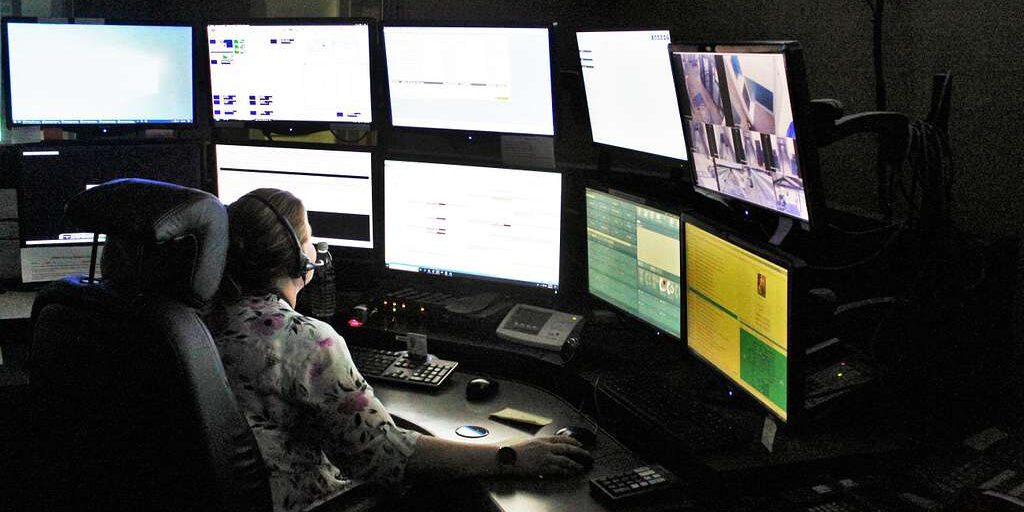
The union representing RCMP telecommunicators have called out new measures to strengthen border security and recognize frontline federal workers because the measures don’t include their members. The federal government announced in October that it would provide early-retirement options and benefit parity for those in high-risk, high-stress roles under the Public Service Superannuation Act (PSSA).
In an email thread sent to rabble.ca Kathleen Hippern, president of local 104 of the Canadian Union of Public Employees (CUPE), urges the prime minister to take action to recognize RCMP telecommunicators after her attempts to reach out to both the Minister of Public Safety and the President of the Treasury Board for clarification and a genuine opportunity to meet.
“RCMP Public Safety Communicators operate in a live, high-pressure environment where decisions must be made in seconds, often under extreme and evolving circumstances,” Hippern wrote in her email to the Prime Minister’s office. “Without their work, the rest of the public-safety system cannot function. They take the calls, dispatch the help, and protect the responders themselves. Recognition as a Public Safety Occupation matters for fairness, for retention, and for the sustainability of public safety across Canada.”
Hippern highlighted that RCMP telecommunications is female dominated, which she said makes their exclusion all the more troubling.
The workers that make up Telecommunications Operators and Intercept Monitor Analysts are 74 per cent women. The workforce in other public safety workplaces, by comparison, did not even consist of 40 per cent women according to the 2021 census. Firefighting employed the smallest percentage of women, with only five per cent of the workforce being female.
“It is difficult not to see a gender dimension in this ongoing exclusion,” Hippern wrote in her email. “RCMP Public Safety Communicators are the only female-dominated occupation within Canada’s federal public-safety community, yet remain the only group unrecognized under the Public Safety Occupation provisions. This persistent omission raises troubling questions about how women’s contributions in critical operational roles are valued compared to those of their male counterparts.”
While Hippern and CUPE more broadly have decried the gender bias that seems to be at play in this exclusion, the Treasury Board Secretariat said the decision was based on the demanding and risky nature of duties, challenging training and certification requirements, and lack of opportunity for public service mobility. In an email to rabble, the secretariat said this rationale was applied “strictly” for the sake of equitable consideration and consistency of application. At this time, there are no plans to include the RCMP Telecommunications Operators and Intercept Monitors into the expansion of the early retirement program.
“The Government recognizes the significant work conducted by RCMP Telecommunications Operators and Intercept Monitors and their important role in promoting public safety,” Rola Salem, a media relations officer for the Treasury Board Secretariat, wrote in an email to rabble.
Hippern said the exclusion of RCMP telecommunicators will only harm the recruitment and retention of these workers.
“Staffing levels in RCMP Operational Communications Centres have reached crisis levels, forcing exhausted employees to manage escalating call volumes and critical incidents with shrinking resources,” Hippern wrote. “Every delay in dispatching help, every missed opportunity to prevent harm, puts Canadians in danger. The safety of the public, the officers we support, and the integrity of Canada’s emergency-response system are all at risk.”
Support rabble today!
We’re so glad you stopped by! Thanks for consuming rabble content this year.
rabble.ca is 100% reader and donor funded, so as an avid reader of our content, we hope you will consider gifting rabble with a donation during our summer fundraiser today.
Whether it be a one-time donation or a small monthly contribution, your support is critical to keep rabble writers producing the work you’ve come to rely on as a part of a healthy media diet.
Become a rabble rouser — donate to rabble.ca today.
Nick Seebruch, editor