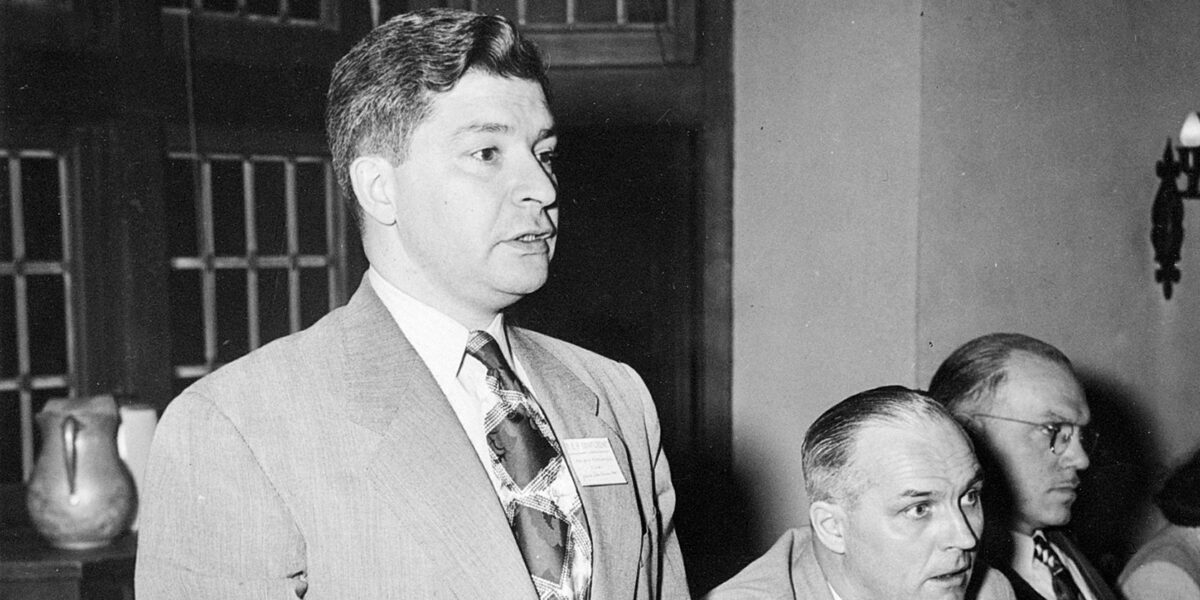
The Jewish Labour Committee of Canada (CJLC) lasted from the 1930s to the 1970s before closing its doors. In its heyday in the late 1940s and the 1950s it worked closely with organized labour, the Canadian Jewish Congress, and people of colour to promote anti-discrimination measures in housing, employment and immigration.
Now, in a surprise move, the Centre for Israel and Jewish Affairs (CIJA) has, in the wake of the October 7 Hamas attack, formed a new organization, using the JLC name but not the political slant to target union leaders and activists who are pro-Palestinian.
Independent Jewish Voices (IJV) took to Twitter, or X, to say that the CIJA is usurping the name of a venerable left-wing Jewish organization from the past for its own agenda.
“The vast majority of Jewish labour history has been leftist, socialist, anti-fascist, and, at times, anti-Zionist. This group is a cynical co-opting of our ancestors’ struggles for the rights of workers internationally, and does a grave disservice to their memory,” IJV stated officially on X.
CIJA has never shown any interest in the issues of the labour movement. Essentially, it is a secretive corporate structured organization that was originally started by large wealthy interests to replace the century old and democratic Canadian Jewish Congress as the representative organization for Canadian Jews. Since then, the focus by the Canadian Jewish leadership has been strictly about Israel, Israel and Israel, as if that is all to Jewish identity.
CIJA has successfully lobbied the federal and provincial governments to adopt the controversial International Holocaust Remembrance Alliance (IHRA) definition of antisemitism which includes characterizing anti-Zionism as Anti-Semitism.
As the pro-Israel lobby works its way through Canadian institutions, CIJA has encountered a serious roadblock with organized labour, because many leaders and activists are taking strong positions favouring the Palestinians as the genocidal Israeli military assault in Gaza continues.
The new organization that the CIJA has created, the Canadian Jewish Labour Committee (CJLC) can also be tracked on the internet by typing in Jewishlabour.ca.
This is how the CJLC describes itself: “Our mission is to unite Jewish workers across Canada’s labour movement by fostering inclusion, combatting antisemitism, and championing engagement and solidarity,” the web site stated.
The CJLC web site is new and there are just a few entries. One is a link to a discussion about CIJA’s legal fight against anti-Semitism. Another is a report that delegates at a recent annual general meeting of Ontario Secondary School Teachers Federation voted down a motion for the provision of resources for training in anti-Palestinian racism.
“The decision followed a point of consideration raised by union members, who opposed the motion on grounds that debate (and by extension, the motion itself) could be harmful and divisive,” the CJLC website stated.
But the CJLC is, perhaps, economical with the truth, says a reliable source who attended the same Ontario Secondary School Teacher’s Federation (OSSTF) Annual General Meeting. He says there were actually three motions, one about training in anti-Palestinian racism and two others pro-Israel in nature, and that all three were lumped together by OSSTF delegates because of concerns that the Israel-Palestine issue is too divisive for the union.
“Someone put forward a motion not to debate the [pro-Palestinian] motion — or two other motions that were pro-Israel — on the basis that any debate over them would cause ‘harm.’ [The anti-discussion motion] needed — and got — a two-thirds vote to succeed,” he explained.
One of the two defeated pro-Israel motions involved asking OSSTF to endorse the IHRA and to consult with certain “mainstream” pro-Israel Jewish groups including the CJLC and B’nai Brith.
The OSSTF AGM decision was in the end a mixed affair. While pro-Palestinian folks will mourn the loss of the training to combat anti-Palestinian racism, they will be happy with the decision by the OSSTF to maintain a distance from CIJA and other pro-Israel groups.
“The problem Zionists are having in unions is that they are democratic organizations where policies are created by members, not ‘leaders,’ and they’re only used to being able to control organizations that are top-down,” my source added.
The resurrection of the CJLC reflects a circling of wagons in a significant pro-Israel portion of the Canadian Jewish community. A sample of this is how in Canada the names and families of the people murdered or kidnapped by Hamas fighters in Gaza on October 7 are well known, but next to nothing is mentioned about the identities of the equally innocent Palestinians who have lost their lives to the Israeli military.
Let us now segue to the original Jewish Labour Committee in Canada and specifically the Polish born Kalmen Kaplansky, who became its executive director in 1946. Like many of his contemporaries in the organization he was influenced by the socialist internationalist principles of the Jewish Bund, which had its roots in the pre-World War II Jewish communities in Poland, prior to their destruction in the Holocaust.
Both the Bund and the JLC embraced a secular version of the Jewish religious principle of tikkun olam (repairing the world).
Kaplansky was a printer and a member of the International Typographical Union. With strong ties to both the Workmen’s Circle and the CCF (predecessor to the NDP) he was a tireless builder of alliances to put human rights principles into action. He managed to pull together Jewish trade unionists who made up the JLC (primarily in the clothing and needle trades) and a more middle class, often employer-led, Canadian Jewish Congress in a common cause.
This was an alliance that made sense in the 1940s, but it would be severely tested over the long haul. What the two sides in the Jewish community shared was a desire to actively oppose all forms of racism, including antisemitism, in Canada that continued after 1945.
Unions themselves were not immune from the scourge, Kaplansky convinced competing national labour federations in Canada, the Canadian Congress of Labour and the Trades and Labour Congress, to set up joint labour committees in major cities to conduct human rights education campaigns among the union rank and file. This was done with the assistance of the JLC, which offered the expertise and the funding.
The Canadian Jewish Congress was also playing a proactive role. It took a lead after the war to push for a fair employment practices law in Ontario, says historian Ross Lambertson, the author of The Dresden Story : Racism, Human Rights, and the Jewish Labour Committee of Canada in the 2001 issue of the academic journal Labour/Le Travail.
That lobbying succeeded. By 1951 and 1954, in separate and complementary legislation, discrimination on the basis of race, colour, nationality, ancestry, or place of origin were prohibited in Ontario, courtesy of Premier Leslie Frost and his Progressive Conservative government. This was the first anti-discrimination law in Canada. Similar legislation was eventually adopted in other parts of the country.
However, the impact in Ontario was initially minimal because of cumbersome enforcement provisions and the Frost government’s slowness in pursuing further improvements in the law. Therefore, the Toronto Labour Committee that was led by Sid Blum, a protégé of Kalmen Kaplansky, mounted a sophisticated publicity campaign that targeted the racially troubled region of southwest Ontario where local Black people experienced discrimination.
They were descendants of the American slaves who had fled north before the US Civil War. One restaurant, Kay’s Cafe in the small town of Dresden, (population 1,700, 20 per cent of whom were Black) became the test case for the Toronto Labour Committee.
Blum personally investigated the tensions in the community and arranged for whites and Blacks to regularly and separately visit this eating establishment. There was confirmation that only whites were being served.
Morley McKay, the restaurant owner, resisted changing his ways despite the negative press. Blum was careful to stay in the background as activist Hugh Burnett, a local Black resident of Dresden and Canadian army veteran did all the explaining to reporters about the racism in this town.
“My impression of my father is that he was not interested in self-promotion. The cause is what counted,” stated Blum’s daughter Lil Blume.
The complaints about the Dresden restaurant owner began in 1954. Charges were laid but were subsequently dropped when the cases went to trial. Apparently, the judge did not want to convict one of his neighbours. But the activists persevered in pressuring the legal system to enforce its own law.
Finally in February, 1956, McKay was convicted and fined. He lost one appeal and considered a second one before the Ontario Supreme Court but eventually gave up. Close to the end of the same year, all patrons regardless of their colour were finally being served at this restaurant.
This is a sample of the human rights campaigning by the Jewish Labour Committee and Sid Blum playing a significant role. This activism included advising Black sleeping porters about fighting railway racist practices, mentoring a younger Alan Borovoy (the future counsel for the Canadian Civil Liberties Association), and challenging restrictive Canadian immigration legislation.
Over the long haul there were changes at the federal level leading to more liberalized immigration laws, the establishment of multiculturalism as an official policy and the Canadian Charter of Rights.
Sid Blum died prematurely of cancer in 1969 in his 40s and so missed much of this. A New York born Jew and a US war veteran he moved north to marry his Canadian sweetheart. A McMaster University historian and an expert on Jewish labour history, Ruth Frager, discovered a fascinating exchange between Blum and his counterpart in the American version of the JLC.
It appears to be a precursor to the rampant conservatism predominant in Canadian Jewish leadership circles today. Blum had earlier succeeded Kaplansky as executive director of the JLC and was working in Montreal.
“We have been having some interesting fights with our partners in the Canadian Jewish Congress public relations committee on tactics, strategies and who should get credit for what,” Blum told his colleague, J. Schlitt in New York.
Blum said he tried to work above the tension.
“I only simmer for about a week after any of these fights and then forget about the whole thing.” But these fights were starting to affect him, “Our labour associates are getting more radical and aggressive about anti-discrimination and our Jewish community associates are getting more reactionary and passive,” he added, completing the letter.
Ruth Frager was unable to find any additional information on Blum’s friction with the CJC. So, it remains a fascinating mystery, worthy of further investigation, she told me. One thing we know is that by the 1960s many Canadian Jews were becoming more middle class and suburban in their outlook and lifestyle. The old Yiddish-speaking working class was dying out and was superseded by more assimilated Canadian Jews prone to voting for one of the mainstream parties.
The JLC, Karmen Kaplansky and Sid Blum are largely forgotten, which is why the CJLC is able to besmirch their legacy.
Finally, I would like to note that attempts on my part to contact and dialogue with both the OSSTF and the CJLC were not successful. I left phone messages at the communications office at the OSSTF, but nobody at the teachers’ union returned my call about the motions at the AGM. I also requested an interview via email with the Canadian Jewish Labour Committee, but they too did not respond.
This article originally appeared in UJPO News, spring 2025 edition
Support rabble today!
We’re so glad you stopped by! Thanks for consuming rabble content this year.
rabble.ca is 100% reader and donor funded, so as an avid reader of our content, we hope you will consider gifting rabble with a donation during our summer fundraiser today.
Whether it be a one-time donation or a small monthly contribution, your support is critical to keep rabble writers producing the work you’ve come to rely on as a part of a healthy media diet.
Become a rabble rouser — donate to rabble.ca today.
Nick Seebruch, editor