

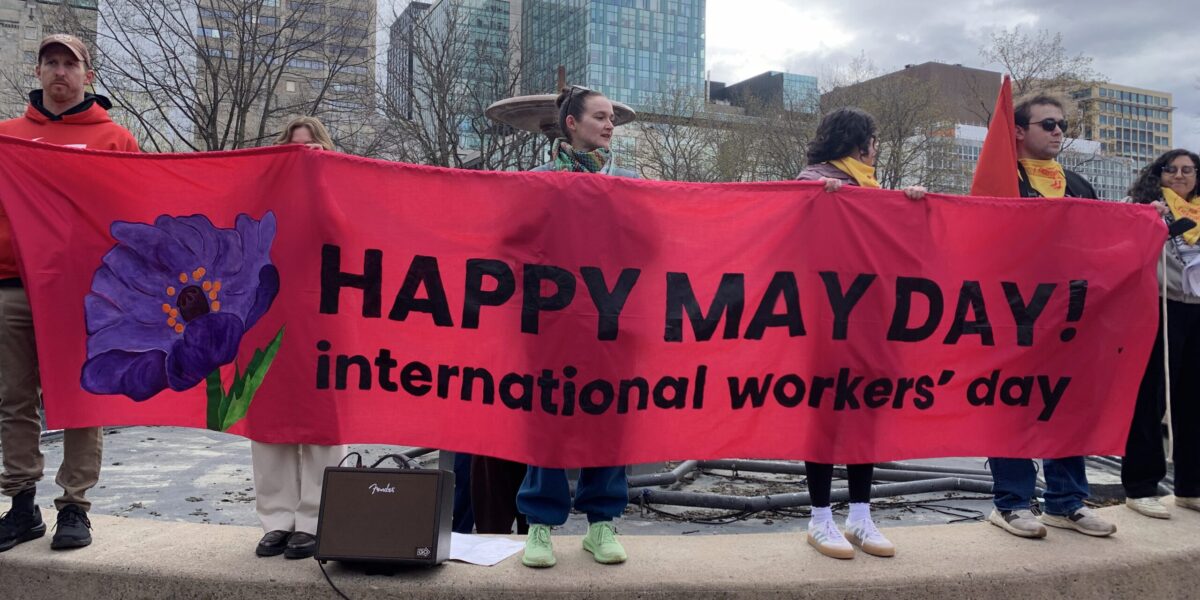
“Workers of the world unite! One planet, one fight,” protestors in Ottawa chanted at the march to mark May Day. Efforts to organize the working class grow as workers navigate hardships caused by government austerity, tariff-driven job losses and a rising cost of living amidst the U.S. led war in Iran.
Alongside the calls for higher wages and better working conditions, organizations are also highlighting the challenges workers face outside the workplace. In particular, workers were calling out the heavy burden workers carry during times of imperialist-led war.
“Each day the world gets scarier,” the Ottawa May Day Organizing committee wrote in a flyer passed out at their rally. “We are seeing a global rise in right-wing authoritarianism. Immigrants and trans people are being targeted. New wars are being waged and threatened around the world as Palestine endures unspeakable horrors and Cuba is denied necessities of life.”
During their march, protestors stopped outside the offices of the Canadian Association of Defence and Security Industries to demand an end to war profiteering. In attendance was a coalition of organizations that make up Shut Down CANSEC, which organizes to stop the largest arms fair trade show in North America that occurs in Ottawa every year.
“Without the armed force that these companies provide, the corporations would not be able to force us to work long hours for starvation wages, or force communities from their land,” Shut Down CANSEC organizer, Rosie Lucente, said to the crowd. “It’s the same companies that profit from the killing of our comrades abroad that profit from the oppression of our movements here.”
Workers are feeling the pinch of war profiteering everywhere, but particularly at the gas pump. CAA’s gas price tracker said gas sat at 184.8 cents per litre on Monday. This is only two cents lower than this year’s highest per litre gas price.
In March, the Alberta Federation of Labour (AFL) called for an oil windfall profit tax because they expected oil companies to offload any market pressures onto the average consumer.
Jim Stanford, an economist with the Centre for Future Work, said this pattern was seen with the invasion of Ukraine in 2022. He said the increase in oil price hikes were driven by financial speculation on futures markets, not oil supply. Lucente said these kinds of impacts caused by war highlight why workers should join anti-war profiteering efforts.
“Not only do we have the duty to stand in solidarity with our siblings abroad, we have an interest in standing with them,” they said. “If we let companies get away with it, we are letting ourselves be undermined.”
Alongside cost-of-living pressures, organizers say war profiteering is also contributing to job losses in Canada. At the May Day rally, protestors chanted against Mark Carney’s pledge to committee 5 per cent of Canada’s annual GDP to defence by 2035.
The Women’s International League for Peace and Freedom Canada launched a petition in April calling for a reduction in military spending. The organization said these spending targets come at the cost of other publicly funded services.
“We want the federal government to adequately invest in housing, health care, education, the Calls to Action of the Truth and Reconciliation Commission and the MMWIG Inquiry, public transit, international aid, and increase the budget for WAGE,” their petition reads. “We appeal to the federal government to fund a green, peace care economy that improves the well-being of all Canadians, protects the climate and environment, and ensures our commitment to UN multilateralism not militarism.”
Support rabble today!
We’re so glad you stopped by! Thanks for consuming rabble content this year.
rabble.ca is 100% reader and donor funded, so as an avid reader of our content, we hope you will consider gifting rabble with a donation during our summer fundraiser today.
Whether it be a one-time donation or a small monthly contribution, your support is critical to keep rabble writers producing the work you’ve come to rely on as a part of a healthy media diet.
Become a rabble rouser — donate to rabble.ca today.
Nick Seebruch, editor