
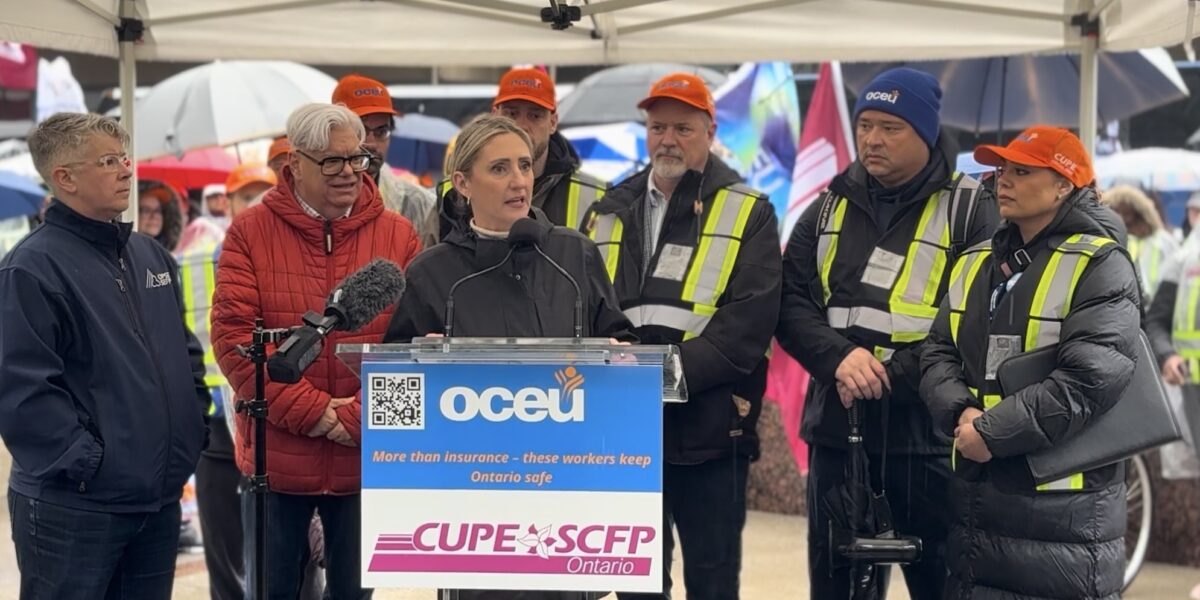
Employees at the Workers’ Safety and Insurance Board (WSIB) began strike action on Wednesday morning, May 21. The board’s workers, represented by Canadian Union of Public Employees (CUPE) 1750, and their employer have been embroiled in collective bargaining for weeks, with some bargaining days taking up to 14 hours. WSIB workers across Ontario have been without a contract since the end of April.
The union says workers’ main concerns include workload, wages, and union representation. According to CUPE, the employer’s most recent offer was a two per cent wage increase in one year, 1.5 per cent in the second and 1 per cent in the last year.
“Our members are committed to supporting injured workers in Ontario. We do the work we do because we care about the people behind the case files, but we are workers too, and right now our employer is trying to bully us into accepting the status quo,” said Harry Goslin, President of the CUPE 1750 / the Ontario Compensation Employees Union (OCEU) in a statement on Wednesday.
Beyond pay issues, CUPE is also citing widespread mental health issues resulting from unfair workloads as another major point of contention. In 2024, the Occupational Health Clinics for Ontario Workers conducted a survey on WSIB employees and found 56 per cent of respondents said the WSIB workplace is toxic. As well, 80 per cent of survey respondents felt their workplace is understaffed.
“Our members need the employer to work with us to reduce these workloads,” said Goslin. “We came to the table ready to work through these issues and get a deal, but instead we learn the shocking truth that employee health and safety is not a priority.”
This strike action is the first time WSIB employees have had a work stoppage. The union said the bargaining impasse haveleft workers no choice but to strike.
“My coworkers and I are taking a stand – right now, this year, this round of bargaining – to defend our own wellness and standard of living, and to fight for a WSIB that prioritizes workers and their needs,” said Goslin.
The WSIB said they remain at the bargaining table but have not heard from the union since Monday.
“Our top priority is helping people. Rather than pursue further disruption, the WSIB is focused on bargaining, and ensuring critical services continue to be offered. We will do everything in our power to support people who rely on what we do,” said Jeff Lang, President and CEO of the WSIB.
CUPE maintains that WSIB is in a position to better fund the services injured workers rely on, but the Ontario government has refused to do so. Ontario’s government, led by Premier Doug Ford, said the province’s businesses will receive $4 billion in rebates through WSIB in 2025. A government document says “these measures reflect the government’s commitment to fostering a robust and resilient business environment to protect against economic uncertainty and the impact of U.S. tariffs.”
Goslin, however, said the decision will only erode the services and coverage available to workers. This money should instead be used to expand coverage to the more than one million workers who cannot access WSIB benefits, he added.
Aside from bargaining woes as the parties try to nail down a collective agreement, WSIB workers are also plagued by the threat of their jobs being outsourced to American companies. The board is in the process of finalizing a contract with the firm Iron Mountain which is based in Boston, Massachusetts.
Goslin said the union met with WSIB on this issue and offered alternatives to outsourcing jobs, but leaders did not budge on their decision.
“WSIB is funded entirely by Ontario employers,” Goslin said. “It is disrespectful to put those dollars into the hands of an American company during a trade war.”
While WSIB workers strike for higher pay and better staffing, 26 jobs with the organization could be lost to U.S. firms.
“The whole country is working together to shore up our economy and protect Canadian jobs and families, except WSIB,” said Goslin, president of the CUPE 1750. “Money that comes from Canadian companies to pay for safety training and workplace insurance for Canadian workers should stay in Canada, period!”
Support rabble today!
We’re so glad you stopped by! Thanks for consuming rabble content this year.
rabble.ca is 100% reader and donor funded, so as an avid reader of our content, we hope you will consider gifting rabble with a donation during our summer fundraiser today.
Whether it be a one-time donation or a small monthly contribution, your support is critical to keep rabble writers producing the work you’ve come to rely on as a part of a healthy media diet.
Become a rabble rouser — donate to rabble.ca today.
Nick Seebruch, editor