
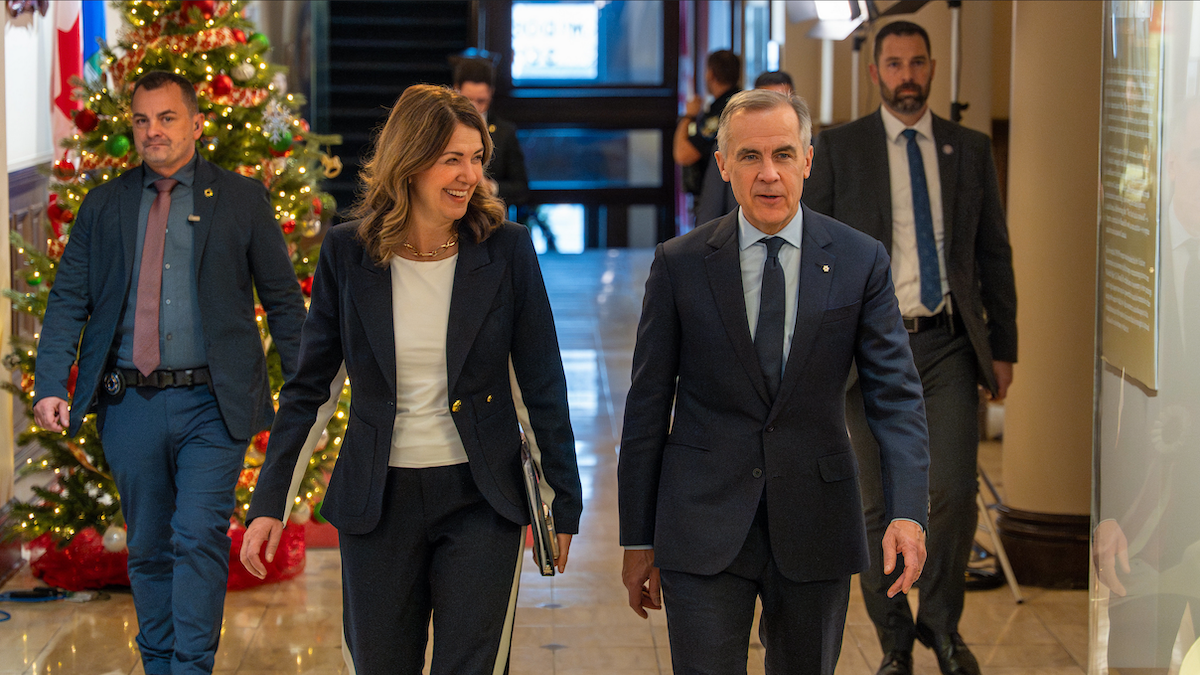
Compared to Venezuelan oilsands crude, according to Prime Minister Mark Carney, Canadian oil is cheaper, cleaner, and “clearly low risk.”
“Canadian oil will be competitive because it is low-risk, clearly low-risk, low cost,” Carney told a news conference in Paris, France yesterday. “There’s been huge progress on getting down the costs, and low carbon, which is what the Pathways Project carbon capture will bring.”
Mostly it ended up being concerned with U.S. President Donald Trump’s designs on Greenland and the likelihood, as stated by Danish PM Mette Frederiksen, that any American military annexation of the huge Arctic island that has been part of the Kingdom of Denmark for more than 300 years would spell the end of NATO. But Trump’s raid on Venezuela last Saturday has stirred up lots of concern about the future of Alberta’s oilsands as well.
Regardless of where he was, though, you can’t fault the prime minister for making this claim. Ultimately, after all, he’s the guy responsible for managing the national economy and you can’t just pull the plug on Canadian fossil fuel extraction even if you believe that it’s eventually bound to shrink significantly.
That’s why the Liberals never have, despite a parade of lies told by their political opponents in Canadian and Alberta Conservative parties about government policy during the Trudeau years. Instead, as is well known – except here on the Prairies, for some reason – Justin Trudeau himself played a significant role in making it possible to complete the Trans Mountain Pipeline Expansion project.
At the risk of sounding like one of those nattering nabobs of negativism, while you can make a case for the extraction cost of oil from Alberta’s oilsands being lower than Venezuela’s, despite the latter’s slightly lower viscosity, and while you can argue that Alberta bitumen is cleaner than the Venezuelan variety (if you’re willing to engage in a little unjustified optimism about the viability of carbon capture technology), there’s no way on God’s green earth you can claim any more that the risk is low.
And the reason for that fact can be summed up in two words: Danielle Smith.
Alberta’s premier and her highly irresponsible campaign to enable, legitimize and support Alberta separatism and some of its most unsavoury self-appointed proponents has introduced a very high level of risk to any investments in Alberta, let alone the kind of multi-billion-dollar spending required to build pipelines hither and yon, as Smith demands, or construct new oilsands extraction mines.
Business, as observers of modern politics anywhere are too well aware, is always screaming about how uncertainty is kryptonite to investment. Personally, I’ve long argued this is an exaggeration, since the kind of uncertainty they’re often screeching about is caused by things like paying employees a living wage or enforcing occupational health and safety regulations.
But, fair enough, if high officials of a provincial government going to talk seriously about breaking up one of the most successful countries on the planet and shoving secession down the throats of a skeptical population in a dubious referendum process, that sure as hell introduces the kind of uncertainty that really will make big business pay attention.
Here’s what Nancy Southern, scion of one of Alberta’s most prominent oligarchical families, said soon after Carney became prime minister last March: “This discussion of separation should have no oxygen.”
“It’s impacting investments now as we look to having partners for our large projects that are from offshore,” the chair and CEO of ATCO Ltd. told the Calgary annual general meeting of the multinational energy and utilities corporation. “Our Japanese partners or our South Korean partners want to invest in a multi-billion-dollar plant in the heart of Alberta and say, ‘Well, what are the rules going to be? What’s the currency going to be? Is there security around this? Who’s going to trade with this? How do we get to tidewater? …”
And let’s face it, folks, depending on the United States in its current state to solve the problem Southern accurately identified is not exactly going to reassure potential foreign investors.
It’s also important to note that while the United States’ mentally ill and self-evidently senile head of state is a significant problem for every country in the Americas, including Canada, and every trading country in the world, he is not the biggest cause of the perception of coming political and economic instability in Alberta.
Face it, Trump, who will be 80 in 158 days and shows obvious signs of both mental and physical decline, isn’t going to be around long enough to complete all his imperialistic projects. The United States may never again be our Best Friend Forever, but there are many reasons to be optimistic that whoever succeeds Trump will return a certain level of predictability to U.S. policy at home and abroad.
But if Smith and her UCP Cabinet and Caucus persist with their secessionist program, that sure as hell will bring investment to a juddering halt and drive corporate head offices and new projects to other provinces, just as they have already driven an estimated $33-billion in investment away by aping Trump’s pathological hatred of renewable energy.
Likewise, should they succeed in moving Alberta closer to separation, that will kill the memorandum of understanding on pipeline construction Smith and the prime minister signed on November 27 last year deader than the proverbial mackerel.
Alberta’s separatists – especially Smith and her allies in the UCP – are already doing enormous damage. The damage will continue to grow worse if they are allowed to persist.
As Southern observed, it’s way past time to cut off the oxygen to separatist talk.
If Smith won’t – and we can safely assume that is going to be the case – she above all others will be the person who history will blame for killing private-sector investment in pipelines and other new Alberta fossil-fuel projects.
Support rabble today!
We’re so glad you stopped by! Thanks for consuming rabble content this year.
rabble.ca is 100% reader and donor funded, so as an avid reader of our content, we hope you will consider gifting rabble with a donation during our summer fundraiser today.
Whether it be a one-time donation or a small monthly contribution, your support is critical to keep rabble writers producing the work you’ve come to rely on as a part of a healthy media diet.
Become a rabble rouser — donate to rabble.ca today.
Nick Seebruch, editor