Three days before the election, an Ottawa CBC radio all-party panel discussion pretty much summed up the 2025 campaign.
The broadcast featured candidates from the riding of Ottawa Centre. The politicians gathered at Ottawa’s downtown YMCA, where both the CBC host and some everyday citizens quizzed them.
The Liberal incumbent, Yasir Naqvi, was earnest and well-rehearsed. He skillfully blended his own biography as an immigrant who came to Canada as a 15-year-old with the Liberals’ leader-focused campaign.
The Green candidate, Amanda Rosenstock, candidly made a pitch for peoples’ votes in order to keep some focus on climate change and other environmental issues – even while tacitly admitting there was scant chance of the Greens electing more than two or three candidates.
The New Democrat, Joel Harden, who resigned his seat in the Ontario legislature to run federally, found much to agree with in what the Liberal said, especially with regard to Liberal leader Mark Carney’s big promise on housing.
Carney has announced a massive post-World-War-II-style plan for housing, the centrepiece of which is a new federal entity, Build Canada Homes. The New Democrat praised that initiative.
But Harden also made a pitch for his own party, to wit: However worthy the Liberals’ intentions, the new Parliament will need New Democratic MPs to make sure Carney and his team keep their promises.
As for the Conservatives – their candidate didn’t show up. The CBC host politely explained that the Conservative was “not available”.
In fact, the Conservatives have systematically avoided all such events. They don’t want their local candidates talking to media, any media, any time, full stop.
At leader Pierre Poilievre’s campaign events Conservative staffers have gone to great pains to block contact between members of the press and local candidates. They have even used physical force.
It seems the Conservative party does not trust its local candidates. Indeed, they barely trust their leader to talk to the news media.
At Poilievre’s press conferences Conservative apparatchiks allow only four questions in total, from handpicked news organizations, with no follow-up questions.
NDP urges progressives to give them a meaningful voice in Parliament
The New Democrats’ tacit support of the Liberals is something new for Canada’s traditional party of the social-democratic Left.
The NDP has run to be a strong third-party voice, not government, in the past. But it has never been quite so open about favouring a Liberal over a Conservative win.
Maybe that’s because the current Conservatives are definitely not your grandparents’ Progressive Conservatives.
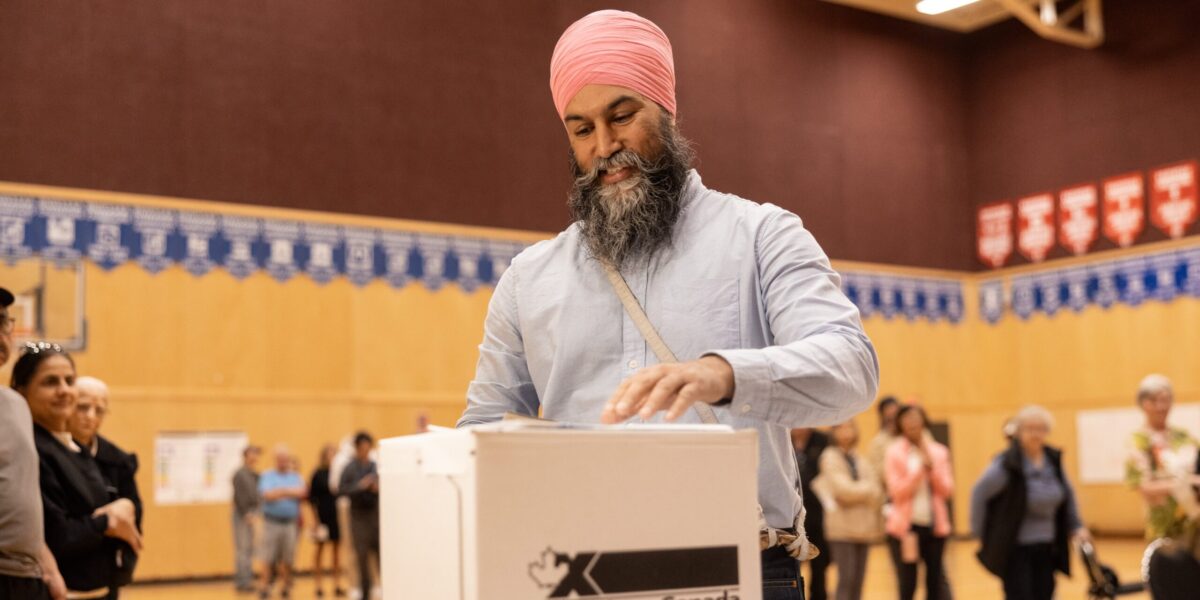
Toward the end of the campaign, NDP leader Jagmeet Singh quite bluntly told the Toronto Star that to stop current Conservative leader Pierre Poilievre from becoming PM he has put “Canada before the NDP.”
Singh’s pitch to voters now is the same as that of Joel Harden, his Ottawa Centre candidate.
The Liberals are going to win, Singh admits, and that, on balance, is a good thing – far better than the alternative. However, Singh and Harden add, we cannot trust the Liberals once in power to resist the pull to the right.
The next Parliament will need New Democrats, they say, to stiffen the Liberals’ resolve to enact progressive measures – and to provide a counter-balance to big business’ well-paid lobbyists and the highly vocal populist Right.
Differing progressive views of the Liberal leader
There are some voices on the Left, other than those of the NDP leadership, who are not quite so sanguine about Mark Carney’s Liberals.
On his blog, TC Norris, Paul Barber, a former CBC producer and senior Ontario public servant, writes:
“The party with the biggest policy victory in this election is going to be Pierre Poilievre’s Conservatives. Mark Carney handed the policy victory to the Conservatives when he announced on day one of the campaign the end of the carbon tax… Carney also conceded to Conservative views on a second issue when he canceled the proposed increase to the capital gains tax.”
Barber is factually correct.
When Carney dumped the consumer carbon tax, he candidly admitted he did so for purely political motives.
The Conservatives, and their media and industry allies, had succeeded in convincing Canadians a modest tax designed to reduce greenhouse gas emissions was too costly.
The anti-carbon-taxers succeeded in swaying public opinion – even though most taxpayers have gotten back more in the federal carbon rebates than they paid in increased prices.
Carney’s other concession to the Right is more puzzling.
The Trudeau government’s increase in the capital gains inclusion rate – from 50 per cent to two thirds for corporations, and for individuals’ net profits over a quarter of a million dollars – had an impact only on a tiny proportion of (mostly) wealthy Canadians.
Carney justified rolling back the increase by saying he did not want to penalize “risk takers”.
Now, it is true that there are some folks who have put a major effort, with few guarantees of success, into getting innovative new businesses up and running. They employ Canadians and help this country remain competitive.
In this time of severe economic uncertainty, Canada needs those creative and adventuresome risk-takers more than ever.
But they are far from the only ones who would see a modest increase in their capital gains tax liabilities.
As it stands now, a person who inherits, say, $50 million, and puts it into the hands of a broker, who then invests it all in U.S. stocks and bonds, pays tax on only half of the profits he earns from the sale of any of his assets.
Trudeau’s new rules would have required that well-heeled investor to pay tax on two thirds of any profits over the high threshold of a quarter million dollars.
Average workers, who make, say, $50,000 a year, pay tax on 100 per cent of their hard-earned income (less the tiny personal deduction the Canadian government allows them).
That is manifestly unfair. Why should people who work for a living pay higher taxes than folks who simply let their investments work for them?
The economist John Kenneth Galbraith eloquently explained that kind of economic philosophy.
“To make the poor work harder, we pay them less,” he wrote. “To make the rich work harder, we pay them more.”
Perhaps the Liberal leader should have put in place a carve-out for the true risk-takers and innovators, whose activities tangibly contribute to the Canadian economy.
A smart economist like Mark Carney should have been able to devise a system flexible and subtle enough to encourage genuine risk and innovation, while demanding a fair tax from those who seek only personal profit by investing in foreign companies.
Carney made a different choice. And that choice should have those who believe in equity and fairness worried.
But there are many ways in which Carney is vastly different from Poilievre.
The Liberal leader will not defund the CBC, for instance. To the contrary, he will enhance government support for the public broadcaster, at a time when we need it more than ever.
Carney will not use the notwithstanding clause to institute unconstitutional and draconian criminal code changes – as Poilievre has promised to do.
Nor would Carney, as Poilievre has promised, impose sanctions, including deportations, on non-citizens whose actions, such as protesting the war in Gaza, do not rise to the level of crimes but might be seen as “destabilizing” our society.
And while Poilievre made a big show of his plans to criminalize homelessness, Carney has said quite bluntly he does not favour what he describes as that American approach.
To make what’s at stake here clear: In the dying days of the campaign Poilievre took aim at unhoused people who have made their homes in encampments on public lands.
There is now no law against camping in urban areas, except, perhaps, for trespassing. It is certainly not a crime for desperate people to try to survive by seeking shelter wherever they can.
Well, the Conservative leader believes he can reap political gain by attacking those people.
He has promised to create a new crime of “discouraging the general public from using or moving through public spaces.” The Conservative platform specifically says it will empower the police to go after people who set up temporary structures, including tents.
British Columbia law professor Benjamin Perrin, who was a senior advisor to former Conservative Prime Minister Stephen Harper, describes this Poilievre gambit as: “Heartless. Cruel. Wrong. Unconstitutional.”
The Conservative leader must never be allowed anywhere near the Prime Minister’s office, Perrin concludes.
Which Carney will show up after Monday’s election?
If Carney does win on Monday, we know we will be spared the hot-button, populist-Right nonsense that is part of Pierre Poilievre’s DNA.
But when it comes to his fiscal plans – and economic policy in general – we do not know which Mark Carney will show up.
Will it be the pro-business, bottom-line focused guy who promises to use AI to make deep cuts in the federal service?
Will it be the economist and banker who described all Canadians who benefit from a generous tax exemption on capital gains as “risk takers” – even those who do nothing but watch their money grow on investments in U.S. companies?
Or will it be the outside-the-box thinker who has committed the federal government to play a major and direct role in housing, for the first time in three quarters of a century?
Carney is a complicated person, with more than his share of contradictions.
He is an advocate for a free-market economy who has lambasted the greed and, at times, inhumanity of capitalism.
He is an environmentalist who also wants to build more pipelines for oil and gas.
He is socially progressive but frets about the cost of expanding Canada’s still frayed social safety net.
One thing is certain about the current and possibly future PM. He knows his own mind. He is not the sort of person who will spout whatever the last person who talked to him said.
Still, politics is a team sport, played out, to some extent at any rate, in a public arena.
Given the multiple sides of Mark Carney’s political personality, Jagmeet Singh and his gang might have a point when they argue it would be more than useful if we had enough New Democrats in the next Parliament to at least exercise a modicum of influence.
If you have not yet voted, good luck in making your choice on Monday.
Support rabble today!
We’re so glad you stopped by! Thanks for consuming rabble content this year.
rabble.ca is 100% reader and donor funded, so as an avid reader of our content, we hope you will consider gifting rabble with a donation during our summer fundraiser today.
Whether it be a one-time donation or a small monthly contribution, your support is critical to keep rabble writers producing the work you’ve come to rely on as a part of a healthy media diet.
Become a rabble rouser — donate to rabble.ca today.
Nick Seebruch, editor