In 2023 the late prime minister Brian Mulroney watched Conservative leader Pierre Poilievre deliver a rousing 90-minute speech to his party’s convention. Then he turned to his son and said:
“I’ve seen a lot of convention speeches, but that was the best I’ve ever witnessed!”
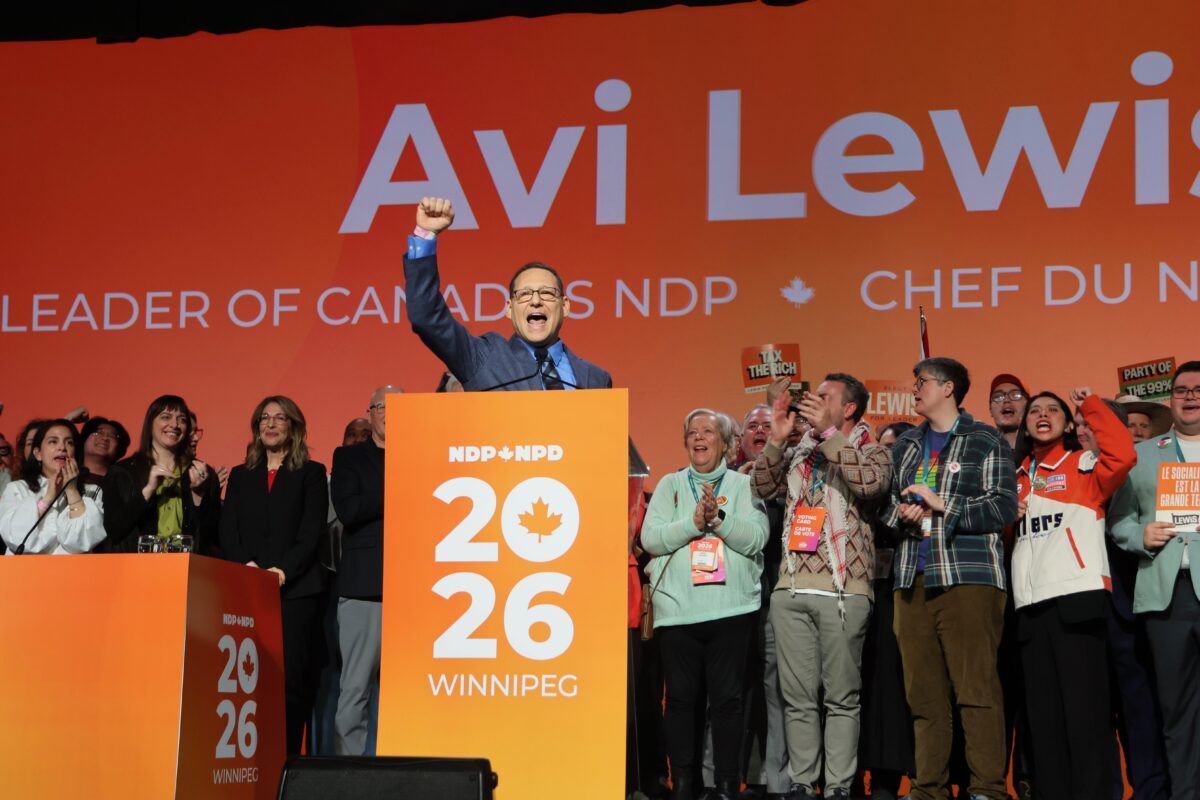
This writer has seen a lot of leadership acceptance speeches, and he can honestly say Avi Lewis’ speech in Winnipeg on Sunday March 29 was the best he ever witnessed.
Victory speeches are not supposed to be Fidel-Castro-length stem-winders of the sort Poilievre gave in 2023.
They are supposed to include thanks to supporters and volunteers, appeals to unity, and some rhetoric to rally the troops.
Lewis’s speech was true to prescribed form.
But within those narrow limits he managed to eloquently encapsulate what his leadership campaign was all about – and why it excited so many people.
Lewis’ proposals are prudent and small-c conservative
Commentators in the media were quick to label Lewis as a radical ideologue of the left.
David Herle, who worked on many Liberal campaigns and was a senior advisor to former Liberal prime minister Paul Martin, admitted Lewis gave an effective speech, but added: “Canadians are not ready to abandon the capitalist system.”
The accusation that Lewis proposes abolishing our current market-economy system is absurd and laughable. But more on that later.
In truth, what was truly remarkable about the Lewis victory speech was that it was almost entirely free of ideological jargon and buzz words.
Without resorting to sloganeering or political clichés, the new NDP federal leader spoke in a tangible and human way about Canadians’ day-to-day concerns and fears – especially the fear of not being able to pay for housing or groceries or a mobile phone plan (a virtual necessity of life in 2026).
Lewis pointed out that while lots of politicians are good at identifying the economic malaise that plagues too many of their fellow citizens, few have much to offer in the way of solutions.
The new New Democratic leader has put forward a number of clearly-delineated policies to address Canada’s affordability crisis, including federally-legislated rent control.
The centrepiece of Lewis’ economic policy offer, however, is one key proposal: to harness the power of the public sector and public ownership.
That means providing a public option in the wholesale grocery, mobile phone, and housing sectors.
It doesn’t mean nationalizing any sector. And it certainly does not mean, as David Herle suggested on television, turning the current Canadian mixed economy into an entirely state controlled one.
Rather, Avi Lewis deftly connected the need to take bold measures to address the high cost of living and declining economic opportunities facing many Canadians with the need to, in his words, “Trump-proof the economy.”
How would Lewis do that? You guessed it: “By investing massively in Canadian economic independence using the unmatched power of public ownership.”
In the Winnipeg speech Lewis enumerated some of his economic and social policy targets. They include embracing the EV revolution, a heat pump in every home, and investing in the care economy, which includes education, child care, and health care.
Lewis pledges to pursue the NDP’s first leader Tommy Douglas’ dream of head to toe, fully accessible health care for all, which would include eyes, teeth, pharmaceuticals, and mental health.
The care economy, Lewis argues, is as much an engine of growth and means of assuring Canada’s economic sovereignty as the natural resource economy.
And his fundamental economic proposition to Canadians is that the State must do more economically than offer subsidies, regulation reductions, and tax incentives to motivate the private sector to invest.
That’s Carney’s principal response to the existential threat posed by Trump, and, says Lewis, it is not adequate.
There will always be a big role for the private sector in Canada. It is unavoidable.
Even if it were desirable, which it is not, it would not be possible to transform our free market economy into a Soviet-style command economy.
But the current prime minister’s obsessive and near-exclusive fixation on the private sector, which owes loyalty to nobody and nothing except its own bottom line, is potentially dangerous and self-defeating.
The economic sovereignty policy Lewis is pushing is, in fact, not radical at all. If anything, it is prudent and small-c conservative.
The Lewis policy’s central postulate is that we cannot count on private enterprise to do all the work necessary to assure Canada’s prosperity and independence. The logical corollary is that we have no choice but to grow the public sector part of the Canadian economy.
One part of achieving that goal will entail taxing the über-wealthy.
The other part would mean using public resources to invest not only in services, but in industries that are now the near-exclusive purview of the private sector, such as food and telecommunications.
Avi Lewis’ biggest challenge (not the West)
Commentators could not help but notice that almost immediately after Lewis was declared victor the Alberta and Saskatchewan New Democrats distanced themselves from him.
NDPers in those two western provinces consider Lewis’ emphasis on green, environmental growth to be a threat to their fossil fuel industries, and they do not like his opposition to new pipelines.
Those dissenting voices will be a challenge for Lewis, but perhaps not as great as it seems right now.
The whole issue of using more pipelines to give Canadian oil and gas access to markets other than Trump’s U.S. is something of a red herring. Even if any pipelines were to get private sector proponents and approval in the near future, it would take many years before they would be operational.
In addition, the Liberal government’s pipeline talk is incoherent and contradicts itself.
On the one hand, they refer to a route through northern British Columbia to get Alberta bitumen to the port of Kitimat and thence to markets in the Asia Pacific region.
Then we have Carney’s energy minister Tim Hodgson going to Texas to tell American oil barons that Canada is ready to revive the Keystone XL pipeline – to ship that same product south to the U.S.
Lewis will never be able to placate New Democrats in fossil-fuel exporting provinces, but given the confusions of those pushing more fossil fuel development in Canada, he should be able to respectfully agree to disagree.
The bigger problem for the newly elected New Democratic leader is one few are now talking about: His lack of anything resembling comfortable French.
In his Winnipeg speech Lewis spoke his written-out and pre-rehearsed French lines well, and with a credible accent. One had the impression that, maybe, he was ready to engage in debates, answer questions spontaneously, and give interviews in French.
The new leader’s press conference the next day told a different story.
Not only did Lewis not utter a single word of French in his opening remarks, when asked to respond to questions in French he struggled mightily. This fluently bilingual listener could not, honestly, de-code what he was trying to say.
Those who wish him well, and not only in Quebec, have to hope Avi Lewis takes to heart this very significant weakness for a 21st century federal party leader – and a progressive one to boot.
The last Conservative leader who had inadequate French was Bob Stanfield, who retired in 1976.
The last such Liberal leader was Lester Pearson, who ceded his office to Pierre Trudeau in 1968.
Not only was former Conservative prime minister Stephen Harper comfortable in French, but so were a number of his non-Quebec cabinet ministers, including James Moore and Jason Kenney.
There are many leading anglophone NDP figures who speak good French, including Peggy Nash, Joel Harden, Peter Julian, and former leader Jagmeet Singh.
Avi Lewis might or might not wish to explain why, as a person with national political ambitions, he did not, years ago, invest the time and effort needed to master the French language.
The past is the past in any case.
Lewis has the big job now, and it’s 2026.
In the 1920s, ‘30s, and ‘40s William Lyon Mackenzie King could win the votes of Quebeckers without speaking French.
In the 1960s nobody worried that the NDP’s Tommy Douglas could not speak French.
Things are different today.
In present-day Canada, a good many Canadians – anglophones as well as francophones – will not take you seriously as a federal party leader unless you can do interviews, take part in debates, campaign door-to-door, and cogently answer voters’ questions in reasonable and comprehensible French.
Those who followed the late NDP leader Jack Layton’s career report that, early in his tenure, he spent many months in Jonquière, Quebec, working earnestly on his mastery of French.
Jonquière is in Quebec’s Saguenay region, north of Quebec City, where there are very few non-francophones. It is where politicians, business people, and civil servants go when they are serious about developing fluency in what a friend calls “Canada’s first official language”.
Even if he has to dip into his own pocket to pay for it, Avi Lewis should book himself transport to and lodging in Jonquière as soon as possible.
He owes it to himself, to the party he now leads, and, most of all, to Canada.
Support rabble today!
We’re so glad you stopped by! Thanks for consuming rabble content this year.
rabble.ca is 100% reader and donor funded, so as an avid reader of our content, we hope you will consider gifting rabble with a donation during our summer fundraiser today.
Whether it be a one-time donation or a small monthly contribution, your support is critical to keep rabble writers producing the work you’ve come to rely on as a part of a healthy media diet.
Become a rabble rouser — donate to rabble.ca today.
Nick Seebruch, editor