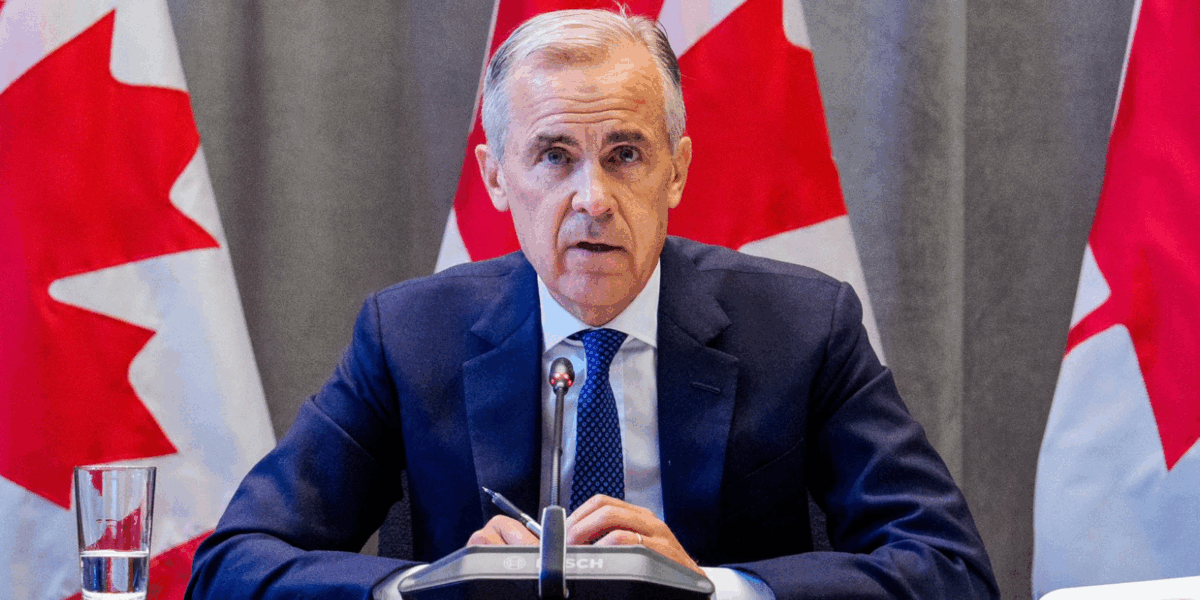
When millions of Canadians decided to vote for Mark Carney’s Liberals this past spring it was in response to an extraordinary threat this country had not experienced since the 19th Century.
For the first time in anyone’s memory, a U.S. president was openly and brazenly attacking the sovereignty of Canada. Some said Donald Trump was just joking; most did not find it funny.
Until Trump started prattling his 51st nonsense it had looked like Pierre Poilievre’s Conservatives would romp to electoral victory here—despite the aura of extremism that surrounded the Conservative leader.
But when sober, rational, experienced Carney took over from the more flamboyant (if also less consistent and coherent) Justin Trudeau, public opinion shifted.
To many voters, the Liberal former banker looked and sounded a lot more like the leader Canada needed at this fraught moment than angry and Trump-like Poilievre.
Mind you, the Conservative leader and his right-wing team did not do badly at all. As Conservatives and their apologists will happily tell you every chance they get, the Conservatives’ performance in the 2025 election was their best in many years.
Carney’s victory was, in fact, rather narrow, and due mainly to the massive defection of New Democratic voters from Canada’s traditional party of the social democratic left to Carney’s version of Liberalism.
Lacking a strong NDP voice Carney shifts Right
The NDP’s score was the worst in its history, even worse than 1993’s, when the party last failed to gain the minimum 12 seats needed for official parliamentary status.
To gain NDP support for his minority government Justin Trudeau had shifted leftward and enacted a number of New Democratic policies, notably pharmacare, dental care, an increased federal minimum wage, and federal anti-scab legislation.
From the outset, Carney saw no need to curry favour with Canadian progressives. During both the leadership and election campaigns he signaled that his would be a back-to-free-market-basics government.
Carney begrudgingly pledged not to scrap any of the measures Trudeau’s government had passed as part of their agreement with the New Democrats. But expanding or enhancing them was never on his agenda.
Carney’s main election promises—which he quickly fulfilled—would be to scrap two of Trudeau’s signature tax measures.
The first and most prominent was the consumer carbon tax. Carney abolished that as soon as he could.
By early 2025, the carbon tax, centrepiece of the Trudeau government’s climate change fighting plan, had become politically toxic. Poilievre was dining out on it daily, with the active or passive help of the mainstream media and much of the big business establishment.
Ironically, given the quarterly carbon rebates most Canadians received, the average taxpayer probably came out financially ahead as a result of the carbon tax.
But those average taxpayers didn’t see it that way. Many did not even know what those mysterious sums which appeared in their bank accounts four times a year were.
While killing the carbon tax might have been bad for the environment, it was great for the Liberals’ political standing. From a crass and opportunistic point of view, it was a no-brainer.
Killing that tax took away the deadliest cudgel Poilievre could use against the Liberals.
Killed a tax measure aimed only at the wealthy
Carney’s other big move on taxes was more of a head-scratcher. Almost as soon as he declared for the party leadership, Carney promised to rollback a modest increase in what is called the inclusion rate for the capital gains tax.
When Trudeau and his finance minister Chrystia Freeland tabled that measure they were sure it was a political winner.
Freeland led the charge, pointing out how a hardworking nurse paid tax on 100 per cent of her earnings while well-heeled investors who sold shares in corporations, or real estate or other assets paid tax on only half their profits. Those profits are also known as capital gains.
In other words, while the inclusion rate for taxing earned income is all of it, 100 per cent, for capital gains, it is only half, 50 per cent
The Trudeau / Freeland reform would have left intact that benefit for most capital gains. It would have raised the inclusion rate to two thirds only for capital gains over a quarter million dollars.
That would still mean all people who made money by selling assets would be taxed at a far lower rate than most Canadians—who make their money by working for a living.
The new, increased inclusion rate would only have had an impact on a tiny proportion of Canadians. But it would have brought in about $7 billion in much-needed tax revenue.
At first, even Pierre Poilievre was reluctant to oppose this popular and populist tax change.
Then, powerful business interests, and their equally influential media allies, launched an effective campaign against the inclusion rate increase.
Public opinion shifted, though, as with the carbon rebate, many were fuzzy as to what the government proposed.
Some owners of vacation properties heard the figure two thirds and believed the government would take two thirds of their profits from selling their properties—a far cry from the truth.
Investors in high-risk ventures, and small-business entrepreneurs who hoped to cash in big on their start-ups, were also up in arms.
Mark Carney got the message. He said his government did not want to punish risk-takers and ditched the capital gains tax change, days after he had abolished the consumer carbon tax.
Once in government, Carney brought in yet another tax cut.
Since the Conservatives had promised to cut the rate of taxation for the lowest tax bracket, Carney’s Liberals felt they had to match them. They cut tax on the lowest bracket, on all income up to $57, 375, by one per cent for 15 to 14 per cent.
That measure does, at least, benefit both high and middle-to-low-income Canadians. But it does mean a significant loss in revenue for the government. The government calculates it as $27 billion over five years,
Now come the steep cuts
For Carney, those moves were the easy part. Governments usually enjoy playing Santa Claus and cutting folks’ taxes—until they have to cope with the resulting loss of revenue.
In the current government’s case, that loss is compounded by the fact Carney has promised huge increases in defence spending. He will boost spending on guns, bombs, tanks and soldiers to five per cent of our gross domestic product (GDP), from less than two per cent currently.
As well, and on the positive side, for the first time in decades, the federal government says it will make major investments in housing.
The result?
Carney has now ordered the rest of the federal government to make enormous cuts, 15 per cent over three years.
Those cuts will mean thousands of public service jobs gone and steep reductions in essential services, such as the Canada Revenue Agency, on which all Canadians depend.
In his analysis of the impact of these cuts, the Centre for Policy Alternatives’ David Macdonald points out that, contrary to the widespread impression of a bloated bureaucracy, parts of the federal public service have already experienced deep cuts to their personnel.
The CRA, Macdonald notes, “lost almost 7,000 full-time jobs due to the Trudeau cuts in 2025. With the federal government’s new directive to cut, losses within the CRA could more than double to 14,277.”
The job cuts, Macdonald explains, will mean “it will be harder to get help with tax issues and current long wait times will get longer.”
Macdonald foresees steep public service job losses across the board, staff reductions the government will not be able to achieve through attrition alone.
All of this is eerily reminiscent of the last time the Liberals won by luring erstwhile NDP voters, and reducing the New Democrats to fewer than 12 MPs. That was in 1993, with the election of the Jean Chrétien government.
Chrétien, like Carney, got elected on a pragmatic program, which laid the emphasis on partnerships with the private sector and building up Canada’s aging infrastructure.
In the 1993 campaign, the Liberals made no mention of steep cuts to health and other social expenditures. Then, once in power, those cuts came, with devastating effect.
One of the Chrétien government’s notable cuts—aside from those to the provinces for health, social welfare and education—was to eliminate all federal housing programs. We are still living with the impact of that decision today.
So far, Carney has received little pushback to his looming austerity regime.
Canadians still solidly support the Liberal leader, at least according to opinion polls. Canadian voters see the current prime minister as far and away the best person to take on Trump.
And that perception trumps all other considerations, at least for now.
But with parliament lacking a strong voice from the Left, it is difficult for anyone to generate anything resembling a healthy debate on the full range of options facing Canada in this time of crisis.
For instance, if the government does not want to increase the capital gains tax, could it not consider other revenue raising options, such as a wealth tax on all fortunes over $25 million?
And if the government is concerned about Trump’s tariffs sucking jobs away from Canada, how about reviving the historically successful Canadian tradition of public ownership of industrial assets?
These, and other progressive options, are not on the table.
That’s because the political pull, currently, is all toward the Right.
Support rabble today!
We’re so glad you stopped by! Thanks for consuming rabble content this year.
rabble.ca is 100% reader and donor funded, so as an avid reader of our content, we hope you will consider gifting rabble with a donation during our summer fundraiser today.
Whether it be a one-time donation or a small monthly contribution, your support is critical to keep rabble writers producing the work you’ve come to rely on as a part of a healthy media diet.
Become a rabble rouser — donate to rabble.ca today.
Nick Seebruch, editor