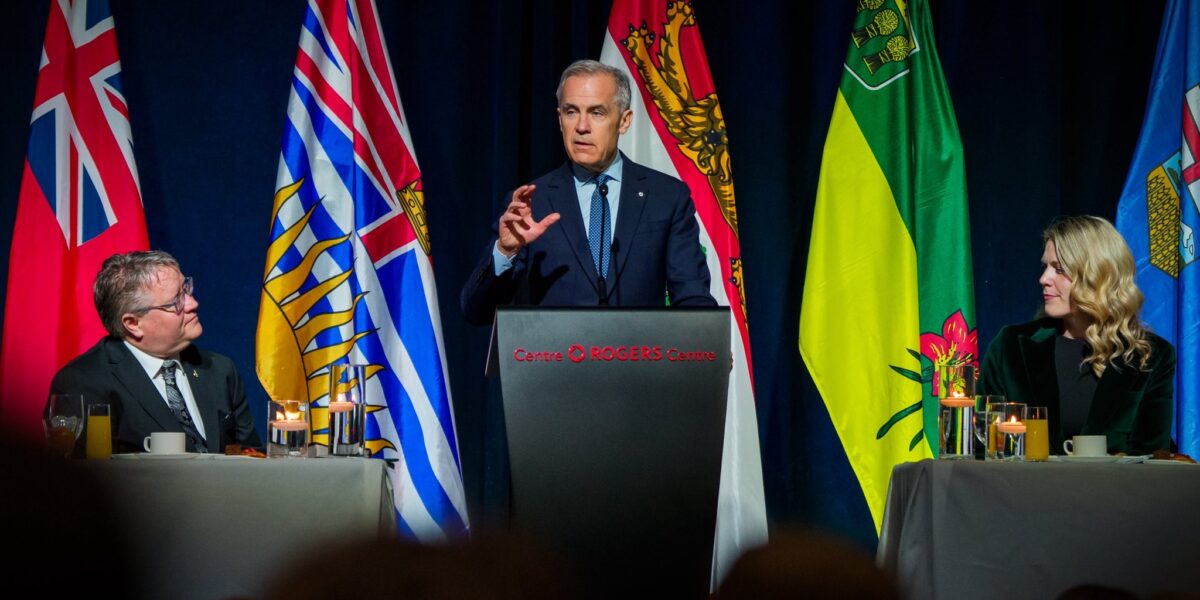
Mark Carney’s Liberal government is focused on two objectives: to ramp up military spending at a rate we have not seen since World War II, and to make Canada into an energy-exporting superpower.
To achieve both – but especially the military goal – without vastly increasing the federal debt, the government is engaging in major cuts in almost all other areas.
Take health care.
Carney’s government is maintaining its billions in health transfers to the provinces at their current level.
That’s pretty much the least it could do. Given the multiple challenges facing provincial health plans – from a severe lack of primary care doctors and nurses to an aging population – it is questionable that the current level is adequate.
But keeping the status quo in federal transfers is at least better than the steep cuts to federal health transfers an earlier bottom-line-focused Liberal government inflicted on Canadians. That was the Jean Chrétien government of the 1990s, with Paul Martin at Finance.
The money the Carney government contributes to the provinces does not tell the whole story, however.
The current Liberal government is in the process of making deep cuts to a long series of other federal health initiatives.
Among the health programs on Carney’s chopping block are:
- the Public Health Agency of Canada (PHAC);
- the National Strategy for Drugs for Rare Diseases;
- the Emergency Treatment Fund, which provides assistance to Indigenous communities and municipalities to deal with the opioid crisis;
- a 10-year $6 billion federal contribution to home and community care;
- and the Canadian Drugs and Substances Strategy.
The government does not have to actively axe most of these programs. With the exception of PHAC, they are all slated to expire this year or next.
Carney’s team can simply let them all lapse, despite the continuing and acute health needs throughout the country. And as far as we can tell, letting them quietly expire seems to be the Carney team’s current plan.
As for PHAC, the Justin Trudeau government had beefed it up in response to the COVID pandemic. Now the group in charge in Ottawa seems to assume we Canadians will not face any similar public health crisis in the near future.
That assumption is based neither on empirical facts nor on scientific and medical advice.
Nonetheless, Carney’s government is bound and determined to slim down a highly effective agency which played a central role in keeping us all safe during a massive global health crisis.
To paraphrase a 16th century proverb: Let the devil – and the health of the Canadian population as a whole – take the hindmost.
Broken pledge for universal coverage of life-saving medications
Then there is pharmacare.
We have known for some time that the one-time Liberal plan to establish universal pharmacare everywhere in the country is as good as dead.
That plan was part of Justin Trudeau’s 2022 agreement with the NDP, the confidence and supply agreement.
Three provinces, British Columbia, Manitoba, and Prince Edward Island (PEI), and one territory, the Yukon, have signed pharmacare agreements with the federal government.
In PEI, where the program is operational, reports are favourable.
But Mark Carney’s health minister Marjorie Michel has said “we are in a new context now” and indicated no interest in expanding pharmacare further.
As part of the legislation that arose from the 2022 agreement the government of the day had set up a committee of experts to make recommendations for achieving the goal of universal pharmacare.
That committee, headed by Dr. Nav Persaud, issued its report late in 2025.
The Persaud report is a powerful document, which Canadians should not ignore – even if that is exactly what Carney and his health minister intend to do.
Dr. Persaud makes his case eloquently in the report’s very first paragraph:
“The cost-of-living crisis is dramatically illustrated by unaffordable life-saving medicines. People die because medicines are still not included in Canada’s publicly funded health care system. In addition to saving lives, pharmacare will save billions of dollars. Pharmacare’s savings provoke opposition from corporations that profit off the unfair status quo while exploiting government subsidies and tax loopholes.”
You could be excused for thinking that was an extract from an Avi Lewis speech – which might explain why Carney’s health minister rejected the entire report outright almost the minute it landed on her desk.
The Persaud report points out that Canada has two options: continue our reliance on American-style private insurance schemes or “take charge and build pharmacare in Canada now.”
The current approach, the American-style option, Persaud asserts, will never provide good value. We cannot save money in a system geared for making profits for private interests.
“Private insurance plans incentivize high drug prices because insurers take a percentage of claims. Per-pill drug costs are higher in Canada than in comparable countries. Some medicines produced in Canada are sold at lower prices overseas than they are here.”
Total spending on prescribed drugs in Canada jumped by $10 billion in 5 years – from $34 billion in 2019 to $44 billion in 2024. But, the report asserts, all that money has brought “no measurable improvements in health or access to medicines.”
The report points out a fact most of us don’t know, but which should be obvious to us all: the federal government heavily subsidizes the private health insurance industry.
How so? Through the non-taxation of employer contributions to private employee health plans. The annual figure for that generous tax break for a profitable industry is $5 billion.
“Before asking how we can afford pharmacare, ask how every year we afford a $5 billion public subsidy for private insurance plans available to only some?”
Persaud and his colleagues go on to recommend a pharmacare system similar to the provincially-run universal health care plans we have now.
And just as all provincial and territorial health plans are subject to the federal Canada Health Act, so should the federal government enunciate a set of principles to guarantee universal pharmacare. Such a plan would cover all essential medications for all Canadians.
Sadly, none of this will happen anytime soon.
It would take a very different sort of government from the current one to make expanding Canada’s porous health coverage a priority.
Tragic consequences of Canada’s cuts to the Global Fund
If working to maintain and improve Canadians’ health is low on this government’s priority list, the health of millions of people in the developing world is even lower.
In last fall’s federal budget, in a brazen act of passive aggression, the Carney government cut Canada’s contribution to a worldwide public health organization called the Global Fund.
The terse text of the budget said Canada – a country that is a perennial laggard when it comes to development assistance spending – was, somehow, contributing more than its “fair share” to the Fund.
Founded in 2002, the Global Fund is a partnership of many national governments, civil society, technical agencies, the private sector, and tens of millions of people affected by three deadly and widely prevalent diseases: AIDS, tuberculosis, and malaria.
This past year Canada cut its contribution to the Fund by 17 per cent. We did so at a time when the world’s richest country, the U.S., has made gargantuan and irrevocable cuts to every facet of its development assistance program.
The Global Fund’s executive director Peter Sands came to Ottawa not too long ago in an uphill effort to get Prime Minister Carney to change his mind.
Sands says his organization is now being forced to make brutal choices: keep someone on HIV treatment, or fund the research that stops the next outbreak. When funding drops, he says, you can only do one.
So far, the Carney Liberal government has offered no response.
Support rabble today!
We’re so glad you stopped by! Thanks for consuming rabble content this year.
rabble.ca is 100% reader and donor funded, so as an avid reader of our content, we hope you will consider gifting rabble with a donation during our summer fundraiser today.
Whether it be a one-time donation or a small monthly contribution, your support is critical to keep rabble writers producing the work you’ve come to rely on as a part of a healthy media diet.
Become a rabble rouser — donate to rabble.ca today.
Nick Seebruch, editor