A long tradition of Canadian leaders kowtowing to American imperial ambitions ended on Tuesday, January 20, 2025.
Over the century and a quarter during which the U.S. empire has actively practiced conquest and both covert and overt interference in the affairs of sovereign states, Canada has stood by in near-silent acquiescence.
We acquiesced in 1898 when President McKinley seized the Philippines, Guam, Puerto Rico and Cuba. (McKinley’s supporters proudly described him as “Chief of our Nation and Empire”.)
We said nothing in 1953 when President Eisenhower helped overthrow Iran’s democratically elected prime minister Mohammad Mosaddegh (and a year later ousted Guatemala’s land-reforming President Jacobo Arbenz).
We stayed mute in 1961 when U.S. operatives collaborated with the Belgians to overthrow and murder Patrice Lumumba in the Congo, and when, in 1963, President Lyndon Johnson engineered a coup that overthrew democratically-elected Juan Bosch in the Dominican Republic.
And we were equally silent when, in 1973, U.S. President Richard Nixon’s CIA fomented a military coup against Chile’s Salvador Allende, and then, three years later, engineered a particularly brutal military overthrow of President Isabelle Peron in Argentina.
In his book Looking for Alicia, Canadian author Marc Raboy reports on how Nixon’s Secretary of State Henry Kissinger actively encouraged the 1976 Argentinian coup leaders to use “all the means necessary”, however violent, to consolidate their power and eliminate resistance.
And that is only a short and very partial list.
It leaves out such outrages as President Ronald Reagan’s financing of right-wing death squads in Central America, and the U.S.’ behind-the-scenes support for the mass slaughter of between 500,000 and 1,000,000 notional Communists in Indonesia.
Official Canada uttered nary a word of dissent about any of it.
Carney punctures the myth
For many decades, this country’s leadership blithely, and in the face of all evidence, continued to nurture the myth that the U.S. was the great protector of democracy and self-determination, the leader of what we oxymoronically called the “Free World”.
Now, Canada finds itself on the precipice of the dilemma German theologian Martin Niemöller described in his poem “First they came”.
You know the one. It starts: “First they came for the socialists, and I did not speak out – because I was not a socialist.” And it ends: “Then they came for me and there was no one left to speak for me.”
Now, at the eleventh-hour, Canada has finally spoken out. We won’t know for a while if it is too little and too late, but Canada has at last taken a stand, and there can be no turning back.
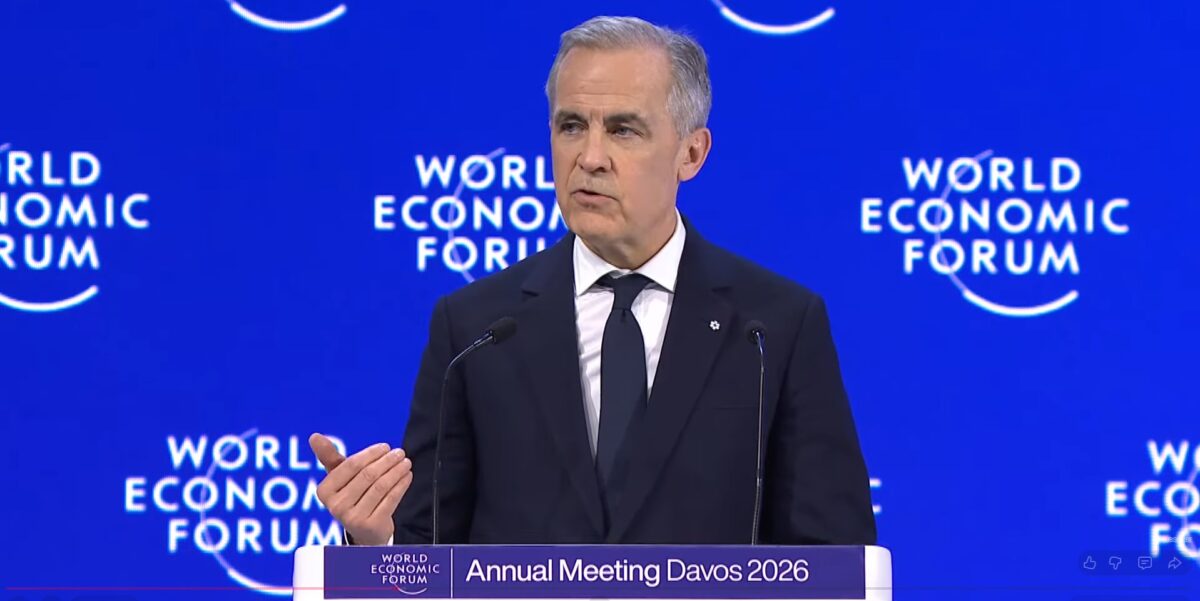
It happened in an unlikely place: the posh Swiss resort at Davos, where the rich and powerful and wannabe rich and powerful meet to network and foster their mutual (enlightened) self-interest.
Mark Carney, Canada’s economist and banker prime minister, prefers tangible policies and actions to rhetoric. He is no Winston Churchill, who believed uplifting words could, all on their own, alter the course of history.
Well, in Davos, on Tuesday January 20, Mark Carney, in his own very Canadian way, channeled some of the eloquence of Britain’s great wartime leader.
Speaking to the world’s elite, Canada’s prime minister punctured the myth of American benevolence and good intentions with some well-chosen words.
Referring to the so-called international rules-based order, Carney told his audience we should have known all along: it was a story that was “partially false.”
We should have realized, he said, that “the strongest would exempt themselves when convenient. That trade rules were enforced asymmetrically. And that international law would be applied with varying rigour, depended on the identity of the accused or the victim.”
When the victims were an obscure Congolese freedom fighter or a social democratic Chilean doctor or thousands of ethnic Chinese in Indonesia, we in the West could turn a blind eye, and act as though orderly respect for national sovereignty and human rights still existed.
“We participated in the rituals,” Carney said, with a bluntness we have very rarely heard from a Western leader. “And we largely avoided calling out the gaps between rhetoric and reality.”
He then stated what has become obvious:
“This bargain no longer works. Let me be direct: we are in the midst of a rupture, not a transition.”
Globalization is not equitable and fair
Even before Trump came along, Carney pointed out that “a series of crises in finance, health, energy, and geopolitics” undermined the myth corporate and political leaders like to propagate, namely that “extreme global integration” is a benign phenomenon which benefits all.
Economic globalization has not been, uniformly, a rising tide that lifts all ships. Many have found themselves poorer and more threatened by environmental catastrophe as a result of the depredations of beyond-borders, globe-straddling capitalism.
That is bad enough. But Carney went on to explain how, of late, the world situation has become far worse.
“More recently, the great powers began using economic integration as weapons. Tariffs as leverage. Financial infrastructure as coercion. Supply chains as vulnerabilities to be exploited,” he said.
“You cannot live within the lie of mutual benefit through integration when integration becomes the source of your subordination.”
Carney then outlined the conclusions “many countries” are drawing:
“They seek to develop greater strategic autonomy: in energy, food, critical minerals, in finance, and supply chains. A country that cannot feed itself, fuel itself, or defend itself has few options. When the rules no longer protect you, you must protect yourself.”
Carney did not pretend this is a good development.
“A world of fortresses will be poorer, more fragile, and less sustainable,” he argued.
But, with the out-of-control U.S. leader in mind, he then added:
“If great powers abandon even the pretence of rules and values for the unhindered pursuit of their power and interests, the gains from ‘transactionalism’ become harder to replicate.”
With an eye to Trump’s thirst for Venezuela’s oil and Canada’s and Greenland’s critical minerals, Carney pointed out that “hegemons cannot continually monetize their relationships.”
“Allies will diversify to hedge against uncertainty. This rebuilds sovereignty— sovereignty which was once grounded in rules—but which will be increasingly anchored in the ability to withstand pressure.”
What middle powers can do
Carney made clear to his Davos listeners that his focus is on the middle powers, of which Canada is one.
These days, one might include members of the G-7 such as France, the UK and Germany among the middle powers.
As Canadian leaders often do, our prime minister lauded this country’s traditional green and pleasant, tolerant and peaceful self-image:
“Canada is a pluralistic society that works. Our public square is loud, diverse, and free. Canadians remain committed to sustainability.”
Without mentioning the U.S., Carney invited his listeners to contrast Canada to its neighbour, where a masked and unaccountable paramilitary force can round up and harass people based on nothing more than their accents and last names.
Having drawn that contrast, Carney invited fellow middle powers to join Canada in strategically and pragmatically – but also forcefully – resisting an unnamed collective entity he called “the powerful”:
“The powerful have their power. But we have something too — the capacity to stop pretending, to name reality, to build our strength at home, and to act together.”
“That is Canada’s path. We choose it openly and confidently.”
Whatever the merits of Carney’s substantive policies for Canada – and there is plenty of room for debate there – in this speech Carney has unambiguously rallied Canadians, and both their actual and potential friends, to stand firm against Donald Trump and all of his bluster and threats.
“Naming reality” is something Canadian leaders should have made a habit of doing multiple decades ago.
Better late than never.
Support rabble today!
We’re so glad you stopped by! Thanks for consuming rabble content this year.
rabble.ca is 100% reader and donor funded, so as an avid reader of our content, we hope you will consider gifting rabble with a donation during our summer fundraiser today.
Whether it be a one-time donation or a small monthly contribution, your support is critical to keep rabble writers producing the work you’ve come to rely on as a part of a healthy media diet.
Become a rabble rouser — donate to rabble.ca today.
Nick Seebruch, editor