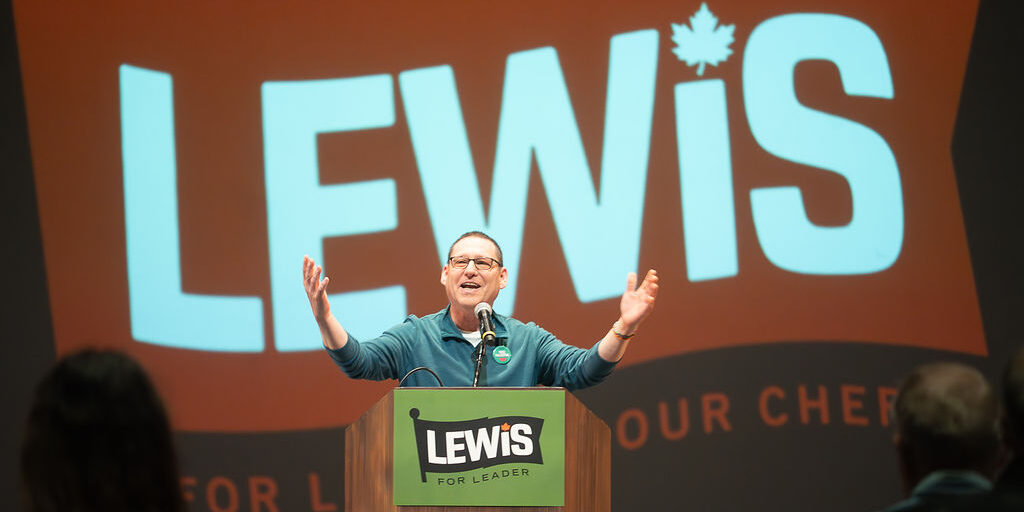
Why We Support Avi Lewis for Leader of the New Democratic Party – A Shared Statement
We are a Palestinian Canadian woman and a Jewish Israeli Canadian woman.
Our histories are different. Our inherited wounds are different. Our visions for the future are not identical.
But we are united by values.
We align most closely with the New Democratic Party; not out of party loyalty, but because of a belief in equality, climate justice, collective responsibility, and the idea that a society should be judged by how it treats its most vulnerable.
In a political culture shaped by fear, branding, and moral retreat, we are choosing—together—to support a leadership candidate who has demonstrated something increasingly rare in public life: moral courage.
This is why we are publicly supporting Avi Lewis for leader of the New Democratic Party.
Why I support Avi Lewis
Mary Mouammar
For me, the values that guide my political choices did not come from books or universities. They came from my father. My father did not have much formal education, due to political circumstances in Palestine, but he was deeply intelligent and instinctively ethical. His socialism was not ideological; it was rooted in a simple moral logic: that no human being should be discarded, and that dignity should never be a privilege of birth or wealth. He believed in fairness, contribution, and care for others as a matter of principle, not charity.
In 1967, my father felt compelled to leave his home, for the second time, to come to Canada because of the state sanctioned inequality he faced in Israel, and because he believed it offered the best possible future for his eight children. That decision cost him more than people usually imagine. Before I was born, my family was living in Haifa, where armed Zionist militia groups carried out campaigns driving tens of thousands of Palestinians out of the city. Within a couple of years, Haifa’s Palestinian population was reduced from 70,000 to 2,000 by the time Israel was established. One of my sisters was killed in one of the attacks, and my family was displaced and forced to move within our own homeland to Nazareth. My father tried for years to reclaim the family’s home in Haifa, but that day never came, instead, like tens of thousands of internally displaced Palestinians, he managed to rebuild a house in Nazareth until his departure to Canada.
My father was never truly happy again. Physically and emotionally, he carried that loss until the end of his life. On his deathbed, he said, “Don’t cry. I died twice. Once when I left Haifa, and again when we left Nazareth.” He sacrificed himself to give us a better future.
Perhaps because of this history, I have always been deeply sensitive to questions of power, displacement, and justice.
Supporting Avi Lewis is meaningful to me because he represents a political horizon that feels distant but remains essential: a world where people are judged not by ethnicity, religion, or national identity, but by compassion and a commitment to justice. He has unequivocally called for an end to what he describes as Israel’s genocide in Gaza, advocated for dismantling Israel’s system of Jewish supremacy, firmly supported the right of return for Palestinian refugees, and endorsed a one-state solution grounded in the same democratic ideals we value in Canada. A system in which equal rights and freedoms, civic belonging, and ethical leadership are not dismissed as naïve, but recognized as necessary.
Every just political system in history began as a moral claim long before it became a political reality. Supporting Avi is an important part of my commitment to that claim.
Why I support Avi Lewis
Karen Golden
My political values are shaped by a different inheritance—an ingrained sense of vulnerability passed down through generations of Jewish persecution, culminating in the Holocaust. That inherited fear was reinforced through my traditional education at a Hebrew day school, where we were taught that the antidote to Jewish vulnerability was the land of Israel.
I grew up with Jewish and Zionist pride. I learned Hebrew, majored in politics and Middle Eastern history, and moved to Israel as a young adult to complete my legal articles.
And then I began to see the gaps in the story I had been told.
I married my Marxist law professor, who joined me in Israel. While I was enjoying the beauty, richness, and sense of belonging that Israeli society offers Jews, I also went through a painful and transformative reckoning. Through his fresh eyes—and through my own growing awareness—I saw how my Jewish right to self-determination had been realized at the great expense of my Palestinian cousins. I saw that my sense of belonging was built on their exclusion.
This experience has made me, in my own way, deeply sensitive to questions of power, displacement, and justice.
I do not share exactly the same vision for the future of Israel and Palestine as Mary or Avi. The vulnerability I carry as a Jew is real, and I believe history supports it. Despite the inordinate ugliness within contemporary Zionism, I cannot abandon the hope for self-determination for both peoples on the land—a Jewish state and a Palestinian state, integrated and at peace.
What unites me with Avi is not identical political conclusions, but shared moral ground. He understands that safety built on another people’s dispossession is no safety at all. He understands that our fear as Jews, however well earned, cannot justify permanent injustice. And he has been willing to say this publicly, even when it has cost him dearly within our own community.
That kind of integrity is why I support him.
A shared conclusion
In an era of democratic erosion, institutional cowardice, and moral exhaustion, we are choosing hope and solidarity; to build a future based on the simple premise that we are human beings of equal worth..
We are choosing to support a candidate who has demonstrated integrity under pressure—someone willing to speak uncomfortable truths even when they carry personal cost.
Whether or not this choice leads to electoral success is not the point.
What matters is that it reflects the kind of political culture—and the kind of world—we refuse to stop imagining: one in which justice remains universal, moral courage matters, and no one’s freedom is secured at the expense of another’s humanity.
Support rabble today!
We’re so glad you stopped by! Thanks for consuming rabble content this year.
rabble.ca is 100% reader and donor funded, so as an avid reader of our content, we hope you will consider gifting rabble with a donation during our summer fundraiser today.
Whether it be a one-time donation or a small monthly contribution, your support is critical to keep rabble writers producing the work you’ve come to rely on as a part of a healthy media diet.
Become a rabble rouser — donate to rabble.ca today.
Nick Seebruch, editor