
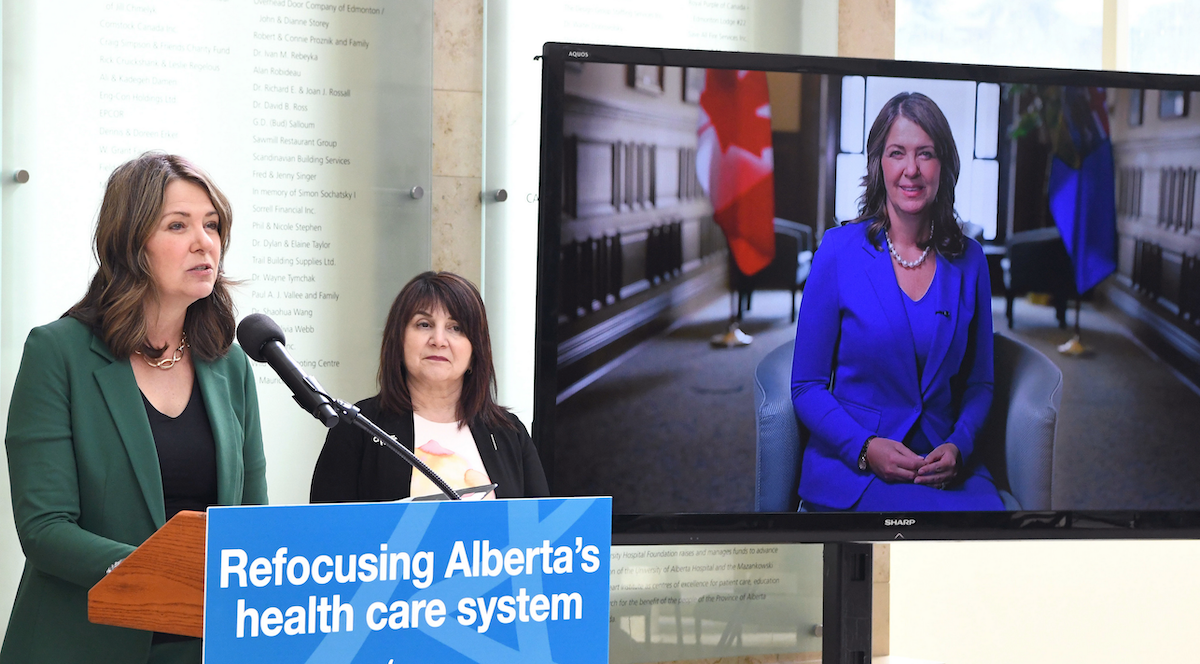
Alberta Premier Danielle Smith claimed yesterday a new “patient-focused funding model” planned for Alberta hospitals “will increase transparency, lower wait times and attract more surgeons – helping deliver better health care for all Albertans, when and where they need it.”
But what will really happen when the United Conservative Party (UCP) puts Smith’s new acute-care funding model into effect at Alberta hospitals?
Back in 2013, Jonathon Ross, a clinical professor of medicine at the University of Toledo in Ohio, warned Canadians what to expect if they were talked into adopting case-based activity fees instead of global funding to operate hospitals.
This is, of course, exactly what Premier Smith touted yesterday at a news conference to announce, in the words of the government’s press release, “a new acute care funding model, increasing the accountability, efficiency and volume of high-quality surgical delivery.”
“I would advise extreme caution and careful assessment of the implications for cost, quality, access, equity and efficiency before adopting this hospital funding model,” wrote Dr. Ross, terming it “activity based funding” or ABF, in a piece for the Canadian Healthcare Network.
“Depending where you live, this method of funding may be called patient-focused funding, payment by results, volume-based funding, service-base funding, case-mix funding, or prospective payment system,” he explained. “But no matter what you call it, ABF has serious side effects.”
It should be noted that “patient-focused funding” is a tendentious euphemism, intended to leave the impression it will make things better for patients, which it will not.
“One of the dangers is that ABF can be used to ‘game the system,’” Dr. Ross said. “When you pay hospitals according to diagnosis, the incentive is to increase or otherwise modify your diagnosis so your hospital will make more money. And that’s exactly what happened when the United States implemented ABF for U.S. Medicare patients.”
“Here in the States, we have a small army of nurses reviewing every case in hospital to remind us to use special words just the right way so we can get more money for each case,” he observed. “The incentive is to list all of the diagnoses you can possibly list for every patient, as some of these will increase the payment even if it does not change your management one bit.”
In addition, he warned, there will also be pressure to discharge patients too soon.
“If the hospitals game the codes upward, then you need another army of regulators to catch them and code them back down,” he said. “There is now a large hospital bureaucracy whose job it is to up-code the severity of illness of Medicare patients and another large Medicare bureaucracy trying to figure out how to stop the hospitals from gaming the system.”
Nothing has changed since then. Indeed, as Nobel Prize-winning American economist Paul Krugman pointed out in January, this is one of the reasons the U.S. health care system costs Americans so much. “Medicare is supposed to provide older Americans with the health care they need,” Dr. Krugman wrote on his Substack. “Yet instead of focusing solely on how best to achieve that goal, we have an arms race between insurance companies trying to game to system to charge more and deliver less and government officials trying to rein them in.”
Smith was accompanied to her news conference by Health Minister Adriana LaGrange and Chris Eagle, the interim CEO of Acute Care Alberta, the administrative agency set up specifically to introduce this funding scheme as part of the Smith Government’s effort to destroy Alberta Health Services and make its remnants easier to privatize.
They burned up some time that could have been used more profitably for questions about how this will really work with a slick hard-sell video of the premier pushing the funding model.
Alas, when it was time for reporters’ questions, with one honourable exception, every single journalist who showed up or tuned into the tightly scheduled newser, used their time to ask questions about the federal election campaign, Prime Minister Mark Carney’s gentle joke about Ms. Smith, and U.S. President Donald Trump’s trade war on Canada.
Only the Toronto Star’s Graham Thomson asked a relevant question: Wouldn’t incentives for surgeons to do more surgeries in private facilities drain resources from public hospitals, making them less efficient? Would the government, he wondered, let surgeons from private clinics use public operating rooms?
The premier responded ambiguously, nodding affirmatively and mumbling, “Mmm-hmm.” (Whether this would be permitted under the Canada Health Act was unanswered.)
Later, she added, “I would hope our public hospitals would look at this as a way of getting more revenue.” More surgeons will come here, she also claimed, because they will be able to make more money.
“The Premier is blowing things up even further with a plan to use public money to accelerate health care privatization,” Friends of Medicare director Chris Gallaway said bluntly in a news release later yesterday.
The announcement, he said, “continues to claim that privatizing surgeries will save money, expand surgical capacity and shorten wait times for Albertans.” Yet a series of reports show otherwise. “If the Premier was serious about shortening wait times for Albertans, she would invest in expanding use of operating rooms in our public hospitals,” Gallaway said.
What this government is serious about, of course, is privatizing as much of our public health care system as quickly as possible.
As Dr. Ross put it a dozen years ago: “Beware of American consultants bearing gifts such as case-based payments for hospitals as a cost-saving idea. Count your blessings, Canadians, and get to work improving the effective system that you have!”
Stephen Harper demonstrates he shouldn’t be running AIMCo
Back on November 20, I wrote that the appointment of Stephen Harper as chair of the governing board of the Alberta Investment Management Corp. meant that we could forget about the notion the provincial pension management Crown corporation has an arm’s length relationship with the political level of government in Alberta.
“Mr. Harper remains an active political figure and far-right ideological advocate in his roles as éminence grise of the Conservative Party of Canada and leader of the Munich-based neoliberal internationale, formally and tendentiously known as International Democrat Union,” I said.
Last night, Harper introduced federal Conservative Leader Pierre Poilievre at a large pre-election pep rally here in Edmonton. That’s fine. Harper can appear anywhere he likes, just as long as we all understand that this clearly demonstrates his complete unsuitability as a leader of a supposedly neutral manager of thousands of Albertans’ pensions.
Support rabble today!
We’re so glad you stopped by! Thanks for consuming rabble content this year.
rabble.ca is 100% reader and donor funded, so as an avid reader of our content, we hope you will consider gifting rabble with a donation during our summer fundraiser today.
Whether it be a one-time donation or a small monthly contribution, your support is critical to keep rabble writers producing the work you’ve come to rely on as a part of a healthy media diet.
Become a rabble rouser — donate to rabble.ca today.
Nick Seebruch, editor