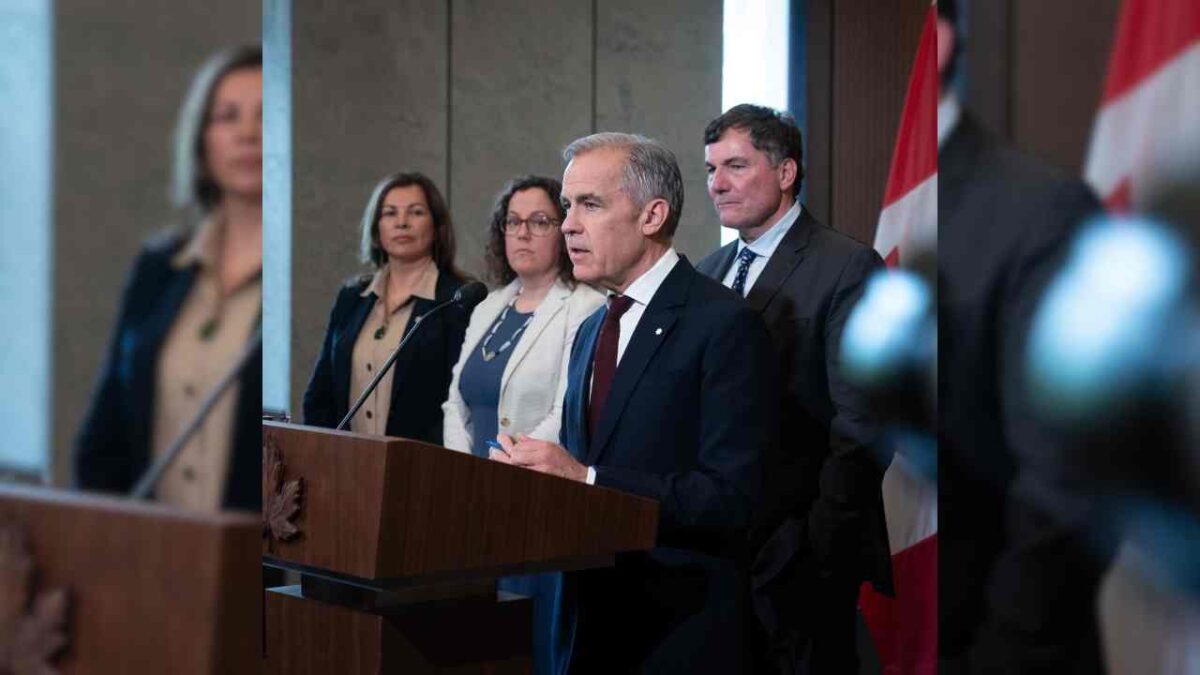
On Friday June 6, prime minister Mark Carney followed Ontario premier Doug Ford with major legislation to fast-track major economic developments by circumventing protection for the environment and Indigenous rights.
Both leaders have cited Donald Trump and his tariff war as the main motivating factor for their precipitous actions.
Ford’s move was Bill 5, the “Protecting Ontario by Unleashing Our Economy Act”, which received Royal Assent and became law on June 5.
Bill 5 repeals Ontario’s existing Endangered Species Act, passed in 2007, and replaces it with weaker, more development-friendly legislation.
It gives the Ontario government the power to capriciously remove protected species from a list prepared by an independent committee of scientific experts. And it significantly narrows the definition of habitat for both plant and animal species at risk.
It also changes existing legislative provisions governing mining, electricity and other sources of energy, in order to reduce what the government deems to be impediments to economically necessary activities.
Ford’s bill also eviscerates Ontario’s laws protecting cultural heritage, which, notably, includes Indigenous artifacts.
And it severely limits the capacity of community and environmental groups, or Indigenous nations, to seek redress in the courts for any violations of their social, aboriginal, economic or environmental rights.
Carney lowballs impact of his bill on Indigenous rights
Mark Carney is being more careful and circumspect, but follows much the same course as Ford.
Since the election, Carney has been promising a great big One Canadian Economy bill, which would deal both with eliminating internal trade barriers and facilitating what he has called “nation-building” projects.
Carney’s Minister of intergovernmental affairs (and one Canadian economy), Dominic Leblanc, tabled that legislation in the House of Commons on Friday afternoon, June 6.
But the branding has significantly changed.
The bill is now called the “Free Trade and Labour Mobility in Canada Act”, plus, almost as an afterthought – wait for it – the “Building Canada Act.”
The Carney government wants the news media and the public to focus on the first part, the internal trade part, on which there is general consensus across the country.
The second part is the one about which there should be big pushback. We’ll see if that happens, and, if it does, how soon.
That second part is not really, as it proclaims itself to be, about “building Canada”.
It is, in fact, about hobbling the Liberals’ own 2019 Impact Assessment Act. In so doing, it will sideline advocates for local communities, the environment and, especially, Indigenous peoples.
The Carney and Leblanc bill explains the pressing need for new legislation in this way:
“It is in the interests of Canada’s economy, sovereignty and security to urgently advance projects that foster the development of economic and trade corridors, and enhance the development of Canada’s natural resources, as well as its energy production and infrastructure.”
The bill makes a point of stating that all of this development must happen everywhere in Canada, including in the North.
It then defines what the government is no longer calling “nation-building” but rather “national interest” projects.
Among other requirements, such projects must: “strengthen Canada’s autonomy, resilience and security; have a high likelihood of successful execution; and advance the interests of Indigenous peoples.”
So far, the new bill sounds pretty good where Indigenous people are concerned.
Indeed, the legislation mentions, at a number of points, the need to respect both the United Nations Declaration on the Rights of Indigenous Peoples (UNDRIP) and section 35 of Canada’s own Constitution Act of 1982. Section 35 upholds “existing aboriginal and treaty rights”.
But the main thrust of the legislation is to allow the government to bypass key provisions of the 2019 Impact Assessment Act, including those that guarantee consultation with Indigenous communities.
The 2019 Assessment Act laid out a detailed roadmap for federal approval of major projects – a process which, the Act deems, must include scrupulous protections for the environment, and genuine and respectful negotiations with Indigenous groups.
But the legislation Dominic Leblanc has just introduced allows the government to set aside a number of the major conditions of the Assessments legislation – if the government waves its magic wand and designates a project to be of “national interest”.
Those requirements include: meaningful public participation in evaluating the social and environmental impact of a project and consultation with Indigenous groups.
You read that right.
The government gives itself the right to systematically ignore the rights of Indigenous peoples, if it deems any project to be in the “national interest.”
Put simply, in this new legislation, what the government gives with one hand, in a general statement of respect for Indigenous rights, it takes, quite forcefully, with the other, in the finest of fine print.
More generally, the new legislation limits the power of the federal government’s own Impact Assessment Agency to require a great range of reporting or compliance measures from the proponents of projects – when, you guessed it, those projects are anointed with the magic words: “national interest”.
First casualties of a trade war: environment and Indigenous peoples
Conservative leader Pierre Poilievre has, for a long time, urged the government to repeal the 2019 assessments legislation entirely.
Carney’s new bill does not do that, but it comes close.
Carney’s justice minister Sean Fraser telegraphed the new Liberal government’s orientation when, last week, he blurted out his view that UNDRIP does not give Indigenous groups “blanket veto-power” over nation-building projects.
Fraser tried to walk that back the next day. But he might have been saying openly what officials, both elected and bureaucratic, were saying behind closed doors.
If the first casualty of war is the truth, the first casualties of a trade war seem to be not only displaced workers, but the environment and Indigenous peoples.
The government could consider a radically different approach to engaging with Indigenous communities. It is one the new minister of Indigenous services Mandy Gull-Masty could tell her colleagues all about.
Gull-Masty was from 2021 to 2025 Grand Chief of the Grand Council of the Quebec Cree.
Back in 1975, her people signed a landmark agreement with the Quebec and federal governments that, while flawed in many respects, did provide what few other deals with Indigenous groups have provided: royalties from the natural resources developed on their territory.
In the Quebec Cree case, the resource is hydro-electricity.
But in respecting Indigenous rights in their fullest scope, the resource could be rare earth minerals of the sort they have in northwest Ontario, or oil and gas, or, even, use of Indigenous territory to transport resources via pipelines, waterways, or roads.
There is a big difference between recognizing at least partial Indigenous ownership of subsurface and other natural resources and the crumbs-from-the-table approach they call Impact Benefit Agreements.
We will leave the rest of that story for another day.
Support rabble today!
We’re so glad you stopped by! Thanks for consuming rabble content this year.
rabble.ca is 100% reader and donor funded, so as an avid reader of our content, we hope you will consider gifting rabble with a donation during our summer fundraiser today.
Whether it be a one-time donation or a small monthly contribution, your support is critical to keep rabble writers producing the work you’ve come to rely on as a part of a healthy media diet.
Become a rabble rouser — donate to rabble.ca today.
Nick Seebruch, editor