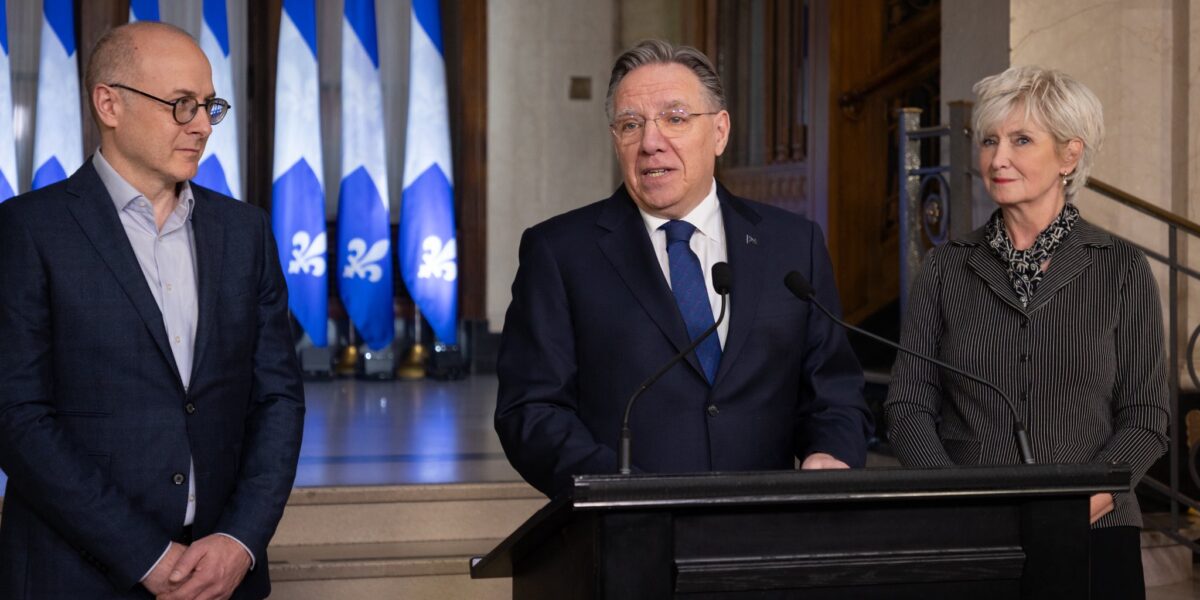
François Legault, who has been Premier of Quebec since 2018, will not be running for re-election later this year.
The Premier’s decision to quit as Premier and leader of the Coalition Avenir Quebec (CAQ) came as a surprise.
Just a few weeks ago, in year-end interviews, Legault said unequivocally that he would run for a third term. Then, seemingly all of a sudden, he had a change of heart.
From a crass political point of view, Legault’s precipitative decision does make sense, given his and his party’s abysmal polling numbers.
The most recent publicly available poll, from a firm called Pallas, has the CAQ at 11 per cent.
Right now, the pro-sovereignty Parti Québécois (PQ), which was reduced to three seats in the last election, in 2022, is polling in first place. Pallas has them at 34 per cent. Other recent polls are in the same ballpark, in the low 30s.
Usually, that level of popular support would result in a minority government. But in the current splintered political environment of Quebec the PQ could easily win a majority of seats with only around a third of the vote.
Here’s why.
Among francophones, who constitute about 85 per cent of the voters, the PQ is polling over 40 per cent. The rest of the French-speaking vote is split almost evenly among the other four parties.
Those other parties are: The Quebec Liberals; Legault’s party, the governing Coalition Avenir Québec; left-of-centre Québec Solidaire, and the recently revived Quebec Conservatives.
In most polls, all four of these parties hover around 15 per cent among francophones. That sort of split creates a perfect storm for the PQ – when it comes to winning seats under the first-past-the-post system.
Support for the Parti Québécois seems to be largely based on the charisma of its young and articulate leader, Paul St.-Pierre Plamondon.
Plamondon is a 48-year-old lawyer who has specialized in international law. His academic credentials are impressive. He has degrees from McGill, Oxford and Lund university in Sweden.
A little less than two decades ago, Plamondon founded a non-profit whose mission was to engage young people in public affairs.
He then used his role as an advocate for youth as a springboard into politics.
“Canadians can’t even keep their country from splitting apart”
In 2020, after a futile try four years earlier, Plamondon won the PQ leadership, at a time when the party was almost at its lowest ebb.
A keystone of Plamondon’s 2020 victory was his firm pledge to hold a referendum on independence in the first term of a PQ government. And there lies the rub.
This is a particularly bad time for this country, Canada, to show any signs of division and disunity.
The U.S.’s openly imperialist president evinces scant interest in events and personalities of foreign countries and territories, even those he wants to take over.
Indeed, when asked about the Greenland prime minister’s opposition to annexation by the U.S., Trump was not embarrassed to admit “I don’t know who that is”.
Donald Trump has certainly not heard of Paul St.-Pierre Plamondon, not yet at any rate.
But if Plamondon were to become Quebec premier in 2026 and then fire up plans for his province to separate from Canada, some ambitious advisor will make sure the U.S. president knows all about it.
We can almost hear Trump gleefully mocking Canadians “who can’t even keep their country from splitting apart.”
Someone in Trump’s palace guard could make matters worse by feeding the U.S. president the line that at least one separatist politician (Bloc Québécois leader Yves-François Blanchet) declared that Canada represents a greater threat to Quebec than does an acquisitive and expansionist U.S.
Add to all that the fact that Alberta might be headed for a separation referendum in the very near future, and it would be hard to conclude Canada was not in the throes of a masochistic exercise in self-inflicted harm.
If there was ever a time in our history when Canadians had to stay united – despite deep cultural, regional, ideological and class difference – this is it.
But don’t try telling that to the short-sighted separatists of both the eastern and western variety.
Legault found a middle road between separation and federalism
In Quebec, François Legault has been, in his own particular way, a voice for unity, willing to make common cause with the feds and with the other provinces.
Indeed, François Legault’s political genius, while it lasted, was to create a political party out of whole cloth, that, at least for a while, helped Quebeckers get out of the stay-in-Canada or leave-it dichotomy.
Legault founded his political formation, the Coalition Avenir Québec, in 2011.
From the outset, the CAQ was pro-business, anti-tax, hostile to so-called “woke”-ness, and deeply suspicious of immigration, especially from non-white, non-Christian parts of the globe.
Those right-wing positions would fit comfortably in the programs of most small-c conservative groups across Canada.
But the CAQ has also been firmly in the Quebec nationalist camp.
Legault’s offer to Quebeckers was that he could wrestle whatever power and influence Quebec deemed it needed from the federal government, without the destabilizing cataclysm of a third sovereignty referendum.
The outgoing Quebec Premier has not been committed, come what may, to the Canadian federation, the way the Quebec Liberals are. Legault and his party are not unconditional federalists.
But nor do they share the PQ’s view that Quebec cannot survive as a culturally distinct entity unless it becomes a fully sovereign, independent state.
Legault has managed to hew to a middle course by pushing nationalistic measures such as tightened language legislation and a law banning teachers, judges, prosecutors and police officers from wearing visible religious symbols.
The chief victims of the latter measure have been hijab-wearing Muslim women, some of whom had to change jobs or face losing their employment altogether.
Given that record, many rabble readers are not likely to mourn François Legault’s departure from the political scene.
Sadly, whoever replaces Legault, both as head of the CAQ and, more important, as premier, could be even more divisive and dangerous.
Ottawa’s political class would be well-advised to start paying close attention to – and preparing themselves for – what is going on in Quebec, now.
Support rabble today!
We’re so glad you stopped by! Thanks for consuming rabble content this year.
rabble.ca is 100% reader and donor funded, so as an avid reader of our content, we hope you will consider gifting rabble with a donation during our summer fundraiser today.
Whether it be a one-time donation or a small monthly contribution, your support is critical to keep rabble writers producing the work you’ve come to rely on as a part of a healthy media diet.
Become a rabble rouser — donate to rabble.ca today.
Nick Seebruch, editor