
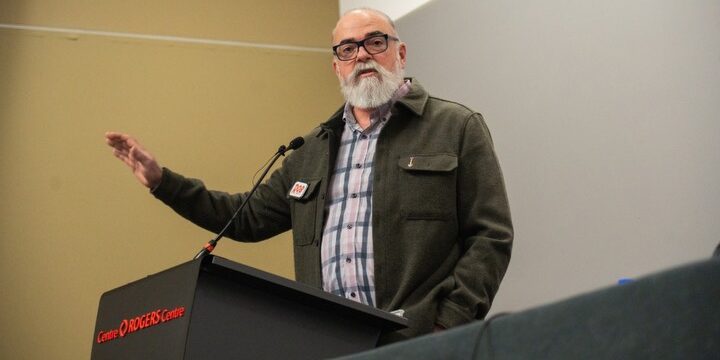
Please tell our readers three policies you would champion as NDP leader.
1. I would champion a Jobs Guarantee. Everyone who wants to work should have the right to a good, union job with fair wages, strong protections, and dignity on the job.
2. I would ensure no one earning under $40,000 pays federal income tax paid by a wealth tax. At a time when people are struggling to afford food, housing, and basic necessities, it makes no sense to tax poverty while billionaires and CEOs walk away richer than ever.
3. An economy where executives make hundreds of times more than the workers who create the wealth is fundamentally broken. I would end outrageous CEO pay and put a price cap that will immediately lower costs on essentials like food. That money belongs in our communities, funding public services, housing, health care… Equality of opportunity only exists when everyone has real economic security.
Which Carney government legislative initiatives would you change, if you could, and in what way?
I would reverse the Carney government’s choice to cut taxes for the wealthy and corporations while holding back investment in public services that working class Canadians rely on. At a time when families are struggling with the cost of living crisis, it makes no sense to reduce the tax burden on those at the very top. I would cancel tax cuts for the rich and instead tax wealth, not work ensuring that obscene fortunes and excessive corporate profits contribute fairly to our shared prosperity.
I would also reverse cuts and underinvestment in public services. Strong public health care, housing, transit, and social supports aren’t expenses to be minimized, they’re investments that unite communities, lower costs for families, and build a stronger economy.
Canada needs policies that put workers and communities first, not ones that reward wealth while asking everyone else to do more with less.
How would you combat separatism in Quebec and Alberta?
I don’t believe in “combating” separatism. Quebecers will decide their own futures. It’s not my place to tell people if they should leave Canada or not.
That said, in a time of global instability and economic upheaval, we are stronger when we stand together. The best way to counter alienation is not through lectures or threats, but by delivering real results that means; good jobs, affordable housing, strong and reliable public services and respect for regional realities. When people feel seen, respected, and economically secure, division loses its grip.
What would your conditions be for supporting a Liberal minority government?
I got into this race because I want to make life better for Canadians and because I want to get a better deal for those who built this country: the working class. So, I’m less interested in talking about hypothetical scenarios where we support the Liberals, but I will say that I’ll approach this the same way I will approach all decisions, and that’s by asking a simple question: does this help the working class?
If you were in charge of Canada–U.S. relations, what would your strategy be for dealing with the Trump administration?
I’ve dealt with bullies my whole life. Canada’s sovereignty is not for sale. It is the foundation of who we are. It’s our economy, our security, and our way of life. If the United States can casually talk about “taking” Greenland, then we are already in serious trouble.
This is a different world now and this moment demands leadership. We cannot outsource our defence and pretend our sovereignty is guaranteed by being next to a superpower and the assumption that everyone likes Canada.
We need to start by investing in our greatest strength: Canadians.
We need to invest in the people that create the wealth in this country, with strong wages, real protections on the job, and economic security we can count on.
We need to ensure we have the capacity to protect our sovereignty. That means building Canadian-controlled defence capacity that doesn’t rely on American technology like the F-35. It means protecting Arctic security and the Northwest Passage working in partnership with, and guided by, Inuit communities who have safeguarded the North for generations. And it means investing not just in equipment, but in the women and men of the Canadian Armed Forces who do the work and carry the risk.
We also need to strengthen our trade relationships with allies. Over the past few years, the United States has been increasingly an unreliable and hostile trading partner whose careless tariffs have led to the loss of thousands of hard-working Canadian jobs. To counter this, we have to make it easier for people to buy Canadian, build stronger ties across the Atlantic and Pacific, and ensure our goods can reach the world. This includes supporting the calls of the Manitoba NDP government to invest in expanding the Port of Churchill and the rail lines that feed the Arctic. We need trade agreements that put workers and communities first.
What steps would you take to decrease growing economic inequality in Canada?
We need to act on inequality directly and urgently. That starts with building a fairer taxation system where the super-rich pay what they owe and we remove the burden on the working class. It means strengthening the Disability Tax Credit, people living with disabilities deserve to live with dignity and security. It means delivering truly affordable housing, by building homes with Canadian resources using Canadian workers. It means capping prices on essentials like food and telecom services where corporate concentration is driving up costs. And it means implementing a Jobs Guarantee, because the most effective anti-poverty program are good, well-paid jobs people can rely on.
What measures are necessary to empower Indigenous communities in Canada and assure their prosperity?
The starting point is clear and non-negotiable: fully implementing the United Nations Declaration on the Rights of Indigenous Peoples (UNDRIP).
That means respecting Indigenous rights, sovereignty, and self-determination, not just in words, but in law, policy, and practice. Indigenous peoples know what their futures should look like. Canada’s role is to respect support, and finally live up to its obligations.
Support rabble today!
We’re so glad you stopped by! Thanks for consuming rabble content this year.
rabble.ca is 100% reader and donor funded, so as an avid reader of our content, we hope you will consider gifting rabble with a donation during our summer fundraiser today.
Whether it be a one-time donation or a small monthly contribution, your support is critical to keep rabble writers producing the work you’ve come to rely on as a part of a healthy media diet.
Become a rabble rouser — donate to rabble.ca today.
Nick Seebruch, editor